
Mixed Breastfeeding: How to Avoid Confusion

Image created with AI

Mixed feeding , also called combination feeding, is when a mother offers her baby both the breast and a bottle: either expressed breast milk or formula. It's a very common choice and not a last resort.
This guide brings together recommendations from the NHS, WHO, ISS-EpiCentro, and Ospedale Bambino Gesù on how to introduce the bottle without confusion, how to prepare formula safely, and how to tell if your baby is getting enough milk.
The goal is to provide practical and verifiable advice to help you approach mixed diets with peace of mind and without guilt, whatever the reason for your choice.
What is mixed feeding and when is it useful?
According to the NHS , mixed feeding is when breastfeeding is combined with bottle feeding, expressed breast milk, or formula. The two can coexist for a few days or for many months.
The reasons are varied: returning to work , needing rest, needing to maintain milk production, difficulty latching, or the choice to share breastfeeding with a partner. There is no single right situation.
The WHO and ISS-EpiCentro recommend exclusive breastfeeding for the first six months and then, with complementary feeding, up to two years of age and beyond. However, when exclusive breastfeeding isn't possible or isn't the family's choice, infant formula is a safe and nutritionally adequate food.
For those who want to understand the basics, from positioning to latching on, it is useful to start with the guide on breastfeeding : positions, times and signs that milk is enough.
Advantages and limitations of mixed
The main advantage is flexibility : mixed feeding allows you to share feedings, respect work schedules and allow yourself a few hours of rest, without giving up the breast completely.
The limitation is that formula doesn't contain breast milk antibodies and tends to reduce production when it replaces breastfeeding. Therefore, it must be dosed carefully.
A balanced approach recognizes both : the value of breast milk and the value of the mother's peace of mind. Mixed breastfeeding, managed without excessive fatigue, is better than exclusive breastfeeding, carried out with suffering.
- Strengths: freedom in schedules, involvement of the partner, less pressure on the mother.
- Points of attention: possible drop in production, dual management of breast and bottle, cost of formula.
- To know: The mix can be started, increased or reduced at any time, gradually.
What happens to milk production
The key point is this: more bottles, less breast milk . The breast produces milk based on how much it empties; if some feedings are replaced, production decreases accordingly.
It's not a defect, it's a physiological adaptation . This is why the NHS recommends introducing formula gradually, giving the body time to reduce production and reducing the risk of swollen, sore breasts or mastitis.
There's also some evidence that some breastfed babies suck less effectively at the breast after learning to bottle-feed. This doesn't happen to everyone, but it's another reason to proceed slowly.
How to introduce the formula without confusion
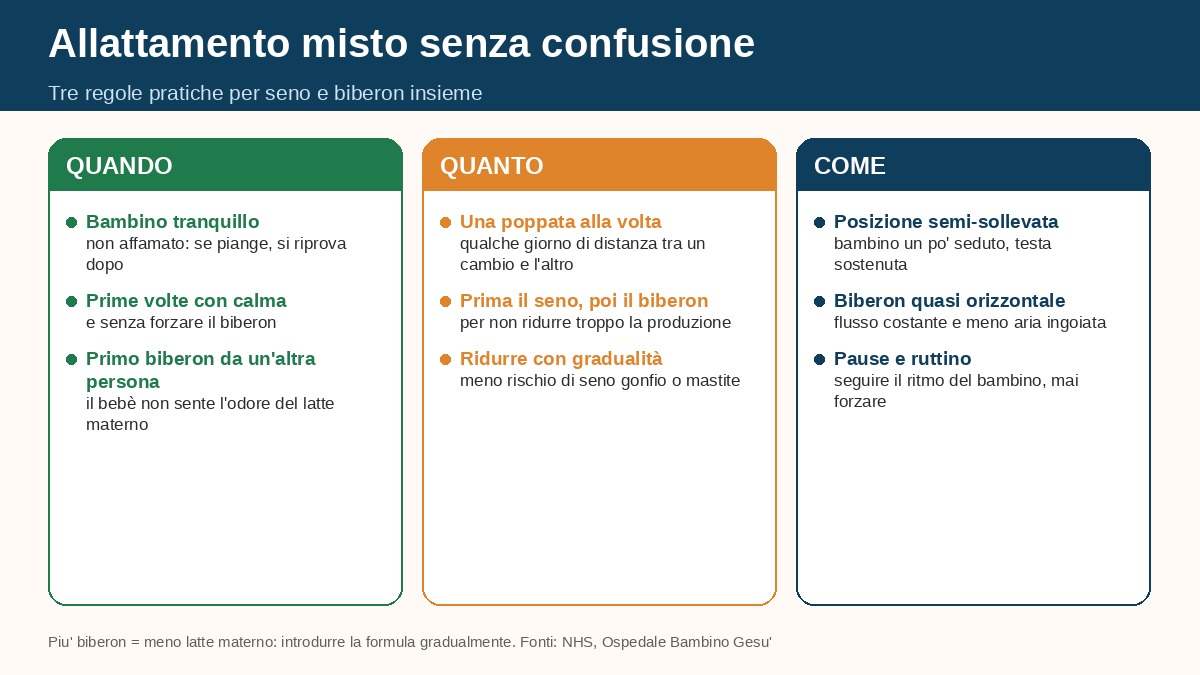
The simplest way is to replace one feeding at a time , wait a few days, and observe how the baby and the breast respond. This way, any engorgement remains manageable.
If the goal is to maintain production , the rule of thumb is “breast first”: always offer the breast and use the bottle only as a supplement or for missed feeds.
Those who want to gradually reduce breastfeeding can cut back on one feeding every few days, slowly, and listen to the signals from their body and the baby.
How many bottle feeds
There's no one-size-fits-all number: it depends on how much milk the mother produces and how many bottles she wants to introduce. One bottle a day is a typical starting point for those who simply want a little freedom.
If you switch to multiple bottles, it's best to do it one feeding at a time , spaced a few days apart, so that production slows without causing shock and the breasts don't become engorged.
The first bottle
The NHS recommends giving the first bottle feeds when the baby is calm and relaxed, not hungry: a hungry infant becomes nervous and is more likely to refuse the teat.
It can help if someone else gives the baby the first bottle , because the baby can't smell the mother's breast milk. Changing the position of the baby during breastfeeding helps distinguish between the two moments.
If the baby refuses the bottle
Refusal is common the first few times and is usually not permanent. It's best to try during a calm moment , at a slow pace, and not to insist: if the baby cries, stop and try again later.
The type of nipple can also make a difference: there's no one best, but some are more popular than others. It's worth trying a few different ones, without switching too often.
How to give a bottle correctly
The bottle isn't just nourishment: it's a moment of contact . The NHS reminds you to hold your baby close, look him in the eyes, and talk to him, as you would at the breast.
The correct position is semi-elevated : the baby should be slightly seated, with his head supported, so he can breathe and swallow comfortably. Never completely reclining, and never with the bottle resting on him.
The bottle should be held almost horizontally , slightly tilted: the milk flows steadily and the baby doesn't swallow air. If the nipple becomes squashed, release the suction by gently pulling on the corner of the mouth.
Don't force, follow the child
Every baby knows how much milk they need. The NHS recommends following your baby's pace and not worrying if he doesn't finish the bottle: insisting can lead to overfeeding and discomfort.
Taking breaks during feedings allows the baby to feel full. After feeding, holding him upright and burping him helps release swallowed air.
Never leave him alone with the bottle
Never leave a baby alone with a bottle on his or her side, or in bed with a bottle: milk could end up in the airways and cause suffocation.
After feeding, any leftover milk should be discarded , as it can become contaminated by saliva. It's best to prepare one feeding at a time, when it's really needed.
Prepare the formula safely
The powdered formula is not sterile: it may contain residual microbes , as the Bambino Gesù Hospital reminds us. For this reason, it must be prepared carefully, following the manufacturer's doses.
The first formula to use is type I milk , which is suitable for the entire first year according to the NHS. "Grow-up" formulas are not necessary before 12 months.
The key steps
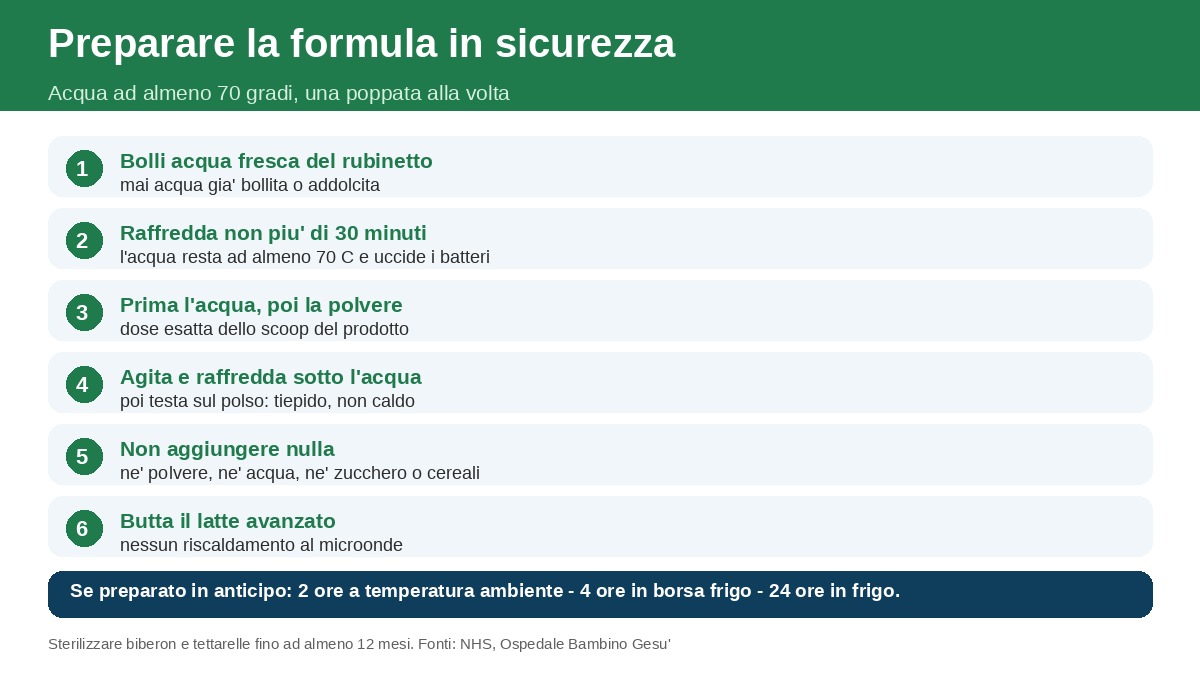
Boil fresh tap water , never previously boiled, and leave it to cool for no more than 30 minutes to maintain a temperature of at least 70°C: at that temperature, bacteria are killed.
Pour in the water first, then the powder , shake by closing the bottle, then cool it under running water and test the temperature on your wrist. It should be lukewarm, not hot.
Never add more powder or water , or sugar or cereal. Don't heat the bottle in the microwave: the heating is uneven and can burn the baby's mouth.
Conservation and sterilization
If preparing ahead of time, Bambino Gesù recommends: 2 hours at room temperature , 4 hours in a cooler with a cooling pad, 24 hours in the refrigerator. However, it's best to prepare it immediately.
According to the NHS, baby bottles and teats should be sterilized for at least 12 months : wash them in hot, soapy water immediately after use, rinse them, and sterilize them with steam, boiling, or cold water.
Which formula milk to choose
For a healthy newborn, the starting choice is first-formula milk , designed for infants and based on modified cow's milk. There's no need to switch to special formulas without a reason.
If the child shows suspicious reactions , such as persistent vomiting, blood in the stool, widespread eczema or poor growth, the pediatrician can evaluate an allergy or intolerance and indicate a specific formula.
Hypoallergenic formulas are not suitable for babies with a known allergy to cow's milk protein, and soy formula should only be given under medical supervision. Never switch formulas on your own.
Returning to work: the practical plan
If the return is planned, the NHS recommends starting a few weeks early : this way the baby gets used to the bottle and the mother to expressing, without the anxiety of the last day.
Those who wish to continue breastfeeding can express milk during their absence and leave it with the caregiver, alternating it with formula as needed during the day.
Expressed breast milk or formula?
Expressed breast milk retains the benefits of breastfeeding , but requires time and consistency. Formula is easier to manage and nutritionally adequate: the choice depends on the situation.
Often, the best solution is a mixed solution, even when feeding a bottle : breast milk when available, formula when needed. There's no one-size-fits-all rule, and it's okay to adapt day by day.
Managing your breasts when you miss a feeding
When a feeding is replaced, the breasts may become swollen and sore . To relieve the discomfort, you can use warm compresses before feeding and cold compresses afterward.
Expressing a small amount manually or with a breast pump helps to empty the breast and reduce the risk of engorgement, without however stimulating production too much if the aim is to reduce it.
If you experience fever, redness, or severe pain in one breast that feels like the flu, it may be mastitis. Contact your doctor if your symptoms don't improve within 12-24 hours.
The pacifier and the bottle
During the first few months of breastfeeding, pacifiers and bottles can interfere with breastfeeding. The NHS recommends waiting until breastfeeding is well established before offering them.
For more information, see the guide on pacifiers, baby carriers, and slings : it explains when to introduce a pacifier without disturbing breastfeeding.
Signs that your baby is getting enough milk
With mixed feeding, it's helpful to observe the signs of adequacy rather than counting milliliters. The first indicator is the number of wet diapers in 24 hours.
From the fifth day of life, at least six wet diapers a day are expected ; after the first few days, stools become yellow or mustard-colored and soft. For details, see the guide on newborn poop.
Behavior also counts : a calm and satisfied baby after feeding, who gains weight again and wakes up to eat, is getting enough milk.
If your baby is sleepy and difficult to wake for feedings, or if he or she loses weight after the first few days, it's a good idea to talk to your pediatrician or midwife right away.
Vitamin D and supplements
Bambino Gesù Hospital reminds that vitamin D supplementation, at a dose of 400 IU per day, is recommended during the first 12 months .
The dose and type of supplement should always be agreed upon with the pediatrician , also based on how much formula the child is taking, because the formula already contains added vitamins.
When to see a doctor
Seeking help from a pediatrician, midwife, or consultant is the right choice when mixed feeding raises concerns. You shouldn't wait until the problem worsens.
Some signs not to ignore : fever or malaise in the mother, very swollen, hot or painful breasts, a reduction in the number of wet diapers, a sleepy baby who does not gain weight, or a complete refusal of the breast or bottle.
If you experience difficulty breathing or choking while feeding, or if your baby is under 3 months old and has a fever of 38°C or higher, contact your doctor or call 112/118 immediately.
Mixed breastfeeding in the first few days
In the first few days after birth, the breast produces colostrum , a thick milk rich in antibodies, in small quantities but sufficient for a newborn baby.
Skin-to-skin contact and frequent feedings help initiate breastfeeding. If formula supplementation is needed, it's best to do so after offering the breast, so as not to reduce the stimulation.
To prepare for returning to the hospital, the guide on what to pack in your hospital bag can be useful : it contains the complete checklist for mother and newborn, with documents and layette.
The role of the partner
In mixed pregnancy, the partner can take one or more bottle feeds, relieving the mother and creating some exclusive time with the baby.
Your support is important even in difficult times : bottle refusal, engorgement, fatigue. The birth plan guide helps you write down your preferences and the support you expect.
Mixed breastfeeding and weaning
Around 6 months , the first foods are added, but milk remains the foundation of nutrition. In mixed feeding, breast and bottle continue to coexist with new foods.
The 6-Month Weaning Schedule guide explains how much milk to offer, what to give, and what to avoid in the first year.
Hygiene and diaper changing: when help is needed
Mixed feeding, diaper changes, and bath time are the first times you can see if everything is going well. They are also opportunities to observe the baby's signs of well-being .
Bathing in the first few months has precise rules: you can find them in the step-by-step guide to bathing your newborn , with water temperatures and safe products.
If your baby cries a lot in the evening, it may be the physiological crying of colic: the guide on infant colic explains when this is normal and which remedies are unproven.
In mixed conditions, it is useful to keep a short diary of feedings and diapers for the first few days: it helps to immediately notice any changes and to respond with concrete data to the pediatrician's questions.
FAQ
Does mixed feeding necessarily cause milk loss?
Each feeding of formula replacing a breastfeeding tends to reduce production , but the rate depends on how many feedings are replaced. Proceeding gradually helps control the effect.
Can I alternate between breast and bottle during the same feeding?
Yes, you can offer the breast first and then the bottle as a complement. This is the recommended strategy when you want to maintain milk production.
Does “breast-bottle confusion” really exist?
The NHS cites a small amount of evidence : some breastfed babies breastfeed less well after experiencing the bottle. This isn't a rule, and it doesn't happen to everyone.
Should I sterilize bottles even if I only use formula?
Yes: sterilizing bottles and nipples is recommended for at least 12 months, regardless of the type of milk used, to reduce the risk of infections.
How much formula should you give per feeding?
The quantities are indicated on the product and vary with age and weight. The best rule is to follow the pediatrician's instructions and the child's signals, without ever forcing.
Can I go back to exclusive breastfeeding after starting mixed breastfeeding?
Yes, many mothers increase their milk supply again by gradually reducing bottle feeding, through frequent feedings, skin-to-skin contact, and regular expression . A midwife or consultant can guide you through this process.
Note: This article is for informational purposes only and does not replace the advice of your pediatrician, midwife, or other healthcare professional. If you have any concerns about your baby's health, always consult your doctor. For safe sleep, see the guide to safe infant sleep.
Find out more from Napolike.com
Subscribe to receive the latest articles sent to your email.