
The Vomero Elevator: The History of Naples' First Public Elevator
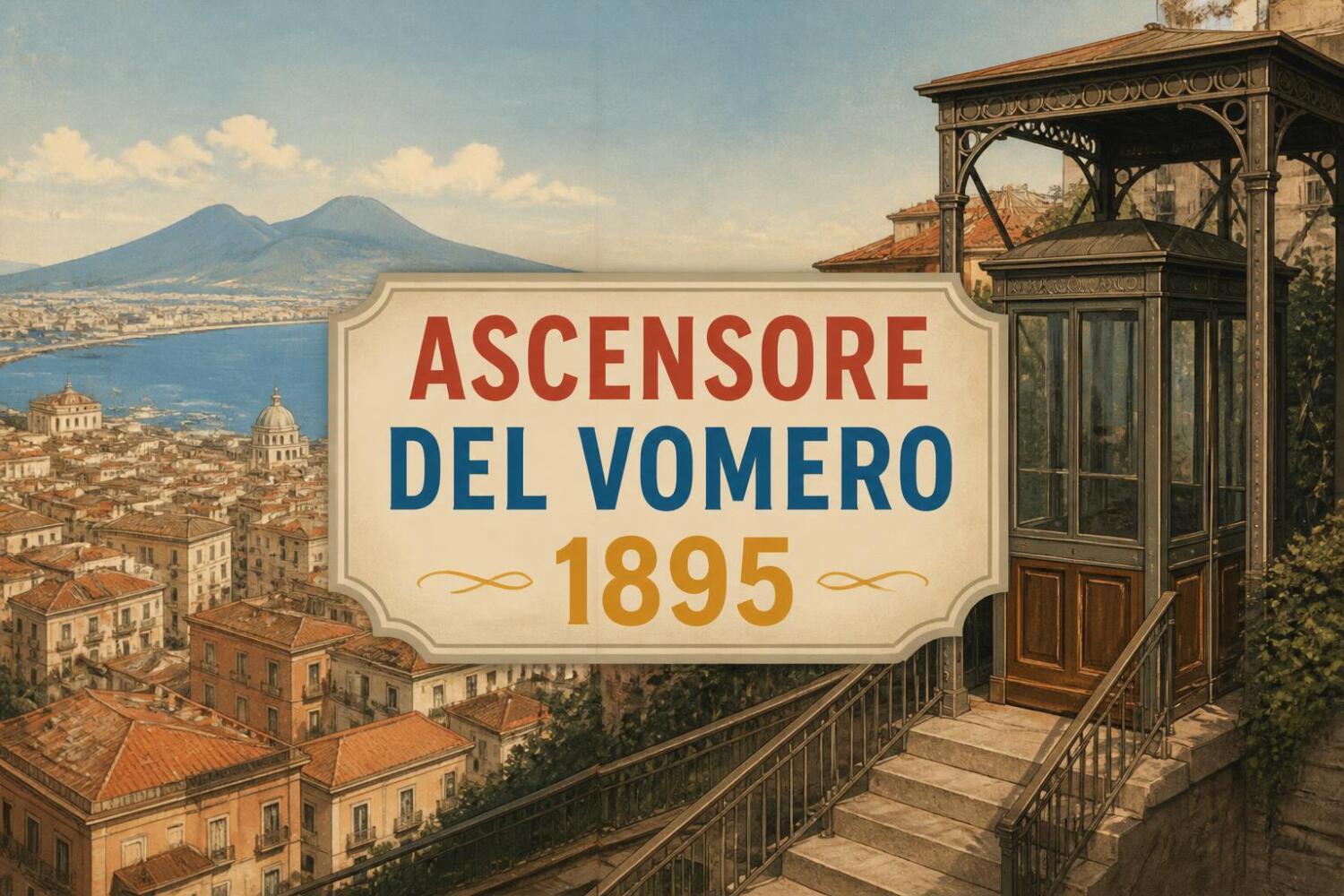
Image created with AI

Naples is a city that climbs. Its monumental stairways, its steep alleys, and the four funiculars that carry thousands of people from the lower city to the hilltop neighborhoods every day speak of this. But before today's funiculars, and long before escalators and subways, Naples experimented with another solution to conquering steep slopes: the public elevator. The city's first, and among the very first in Italy, began operating in 1895 and served to ascend the Vomero hill . Its history is one of steam, wooden carriages, a French design, and a brutal end during World War II.
Naples, the city that climbs
For centuries, Vomero and the hills surrounding the city remained almost uninhabited. In Greek times, the hill was called Bomòs , meaning simply "hill"; in Roman times, Paturcium . Until the 19th century, it was a mosaic of fields, vegetable gardens, and farmhouses, earning it the nickname "broccoli hill ." Only when Naples became a major capital, first under the Bourbons and then under Italian rule, did upward expansion cease to be an exception and become a necessity: the flat city was no longer sufficient.
Climbing the slopes, however, meant daily toil. For generations, people climbed on foot, along historic steps like the Pedamentina or the steps of San Martino. Then, in the last two decades of the 19th century, the first mechanical systems arrived: the Chiaia funicular , opened in 1889 and still the oldest in the city, followed by the Montesanto funicular in 1891. They were revolutionary means, but they were not the only ones being studied by engineers of the time.
The Piedigrotta Elevator, the first public elevator in Naples
While funiculars ascended along tracks, another technology promised to do the same thing vertically: the elevator. In Naples, the gamble was made early. In 1895 , the Tramways de Naples company , designed by French engineers Du Mesnil and Treize Dreyes , built a system along Via Manzoni , at numbers 88 and 90, which connected the Piedigrotta neighborhood with the upper part of the hill, towards Posillipo.
The numbers are still impressive today: the elevator climbed 127 meters , more than double the travel distance of a modern public elevator. In contemporary sources and images, the system was also known as the "Vomero elevator ," precisely because it was used to ascend the hill overlooking the city. For the first time in Naples, an elevator existed designed as a public passenger transport service, rather than as a private convenience for a hotel or building.
How it worked
The system consisted of two carriages , each capable of carrying up to eight people , four of whom were seated . Movement was provided by a steam engine , the same energy that powered trains and trams in those years. The carriages moved in counterweight: as one ascended, the other descended, a system that reduced the strain on the engine and closely resembled that of funiculars.
From steam to electric, and then the end
In 1925, the system was converted to electric power, reaching a speed of 1,5 meters per second , with runs every 5 minutes . It seemed like the beginning of a new life. Instead, it was the end: that same year, service was suspended and never reopened. In 1939, the General Planning Scheme called for the elevator's restoration, but the project was shelved as war approached. In 1943, the structure was demolished, at least in part, by German troops to hinder partisan movements. In 2003 , two experts, Giuseppe Ierace and Antonio Angiolillo, presented a restoration project that included an interchange with the new subway line 6 : the idea was never realized, and today only traces of the old elevator remain.
TIP: An elevator and a funicular are not the same thing. A funicular is a track-based system where one or two cars move together along a cable, designed for constant, steep gradients. A public elevator is a vertical system, with cabins that move in a shaft or shaft, used to overcome concentrated differences in height, such as the jump between a low-lying street and an elevated road. Both are classified as "hectometric systems," i.e., short-distance transportation systems.
Fourteen years before Genoa
The history of Italian public elevators is often confusing, and it's worth putting it in order. In 1909, Genoa inaugurated the Castelletto elevator, from Piazza del Portello to the Montaldo viewpoint. It's still in service today and often cited as "Italy's first public elevator." However, Naples' Piedigrotta elevator had begun operating fourteen years earlier , in 1895. Looking at the chronology, Naples is therefore among the first Italian cities to use the elevator as a true means of public transportation.
For the sake of completeness, we must distinguish the records: the first Italian elevator for the transport of people was installed in a hotel in Rome as early as 1870 by the Stigler mechanical workshops, while the first Italian electric elevator arrived in Palazzo Barberini, also in Rome, in 1904. However, these were private systems, inside buildings. The Neapolitan one of 1895 was something else: a public service, open to anyone who needed to climb the hill. For technical details and bibliographical references, you can also consult the Wikipedia entry on the Piedigrotta elevator.
The other public elevators in Naples
After the Piedigrotta experience, Naples has never stopped playing with verticality. Today, the city's ski lift network, managed by the ANM , includes four funiculars , five elevators , and two escalator systems . Here are the protagonists.
The Pizzofalcone elevator
Built in the 1920s , it connected the upper area of Pizzofalcone , also known as Monte di Dio, with the Vittoria tunnel below and the nearby Chiatamone. It was closed in 1968 due to water infiltration and never restored. Its upper station, with its eclectic style, still stands today near the Nunziatella military school.
The Chiaia elevator
Inaugurated in 1956 as the first public cable-operated vertical lift system, it connects Via Chiaia with Via Nicotera , next to the Chiaia Bridge. It has two 15-person cabins and a 16,6-meter ride . Since 1990 , it has been hydraulic and has replaced the original cable system; the lift shaft is made of masonry with eclectic cladding.
Acton, Sanità and Fantaglieri
The Acton elevator connects Piazza del Plebiscito, at the height of Via Cesario Console, with Via Ferdinando Acton below: it is free, with 11-person cabins . The Sanità elevator connects the Sanità bridge and Corso Amedeo di Savoia with the neighborhood of the same name, with a capacity of 18 people . The Ventaglieri elevator , which began operating on August 28, 2014 , connects Ventaglieri park to Corso Vittorio Emanuele with 15-person cabins . All three are free.
The Monte Echia lift
The most recent and spectacular is the Monte Echia elevator , inaugurated on April 8, 2024 , and in service the following day. It connects Borgo Santa Lucia and the Via Partenope seafront with the Pizzofalcone viewpoint , atop the rocky spur of Monte Echia, overcoming a 56-meter journey inside a reinforced concrete shaft 15 meters in diameter, with two 18-passenger cabins and a helical safety staircase. The work was approved in 2005 and lasted almost 18 years . It is open daily from 7:00 am to 22:30 pm ; to use it, you need an ordinary ANM urban ticket, with free access for season ticket holders and residents.
The funiculars, the other way to get to Vomero
Alongside the elevators, the Neapolitan transport system is based on funiculars, which remain the most famous way to reach Vomero. The Chiaia funicular (1889) and the Montesanto funicular (1891) were joined in the twentieth century by the Centrale funicular (1928) and the Mergellina funicular (1931). For those who wish to retrace the history of these systems, it is worth reading the history of the Montesanto funicular , the oldest direct connection between the historic center and the hill. Furthermore, since 2002 , an intermodal escalator system has connected the Vanvitelli station on line 1 and the Chiaia, Centrale, and Montesanto funiculars in a single hub, making the climb to Vomero an almost step-free journey.
Curiosities about Naples' elevators
- The Piedigrotta lift overcame a difference in height of 127 meters, the longest ride ever made by a public elevator in Naples.
- The Monte Echia lift took almost 18 years of works, from the project approved in 2005 to the opening in 2024.
- The Acton lift is among the shortest: just 11,85 meters running between Piazza del Plebiscito and Via Acton, but it covers an otherwise inconvenient urban gap.
- Piedigrotta, where the elevator of 1895 was located, is also the district of Parco Vergiliano, where tradition places the tomb of the poet Virgil.
FAQ
What was the first public elevator in Naples?
The Piedigrotta elevator, which began operating in 1895 along Via Manzoni, was the first vertical system designed in Naples as a public transportation service, even preceding the subsequent elevators in Pizzofalcone and Chiaia.
Where was the Vomero elevator located?
Not on the top of Vomero, but along its slope: the 1895 lift, also known as the “Vomero lift”, went up from Piedigrotta towards the upper part of the hill and Posillipo, overcoming a difference in altitude of 127 metres.
Why was the Piedigrotta elevator closed?
It was converted to electric power in 1925 , but service was suspended that same year and never reopened. The reopening planned in the 1939 Master Plan was not realized due to the outbreak of war, and in 1943 the plant was demolished by German troops.
Are public elevators in Naples free?
Generally, yes: use of the elevators and escalators operated by the ANM is free. The Monte Echia elevator is an exception , requiring a standard ANM urban ticket, which is free for season ticket holders and residents of the Pizzofalcone area.
How many public elevators are there in Naples today?
Five: Acton , Chiaia , Monte Echia , Sanità , and Ventaglieri , plus four funiculars and two escalator systems. Together, they form one of the most complex urban transport networks in Italy.
Find out more from Napolike.com
Subscribe to receive the latest articles sent to your email.