
Villages to visit on the Domitian Coast
Image created with AI

When you think of the Domitian Coast, your mind turns to the sandy beaches between Castel Volturno and Baia Domizia. Yet the Caserta hinterland, the historic Terra di Lavoro , is home to some of the most charming villages in northern Campania.
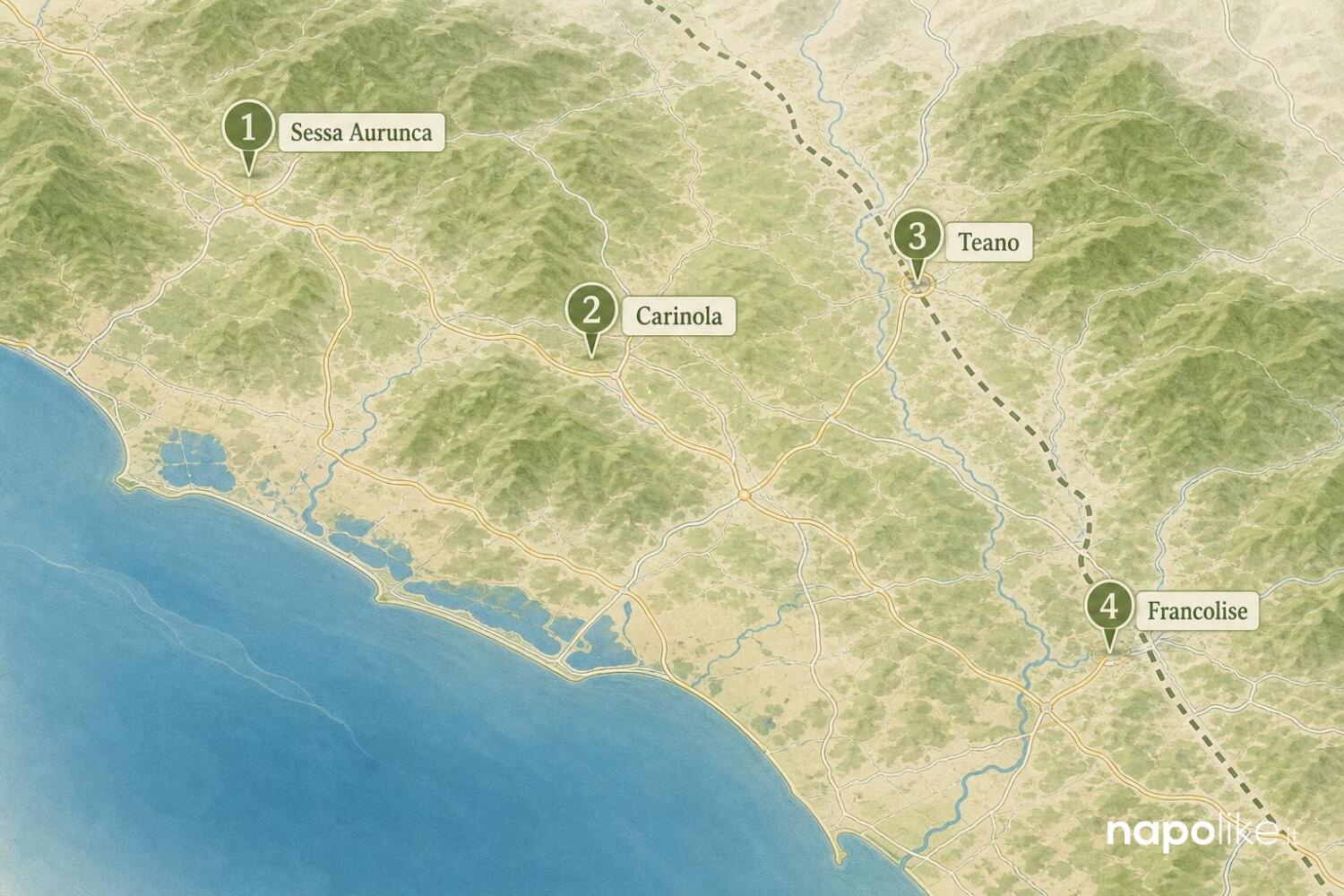
Sessa Aurunca , Carinola, Teano and Francolise tell over two thousand years of history, from the Romans to the Normans, from the Middle Ages to the Risorgimento.
This guide to the villages of the Litorale Domizio takes you on a discovery of monumental Roman theaters, Romanesque cathedrals, Norman castles, and ancient villas, all less than an hour from Naples. For each village, you'll find what to see, the pros and cons, and reviews from those who have already visited.
We recommend organizing the tour in one or two days, combining the inland areas with coastal beaches. For those who want to complete the trip, here's a guide to the most beautiful beaches along the Domitian Coast.
Sessa Aurunca: the Roman capital of the Terra di Lavoro
Sessa Aurunca is the town with the most monuments in the entire district. Nestled on the slopes of the Roccamonfina volcano, it preserves a heritage spanning from the Roman era to the Baroque period.
The old town is a labyrinth of alleys paved with lava, ancient portals, and yellow and green majolica domes.
The highlight is the Roman Theatre , brought to light and restored between 1999 and 2003. It is one of the most impressive Roman theatres in Italy, second only to the theatre in Naples in grandeur.
Visits are possible every day from 9 am to 17:30 pm, also with a guide.
Don't miss the Cathedral of Saints Peter and Paul , a Romanesque masterpiece built in 1113 with reused Roman materials. Its façade is one of the most beautiful in the province of Caserta.
Inside you can admire the Cosmatesque floor and the Paschal candelabra.
The Ducal Castle dominates the village from its summit. Built in the 10th century by order of the steward Landone, it now houses the National Archaeological Museum , with statues, reliefs, and frescoes from the theater and the Roman city. Tickets can be purchased online on the Musei Italiani portal.
Just outside the center is the Ronaco Bridge , a 21-arch Roman bridge along the Appian Way, dating back to the time of Tiberius. It's worth a visit for its grandeur. Also standing out in the village are the Tower of San Biagio , dating back to 1276, and the remains of the ancient Roman amphitheater.
pros and cons
- Pro: the village with the largest number of monuments in the area, a Roman theatre among the largest in Italy, and a national-level archaeological museum.
- Pro: Authentic and less touristy historic center, ideal for those seeking a real atmosphere.
- Against: Several monuments have reduced visiting hours, the theatre and the museum require tickets.
- Against: Parking is not always convenient; it's best to leave your car outside the city center.
Reviews
On TripAdvisor, the Roman Theatre is described as "a hidden wonder, the second largest Roman theatre in Italy, managed with passion by local guides." The cathedral garners rave reviews: "a jewel of history and beauty."
The village is described as "rich in history, with the theatre, the Roman bridge and the cryptoporticus all waiting to be discovered".
Carinola: the medieval village between the Appian Way and the sea
Carinola is a medieval village a few kilometers from the coast, between Mondragone and Sessa Aurunca. The historic center has preserved its original form, with an urban layout dating back to the Middle Ages. At the northern entrance to the village stands the city castle.
Strolling through, you'll encounter arches supported by octagonal columns and vaults decorated with Renaissance frescoes. It's one of the best-preserved examples of medieval architecture in the area, made famous by the Lilladis Cooperative , which organizes guided tours exploring local history and traditions.
Carinola's jewel, however, is in the hamlet of Ventaroli : the Basilica of Santa Maria in Foro Claudio , also known as the Episcopio. It stands on the site of the ancient Roman city of Forum Claudii , along the Appian Way, and preserves a cycle of frescoes dating back to the 11th century, among the oldest in Campania.
Nearby, you can visit the Convent of San Francesco in Casanova di Carinola and the Libellula Park in Cascano, a natural area with lakes and green paths. Carinola is also a good base for those who want to combine village and seaside for a day trip.
pros and cons
- Pro: Early Christian basilica with 11th-century frescoes, rare and of great historical value.
- Pro: still an authentic village, almost without tourists, perfect for a half day.
- Against: The frescoes in the basilica are undergoing conservation work; some areas may be closed.
- Against: Limited tourist signage; it's best to arrive with a GPS.
Reviews
Visitors to the basilica on TripAdvisor describe it as "a hidden treasure along the Appian Way, with medieval frescoes of extraordinary intensity." The village is described as "quiet and authentic, with an imposing castle."
The guided tours of the Lilladis Cooperative receive positive ratings for the competence of the stories.
Teano: where Italy was made
Teano is the ancient Teanum Sidicinum , capital of the Sidicini and gateway to Campania in Roman times. It is famous for the Teano Meeting of 26 October 1860, when Giuseppe Garibaldi greeted Victor Emmanuel II.
With the handover of the Kingdom of the Two Sicilies, Teano is considered the cradle of Italian unification.
The Cathedral of Teano deserves a careful visit: in the atrium are two sphinxes made of pink Aswan granite , a testament to the Roman city's wealth. Inside, a crucifix from the Giotto school is preserved.
The cathedral, damaged by the bombings, was recovered with the ancient façade and the bell tower.
The Roman Theatre of Teanum Sidicinum , built at the end of the 2nd century BC and modified in the Augustan age, stands in the lower city, on the slopes of the Villino Sant'Antonio.
It was part of a large complex with an artificial terrace and a temple. The visit is organized by the Archaeological Museum of Teanum Sidicinum.
The museum houses finds from the excavations: ceramics, coins, weapons, funerary objects, and reconstruction models of the theater. The tour concludes with the Convent of Santa Caterina , founded in the 16th century by Benedictine nuns, and the historical-Risorgimento trail curated by the local tourist board.
pros and cons
- Pro: A unique story linked to the unification of Italy, with itineraries dedicated to the 1860 meeting.
- Pro: Cathedral with Aswan sphinxes and Roman theatre which can be visited with the museum.
- Against: The theater and museum require reservations or check opening times.
- Against: the modern city surrounds the ancient village, the medieval part must be sought carefully.
Reviews
TripAdvisor describes the cathedral as "harmonious and pleasant, with a beautiful façade, partly ancient." Visitors to the Roman theater describe it as "an impressive site, little-known but of great impact."
For Risorgimento enthusiasts, the Teano meeting route has received moving reviews: "It's thrilling to walk where Italy was made."
Francolise: the Norman castle and the Roman villas
Francolise is a small village on a hill between the Volturno River and the sea, a few kilometers from Carinola. Its symbol is the irregularly shaped medieval castle , built in the second half of the 9th century by the Normans.
The manor, commissioned by a cardinal, dominates the village and the surrounding countryside.
The real surprise is in the San Rocco area : here, excavations have uncovered Roman villas from the Republican era , with elaborate structures and remarkable mosaics. They are among the most interesting archaeological sites in the Caleno countryside and can be visited in conjunction with the village.
In the hamlet of Sant'Andrea del Pizzone, you'll find the Church of Maria Santissima delle Grazie , a pilgrimage site and a panoramic viewpoint over the Volturno plain. The village of Francolise is small, but offers a genuine atmosphere and views that reach all the way to the sea.
pros and cons
- Pro: a fascinating Norman castle and little-known Roman villas.
- Pro: authentic village, suitable for a short stop on a tour of the villages.
- Against: few accommodation and restaurant facilities on site.
- Against: Roman villas are not always accessible; check opening times.
Reviews
Those who have visited the castle describe it as "an imposing historical monument that dominates the countryside." The church of Sant'Andrea del Pizzone draws praise for its views and intimate atmosphere.
On TripAdvisor, Francolise is recommended as a short stop: “a quiet village, perfect when combined with Sessa Aurunca.”
The surroundings not to be missed
The tour of the villages extends to Roccamonfina , immersed in the greenery of the Volcanic Area Regional Park, famous for the Chestnut and Porcini Mushroom Festival and for the Sanctuary of the Madonna dei Lattani.
Also charming are Vairano Patenora , a medieval village with a castle, and Cascano di Carinola with its Libellula Park. Riardo preserves an Angevin castle, now abandoned and admirable only from the outside.
After visiting the villages, the day ends in a trattoria. For seafood flavors, check out the guide to where to eat fish on the Litorale Domizio.
For excellent dairy products, here is a selection of the best dairies on the Domitian coast and the great classic of Capaccio Paestum mozzarella.
FAQs about the villages of the Domitian Coast
How far are the villages from Naples?
Sessa Aurunca is about 65 km from Naples, Teano about 55 km, Carinola about 45 km, and Francolise about 40 km. By car, taking the Domiziana road or the A1 motorway, you can get there in less than an hour. The entire itinerary of the four villages can easily be covered in a day.
What is the best time to visit them?
Spring and autumn are ideal, with mild weather and sparsely populated villages. In October, Roccamonfina hosts the Chestnut and Porcini Mushroom Festival. On October 26th, the anniversary of the Teano meeting, historical reenactments and Risorgimento celebrations take place.
Do you need tickets for the Roman Theatre of Sessa Aurunca?
Yes, the Roman Theater of Sessa Aurunca is open daily from 9:00 am to 5:30 pm. Tickets can also be purchased online. A guided tour is recommended to appreciate the site's history.
The Archaeological Museum in the Ducal Castle also requires a ticket, which can be purchased on the Musei Italiani portal.
Can you visit the villages without a car?
It's possible, but inconvenient: the villages are connected by local buses with limited routes. A car is the recommended means of transport, or you can organize the tour with guided tours of the area, such as those offered by the Lilladis Cooperative in Carinola.
How long does it take for the whole tour?
A full day is sufficient for the four main villages, with a half-day dedicated to Sessa Aurunca and Teano. With stops near Roccamonfina and the Roman villas of Francolise, it's best to plan a weekend.
Find out more from Napolike.com
Subscribe to receive the latest articles sent to your email.