
Neapolitan Song: From 'O Sole Mio' to Caruso
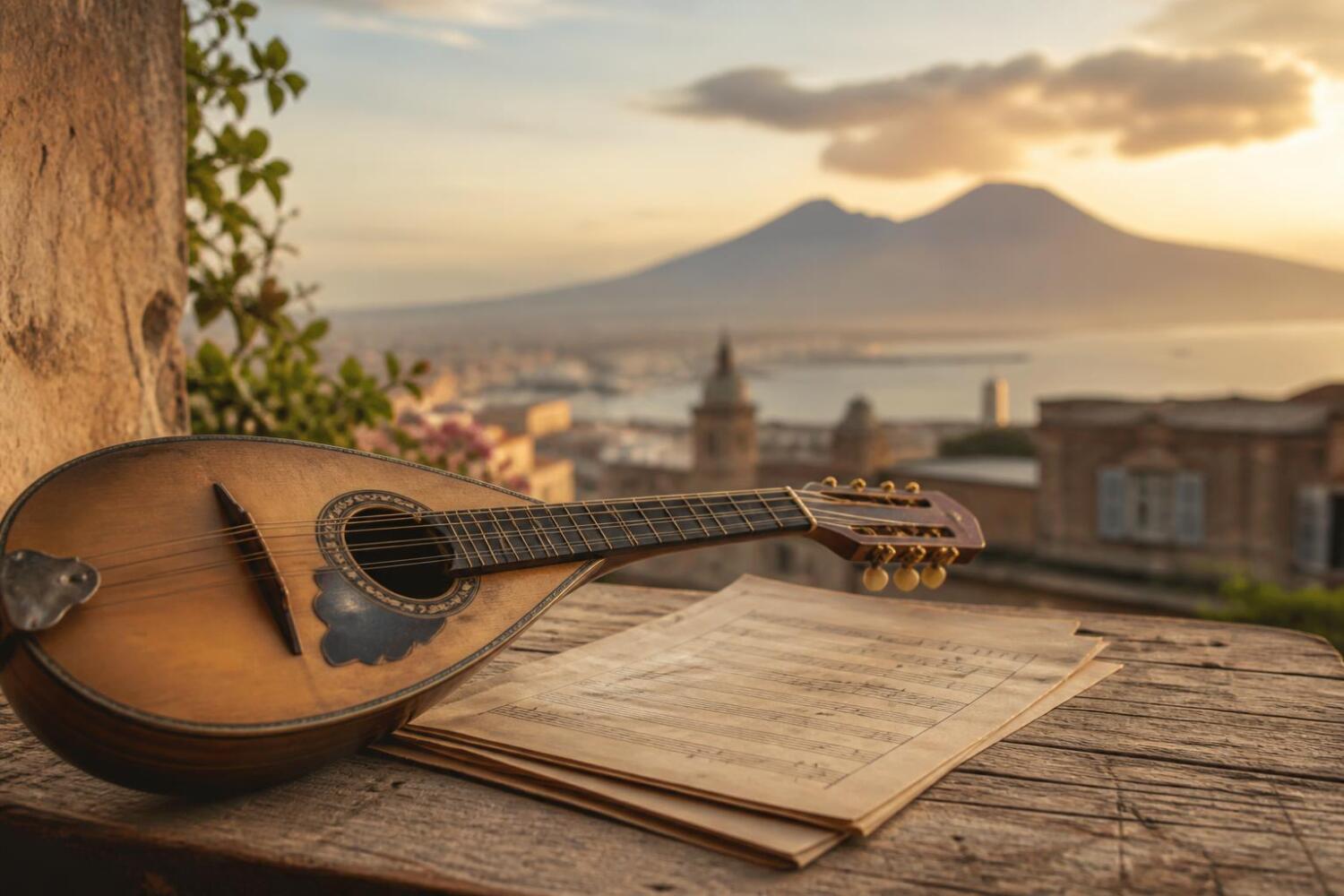
Image created with AI

From "O sole mio" to "Caruso ," Neapolitan song is Italy's most famous musical calling card: a repertoire born in the alleys of Naples and now a global heritage, capable of uniting generations and continents. In this guide, we retrace the history, authors, performers, and locations of a tradition spanning nearly two centuries.
The Origins: From "Te voglio bene assaje" to the Piedigrotta Festival
The history of modern Neapolitan song officially begins in 1839 , when “Te voglio bene assaje,” written by Raffaele Sacco and set to music by Filippo Campanella , was performed at the Piedigrotta festival . The song, hailed as the birthplace of Neapolitan songwriting, conquered the city in just a few weeks (one legend attributes the music to Gaetano Donizetti, but Campanella's authorship is now established).
For decades, the Piedigrotta festival, held in September, has been a springboard for new songs: a contest of popular creativity in which poets and musicians challenged each other before the city. From that melting pot emerged masterpieces that we still sing today. The tradition, though transformed, lives on: every year, the Mergellina neighborhood and the Trianon Viviani celebrate the festival with concerts and shows, such as the Piedigrotta Festival at the Trianon Viviani.
The golden age: “Funiculì funiculà”, “Marechiaro” and the other classics
The second half of the 19th century was the golden age of classical Neapolitan song. 1880 brought "Funiculì funiculà ," written by Giuseppe Turco with music by Luigi Denza to celebrate the inauguration of the Vesuvius funicular: the catchy, rhythmic tune immediately conquered Italy and Europe.
These are the years of Salvatore Di Giacomo , the greatest poet of Neapolitan song. He is responsible for immortal lyrics such as "Marechiaro" (with music by Mario Costa), "Era de maggio" and "Luna nova" . His poetry, elegant yet rooted in the life of the people, brought the Neapolitan dialect to cultured salons around the world.
The beginning of the twentieth century added to the repertoire “Torna a Surriento” , composed by Ernesto De Curtis on verses by his brother Giambattista (tradition dates it back to a stay of De Curtis in Sorrento in 1902), and “Core 'ngrato” , written in 1911 in New York by the poet Riccardo Cordiferro with music by Salvatore Cardillo : two Neapolitan emigrants who talk from a distance about their homesickness.
“'O sole mio”: the symbolic song
The most famous piece of all remains "'O sole mio ," composed in 1898 by musician Eduardo Di Capua based on a text by journalist and poet Giovanni Capurro (over the years, Alfredo Mazzucchi's co-authorship has been recognized by case law). Legend has it that the melody originated in Odessa, where Di Capua was on tour: from there, the tune, dedicated to the sun and beauty of Naples, took flight.
The song didn't take off immediately: it was Enrico Caruso 's voice that transformed it into a global anthem. In 1916, the great tenor recorded a 78 rpm version for Victor, which the label would later reissue dozens of times. Since then, "'O sole mio" has entered the repertoire of tenors such as Luciano Pavarotti and Andrea Bocelli and has become the most famous Italian song in the world. For the complete history of the song, read our in-depth article on "'O sole mio".
Enrico Caruso, the ambassador of Neapolitan song
Born in Naples in 1873, Enrico Caruso was the first great global star of recorded music. With his recordings, he brought Neapolitan song to living rooms and gramophones around the world, from New York to Tokyo: a repertoire that included, in addition to "'O sole mio," songs such as "Core 'ngrato" and "Santa Lucia . "
The connection between the tenor and Neapolitan song is so profound that it has become the subject of a song itself: in 1986, Lucio Dalla wrote "Caruso ," inspired by the tenor's final days at the Hotel Excelsior Vittoria in Sorrento, where Caruso stayed before his death. The song, sung in Italian and Neapolitan, became one of the biggest Italian hits of all time: the Neapolitan song that celebrates its most famous interpreter.
Protagonists of the Twentieth Century: From Murolo to Pino Daniele
Throughout the twentieth century, the tradition was preserved and renewed by a host of extraordinary performers. Roberto Murolo , with his guitar and warm voice, collected and reinterpreted the entire classical repertoire in essential collections; his birthplace in Naples now houses the Murolo House Museum , a member of the National Association of Houses of Memory.
Sergio Bruni and Massimo Ranieri brought Neapolitan song to theaters and television, while Renato Carosone launched it into the world of swing and jazz with hits like "Tu vuo' fa' l'americano." On the more modern side, Pino Daniele fused blues with Neapolitan tradition, creating an unmistakable language, and Peppino Di Capri updated it with international elegance, as recounted in our memory of Peppino Di Capri . And let's not forget Renzo Arbore , who brought the classics of the 1930s back into fashion with his show "Indietro tutta."
Poets and musicians: who wrote the great classics
Behind every masterpiece lies a pair of composers. Alongside the aforementioned Di Giacomo , Capurro , De Curtis , and Cordiferro , standout figures include Libero Bovio , author of "Passione" and "Lacreme napulitane," Ernesto Tagliaferri , EA Mario (pseudonym of Giovanni Ermete Gaeta), who penned the famous "Santa Lucia luntana" about departing soldiers, and Salvatore Gambardella . Many of these pieces originated as "walking" music or for the Piedigrotta festivals, but their poetic quality makes them immortal.
Dialect, far from being a limitation, is the key to the universal success of this repertoire: as we explain in our guide to the Neapolitan dialect , the language of Naples has travelled the world precisely thanks to song.
The places of Neapolitan song in Naples
Those who want to experience this tradition live have many options. The Teatro San Carlo , the oldest opera house in Europe, and historic theaters such as the Bellini, Nuovo, and Augusteo host performances and concerts. The Museum of the Conservatory of San Pietro a Majella preserves scores and ancient instruments, while the Murolo House Museum celebrates the figure of Roberto Murolo. For a complete overview of theaters, museums, and music venues, consult our guide to Neapolitan music: history, places, and tradition.
Why Neapolitan songs are loved all over the world
The secret of Neapolitan song lies in its ability to express universal feelings—love, nostalgia, jealousy, melancholy—with immediate melodies and words brimming with imagery. It's a music that needs no translation to be understood, and that's why it has spanned over 180 years of history without aging, reinventing itself from generation to generation: from the mandolin of the late 19th century to modern orchestrations, from Caruso to Dalla, all the way to the young artists rediscovering it today.
FAQ
What is the most famous Neapolitan song in the world?
“'O sole mio”, composed in 1898 by Eduardo Di Capua with lyrics by Giovanni Capurro, is considered the best-known Neapolitan song worldwide, especially thanks to Enrico Caruso's 1916 recording.
Who wrote “'O sole mio”?
The lyrics are by Giovanni Capurro, the music by Eduardo Di Capua, with subsequent co-authorship credited to Alfredo Mazzucchi. Legend has it that the melody originated in Odessa, where Di Capua was on tour.
What is the first Neapolitan song in history?
“Te voglio bene assaje”, performed at the Piedigrotta festival in 1839, is considered the birth certificate of the modern Neapolitan song.
Who sang Lucio Dalla's "Caruso"?
"Caruso" was written and performed by Lucio Dalla in 1986, inspired by Enrico Caruso's final days at the Hotel Excelsior Vittoria in Sorrento. The song has since been covered by Luciano Pavarotti and many other international artists.
Where to listen to Neapolitan music in Naples?
Theaters such as the San Carlo, the Bellini, and the Trianon Viviani, museums such as the Murolo House Museum and the Conservatory of San Pietro a Majella, and events related to the Piedigrotta festival offer opportunities to listen to Neapolitan song throughout the year.
Find out more from Napolike.com
Subscribe to receive the latest articles sent to your email.