
The Naples Power Plant: A History of the City's Electrification
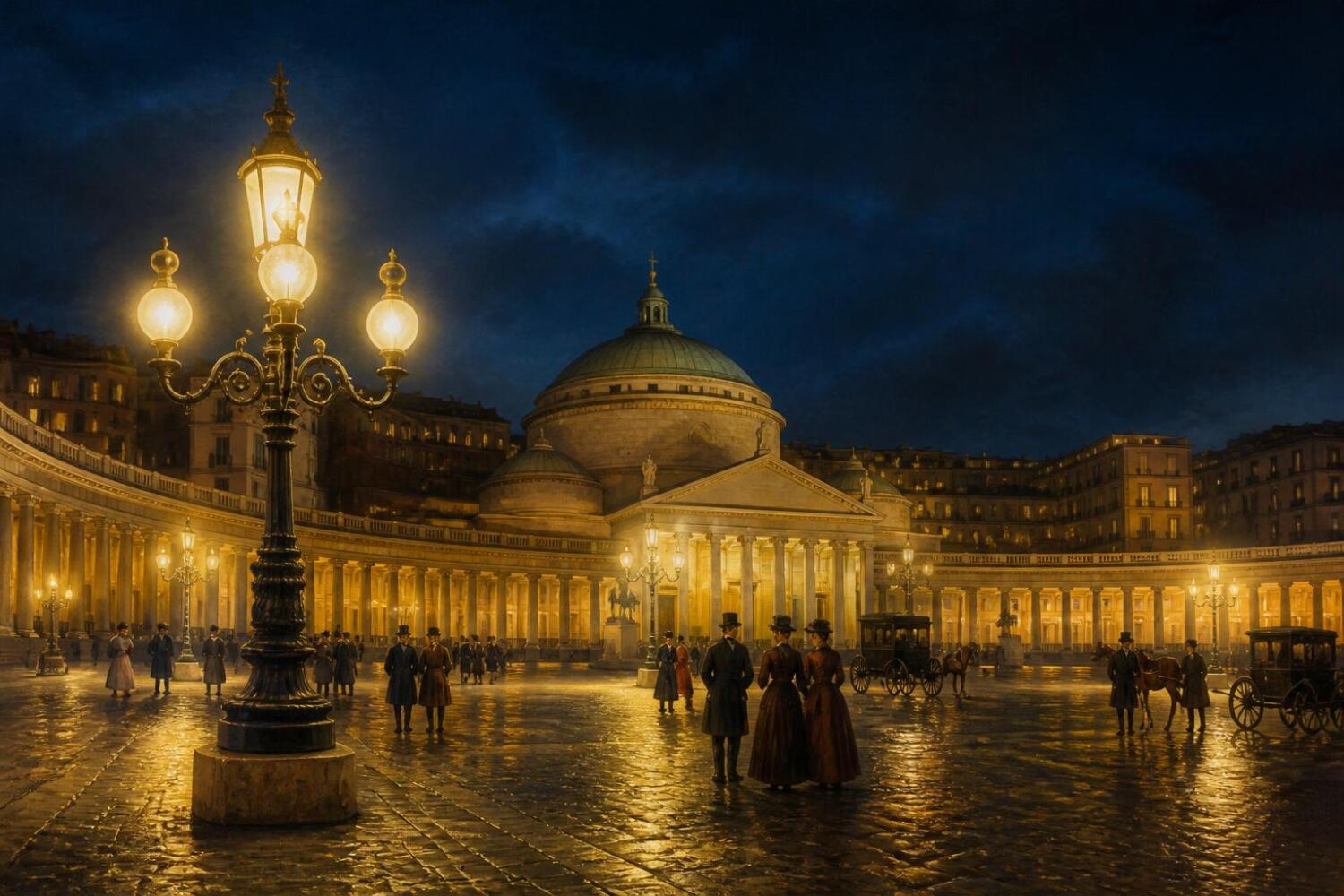
Image created with AI

When we talk about Naples's power plant, we touch on one of the city's most fascinating and lesser-known stories: that of a metropolis that, between the late 19th and early 20th centuries, went from oil street lamps to electric lamps, from dark alleys to brightly lit squares. A transformation that forever changed the face of Naples and deserves to be told step by step.
In this in-depth study, we retrace the stages of Naples' electrification : the first experiments, the electric lighting of the Teatro di San Carlo and Piazza del Plebiscito , the birth of SME, and the arrival of ENEL. We'll also clarify an often-confused point: what was Italy's first thermoelectric power plant?
Naples before electricity: oil and gas streetlights
For centuries, after sunset, Naples was a city of dim, intermittent lights. Until the first half of the 19th century, the streets were lit by oil lamps , later supplemented by gas lighting . The qualitative leap came with the contract of December 13, 1838 , signed between Mayor Giuseppe Caracciolo and the company responsible for illuminating 34 locations in the city with over 400 lamps , some gas-fired and some oil-fired.
The real driving force behind change, however, was a dramatic event: the cholera epidemic of 1884. To reclaim the most degraded and unhealthy neighborhoods, the great Risanamento plan was launched , led by mayor Nicola Amore , in office from 1883 to 1887 and again in 1888-1889. Thus were born Corso Umberto I, the new squares, and the Galleria Umberto I , symbols of a city that wanted to give itself a modern face. And modernity, by definition, spoke the language of electricity.
When Naples lit up: San Carlo, Plebiscito and Galleria Umberto I
The first public electric lights arrived in Naples in the late 1880s. According to the Enel Historical Archive , the illumination of Piazza del Plebiscito and the church of San Francesco di Paola in 1890 was particularly spectacular, along with the first electric lighting of the Teatro San Carlo . An electrically lit opera house was, for its time, a true technological marvel.
During the same period, the Galleria Umberto I was also turned on : built between 1887 and 1890 and inaugurated on November 10, 1890 , it was equipped with an electrical system already foreseen in the agreement of December 30, 1886, signed by the Municipality of Naples with the Esquilino di Roma and Deserti e Fantoni companies. The Galleria thus became one of the brightest showcases in the city, a place where electricity was no longer a scientific curiosity but a daily service.
The spread of electricity to homes, however, was slower. For years, electricity in Neapolitan homes often came through so-called coin-operated meters , devices that supplied electricity in exchange for a coin, which were only definitively replaced after the Second World War.
The Italian record belongs to Milan, not Naples
Over the years, the belief has spread that Italy's first thermoelectric power plant was built in Naples. Historical sources, however, tell a different story. The Italian, and even continental, record belongs to Milan: the Santa Radegonda power plant , inaugurated on June 28, 1883, designed by engineer Giuseppe Colombo.
Coal-fired and based on the Edison direct current system, Santa Radegonda was the first thermoelectric power plant in Italy and the first in continental Europe, after those in Holborn, London (June 1882) and Pearl Street, Manhattan (September 1882). Its energy initially illuminated the shops around Piazza del Duomo, such as the Caffè Biffi and the Bocconi department store, then the Teatro Manzoni and, from the end of 1883, the Teatro alla Scala. Milan demolished it in 1926 to build the Odeon cinema.
Naples, therefore, does not hold the national record. However, it was among the first major Italian cities to adopt electric lighting for monuments and public spaces, and in just a few decades it became the true heart of the electricity industry in Southern Italy.
SME: the company that electrified the South from Naples
Naples' role in the history of Italian electricity was consolidated on March 20, 1899 , with the founding of SME, the Southern Electricity Company . The company was born from the initiative of the Neapolitan Lighting and Gas Company, the Banca Commerciale Italiana, and the Franco-Suisse Company of Geneva, and established its headquarters in Naples.
SME built large hydroelectric plants using the currents of the Tusciano, Tanagro, and Aventino rivers and came to control energy production and distribution throughout much of continental Southern Italy, absorbing dozens of smaller electricity companies. In 1924 , it was listed on the Milan Stock Exchange, and in 1937, it became part of the IRI (Italian National Institute of Renewable Energy). For decades, when electricity was discussed in Naples, SME was the name of the game.
From ENEL to the Historical Archives of Naples
History turns a page with the nationalization of the electricity industry : the law of December 6, 1962 , established ENEL , operational from January 1, 1963 , unifying the production and distribution of energy throughout Italy into a single public entity. SME, having privatized its electrical core, reinvented itself as a large food group, with brands such as Cirio, Motta, Alemagna, and Autogrill.
Today the memory of that long adventure is preserved in Naples, where the Enel Historical Archive is based : a heritage of around 30.000 archival resources , housed in Naples, which documents over a century of electrification of Southern Italy, from the 19th century to 1963. It is one of the most important collections in Italy on the history of energy.
What remains today of the electrification of Naples
The large 19th- and 20th-century power plants are no longer operational, and not all of them are open to visitors, but the legacy of electrification is still visible to those who wander the city: the Risanamento streets, the Galleria Umberto I, the illuminated squares, and, above all, a wealth of industrial archaeology that tells the story of Naples's entry into modernity. For those who love this type of history, another unmissable stop is the National Railway Museum in Pietrarsa , a symbol of the early industrialization of the South.
Don't miss: if you're fascinated by the era of the first electric lights, also read the history of the Teatro San Carlo, the oldest opera house in Europe , one of the first Neapolitan buildings to be lit by electricity.
FAQ
What was the first thermoelectric power plant in Italy?
The Santa Radegonda power plant in Milan, inaugurated on June 28, 1883 , designed by Giuseppe Colombo. It was also the first thermoelectric power plant in continental Europe, after those in London and New York in 1882.
When did electric lighting arrive in Naples?
Between the late 1880s and 1890. In that year, according to the Enel Historical Archive, the lighting of Piazza del Plebiscito and the first electric lighting of the Teatro San Carlo were recorded . The Galleria Umberto I , inaugurated on November 10, 1890, had an electrical system from the very beginning.
What is SME and why is it linked to Naples?
SME (Società Meridionale di Elettricità) was founded in Naples on March 20, 1899 , and became the leading electricity producer in continental Southern Italy, with headquarters in the Campania capital. In 1924, it was listed on the Milan Stock Exchange.
When was ENEL founded and what happened to Neapolitan electricity companies?
ENEL was established by the law of 6 December 1962 and became operational on 1 January 1963 , unifying all the electricity companies, including those active in Naples and the South. SME later transformed into a large food group.
Where is the Enel Historical Archive located?
Located in Naples , on Via Ponte dei Granili. It houses approximately 30.000 archival resources on the history of electrification in Southern Italy, from the 19th century to 1963.
What remains today of the old Naples power plant?
The historic structures are almost never open to visitors, but their legacy is visible in the streets of the Risanamento, in the Galleria Umberto I, and in the city's industrial archaeology heritage, also documented by the Enel Historical Archive.
Find out more from Napolike.com
Subscribe to receive the latest articles sent to your email.