
What Happened in Ceuta: The Migration Crisis Explained
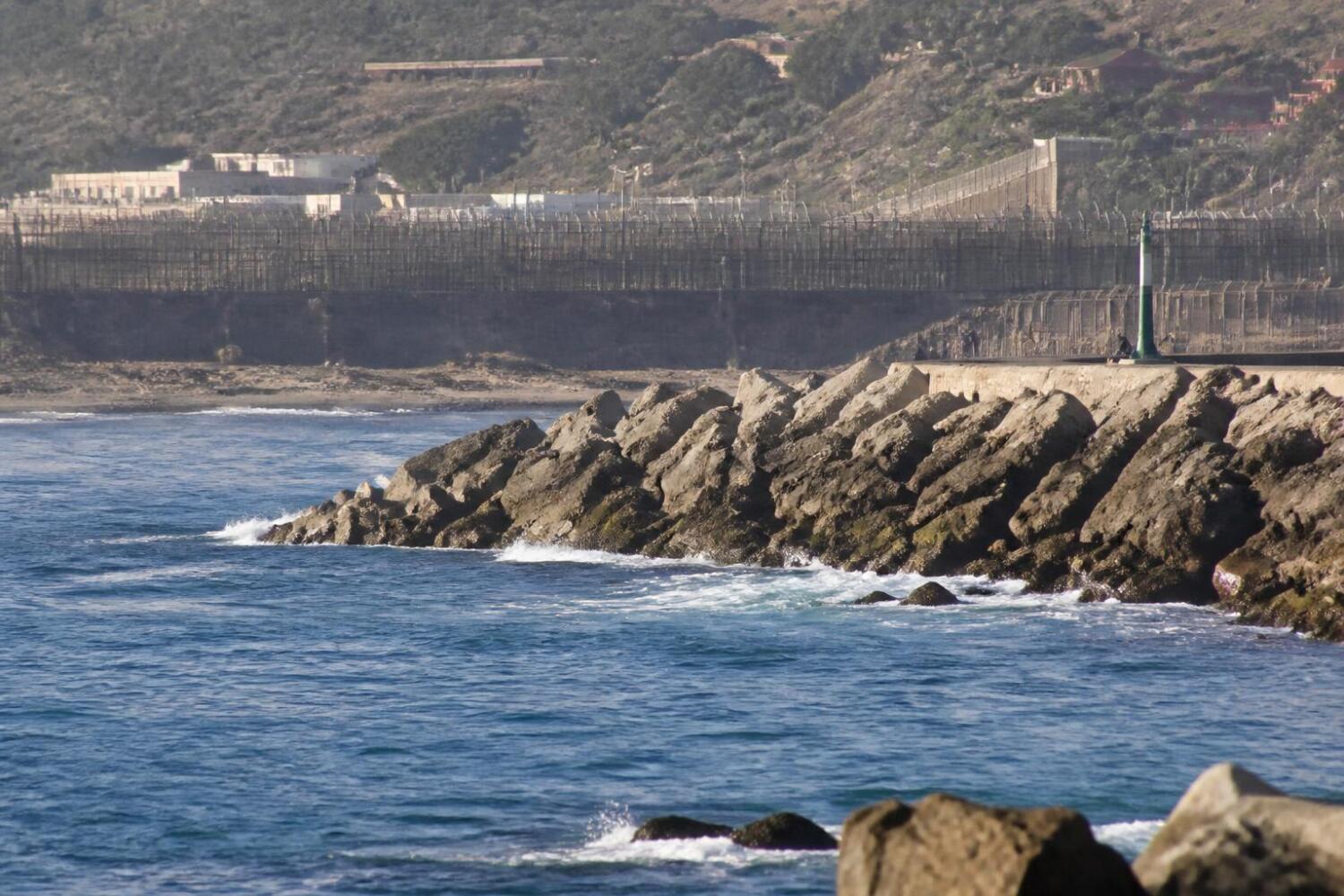
Image created with AI

In the final days of July 2026, the Spanish enclave of Ceuta , in northern Morocco, was hit by one of the most serious waves of migration in its recent history. Thousands of people attempted to reach European territory by swimming or climbing over the border fences, in a situation that led to the deployment of the Spanish army and a diplomatic crisis between Rome and Madrid. Here's what happened, with verified numbers and facts.
What is Ceuta?
Ceuta is one of two Spanish exclaves surrounded by Moroccan territory, along with Melilla . It is located on the North African coast, a few miles from the Strait of Gibraltar , and has approximately 83.600 inhabitants. It is one of the few land borders between the European Union and Africa, which is why it has always been a transit point for those seeking asylum in Europe or seeking other forms of international protection.
What happened since July 30th
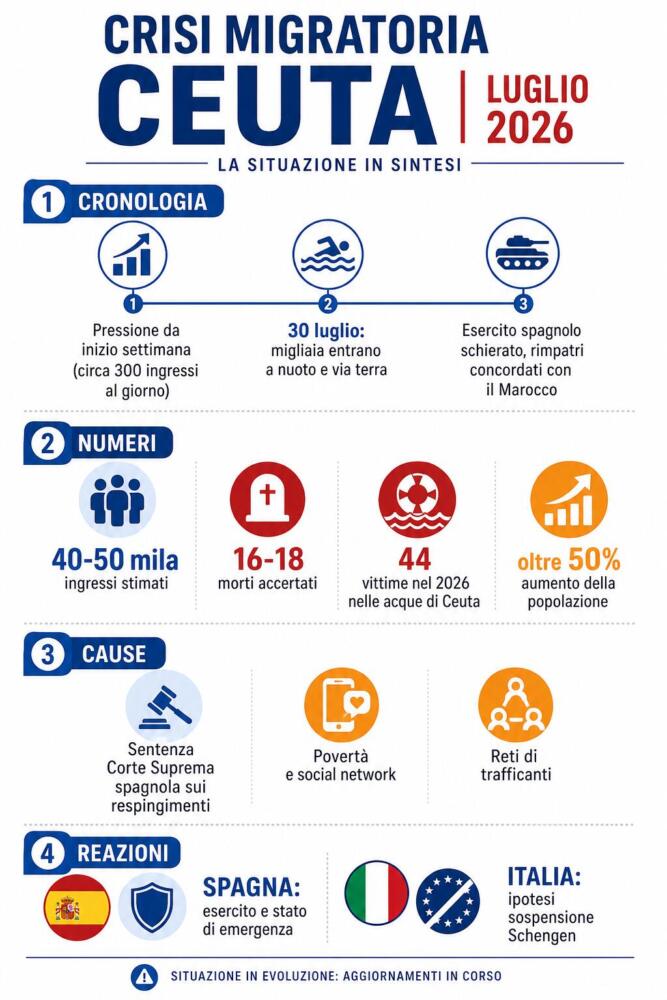
Migratory pressure had been growing throughout the week: according to the enclave's president , Juan Jesús Vivas , between 1.500 and 2.000 people had already swum across the border in the previous days, at a rate of around 300 per day. Then, starting on Thursday, July 30, the situation escalated: thousands of people flocked to the border in broad daylight, many swimming along the Tarajal breakwater , others jumping over and over the border barriers.
From the Moroccan town of Fnideq (Castillejos), on the other side of the border, convoys of young people, families with children, elderly people, and people with limited mobility set out, many of whom jumped into the water even at night, taking advantage of the calm sea and thick fog. The Moroccan police were overwhelmed and unable to contain the influx.
Estimates of arrivals are still provisional and vary among sources: according to the Post, over 40 people have crossed the border, while Euronews estimates that around 50 people have reached the coast and been thrown into the sea. These numbers, according to the highest estimates, equate to an increase of over 50% in the city's population. Thousands of migrants spent the night stranded in the streets of Ceuta.
The victims and the missing
The death toll is still uncertain. According to ANSA, citing La Vanguardia , in the last 24 hours border control units have recovered the bodies of at least 16 people from the waters, bringing the total number of migrants who have died this year attempting to reach the enclave by sea to 44. Il Post reports at least 18 dead and a dozen missing. The figures could rise in the coming hours: the Guardia Civil has recovered at least eleven bodies of drowned people, and many are still missing at sea.
Why right now?
The causes of the surge are multiple. On the one hand, there's poverty, a lack of prospects, and expectations fueled by social media, fueled by the good weather and calm seas just a stone's throw from the Strait of Gibraltar.
On the other hand, there's a ruling from the Spanish Supreme Court in early July, according to which migrants intercepted at sea while trying to reach Ceuta or Melilla cannot be immediately repatriated and remain the responsibility of the Spanish authorities. The Spanish government attributes part of the recall effect to this decision, arguing that smuggling networks are exploiting it; Morocco speaks of criminal organizations organizing the avalanche. However, the newspaper El País , interviewing migrants who arrived in recent days, has gathered reconstructions that partially refute this theory.
On Thursday evening, the Spanish government clarified that the ruling does not apply to people who entered from Morocco in recent days and announced an agreement with Rabat to expedite repatriations, without providing details. The historically volatile diplomatic tensions between Madrid and Rabat remain in the background, as does Spain's progress in recognizing the nationality of Saharawis born during Spanish rule.
Spain's response
Pedro Sánchez 's government ordered the deployment of the army to Ceuta to support the Guardia Civil, with reinforcements from the reserve unit, civil guards from Andalusia, and GEAS divers . The Duque de Ahumada ship also arrived in the city, carrying helicopters and drones. In Melilla, the Beni Enzar crossing was closed due to similar attempts at irregular entry.
On Friday, July 31, Sánchez and Interior Minister Fernando Grande-Marlaska traveled to Ceuta, visiting Tarajal and holding a coordination meeting with local authorities. Enclave president Vivas described the situation as a state of absolute humanitarian and social emergency, calling on Madrid to declare a state of national emergency and establish a single command. The Ceuta Assembly unanimously approved a motion calling for the temporary closure of the border with Morocco.
The diplomatic clash with Italy
The crisis has opened an unexpected front between Rome and Madrid. Prime Minister Giorgia Meloni has said she is considering temporarily suspending the Schengen Agreement with Spain, linking the wave of migration to the regularization of 500 people approved by the Spanish government, a claim Madrid rejects. Foreign Minister Antonio Tajani has gone further, calling for the closure of the Schengen area.
As the Post noted, these are largely symbolic statements: Italy and Spain do not share a land border, so a suspension would primarily lead to increased controls on those arriving by air or sea. Spanish Foreign Minister José Manuel Albares summoned the Italian ambassador and called Rome's message unworthy of a friend and partner country, calling it partisan demagogy.
Previous: 2021 and 2014
Ceuta's history is marked by similar episodes. The most notorious precedent occurred in May 2021 , when in just 48 hours, over 8 people entered the enclave, mostly by swimming, following a clear relaxation of controls on the Moroccan side, linked to tensions between Madrid and Rabat over Spain's hospitality of Polisario Front leader Brahim Ghali . At that time, too, the Spanish government deployed its army along the coast.
The most tragic case remains that of Tarajal in February 2014 : fifteen people drowned after Guardia Civil officers used riot control equipment, including rubber bullets, to contain an attempted crossing. The officers involved were acquitted in 2019, a decision contested by human rights organizations.
The situation in real time
The crisis is evolving, and the data changes hourly. What is certain at the moment is that Ceuta is experiencing its worst migration day since 2021, with the army deployed, thousands of people on the streets, and a diplomatic standoff between Italy and Spain that could have repercussions on the Schengen area . For further information and updates on the category, you can consult the articles in the Information section and other news on the site.
FAQ
Where is Ceuta located?
Ceuta is a Spanish enclave on the North African coast, surrounded by Moroccan territory, a few miles from the Strait of Gibraltar. Along with Melilla, it is one of the few land borders between the European Union and Africa.
How many people entered Ceuta?
Estimates are provisional: according to the Post, over 40 people have crossed the border, while Euronews estimates that around 50 people have reached the coast and been thrown into the sea. The numbers are not yet official.
How many are dead?
The data are conflicting: La Vanguardia, cited by Ansa, reports at least 16 bodies recovered in 24 hours and 44 total victims in 2026 in the waters off Ceuta; Il Post reports at least 18 deaths and a dozen missing.
Why did thousands of people try to get in?
Poverty, lack of prospects, the impact of social media, and a Spanish Supreme Court ruling in early July limiting immediate pushbacks of migrants intercepted at sea are contributing factors. The Spanish government and Morocco are pointing the finger at smuggling networks.
Why is Italy threatening to suspend Schengen?
Prime Minister Meloni has said she is considering temporarily suspending the Schengen Agreement with Spain, linking the crisis to the regularization of 500 people. However, Italy and Spain do not share a land border, so the effects would primarily be increased checks on aircraft and ships.
What happened in Ceuta in 2021?
In May 2021, over 8 people entered the enclave in 48 hours, mostly by swimming, after Moroccan controls were eased due to diplomatic tensions between Madrid and Rabat over Western Sahara and Polisario leader Brahim Ghali.
Find out more from Napolike.com
Subscribe to receive the latest articles sent to your email.