
Italy's housing crisis: prices, rents, and why young people can't afford to buy.
Image created with AI

In Italy, a home has always been much more than a roof: an investment, a source of security, an almost obligatory part of adult life.
In recent years, however, something has broken. House prices are rising again decisively, rents have hit all-time highs and young people stay at their parents' home longer than in almost all of the rest of Europe. It's not just a feeling: it's a crisis documented by numbers from Istat, Eurispes, the Bank of Italy, and even a European Parliament study dedicated to the housing crisis.
In this article, we look at what's really happening, with the data in hand: how much prices and rents have risen , why young people can't afford to buy, what's changed for mortgages, and what tools exist (from guarantee funds to public housing) for those looking for a home today.
With a focus on what those who want to leave home can actually do in this market phase.
What is the housing crisis and why is it so talked about?
The " housing crisis " (or housing crisis) refers to the growing difficulty people have in finding and maintaining a home , due to rising mortgage and rent costs. This is the definition given by the European Parliament in its study on the housing crisis published in early 2026, and it captures a phenomenon that isn't unique to Italy: across Europe, buying or renting a home has become more difficult , especially for young people.
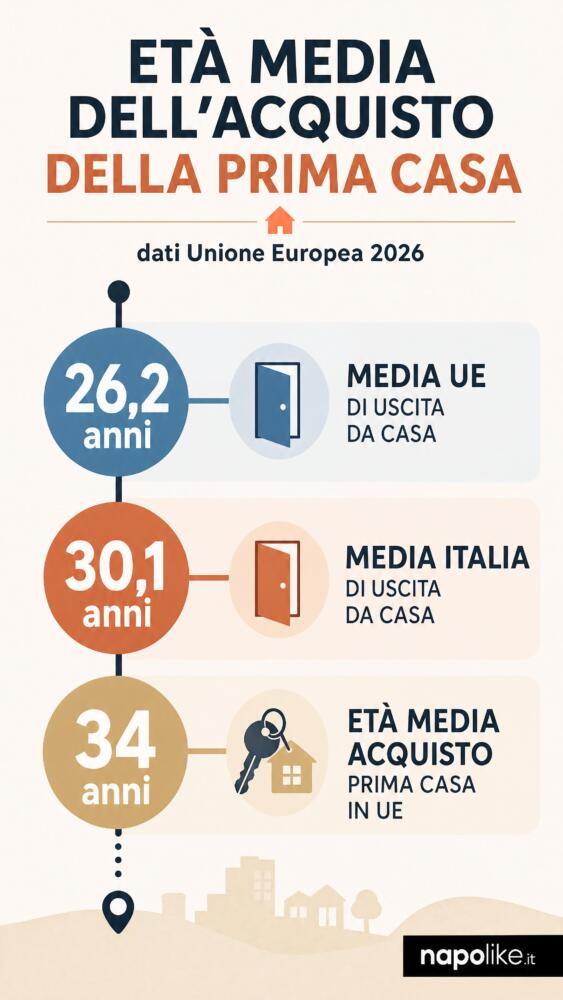
The most cited data is the age at which people leave their parents' home : in Italy, the average age of leaving home is 30,1 , the fourth highest in the European Union, compared to an EU average of 26,2. In Finland, for comparison, people leave at 21,4. And 79% of Italians between the ages of 20 and 29 still live with their parents, compared to the European average of 54%, 44% in France, and 33% in Germany.
This Italian peculiarity was once explained by culture, by the strong bond with family. Today, scholars interpret it differently: staying at home with one's parents is increasingly a necessary buffer to offset the imbalance between young people's earnings and the cost of living.
House prices: how much have they really risen?
Let's start with purchase prices, because they're the first indicator that catches the eye. According to Istat, in the first quarter of 2026, the house price index rose by 5,2% year-on-year , accelerating from the 4,0% increase recorded at the end of 2025. In practice, homes are more than 5% more expensive than a year earlier, and growth is accelerating.
This data is part of a very specific long-term trend.
Looking at the last thirty years, real estate values have had a strong growth between the late 1990s and 2008, then a phase of decline after the financial crisis, a stabilization between 2016 and 2023 with localized increases and now a new phase of increase, concentrated above all in large cities.
The average price per square meter recorded by real estate portals in April 2026 is approximately 2.188 €, with much higher peaks in urban areas.
The forecasts for 2026, drawn up by Nomisma, Immobiliare.it and Scenari Immobiliari, indicate a rise in prices between 1% and 4,2%, with peaks of +7,3% in MilanThe North is driving the market, while the South is showing more modest increases.
But beware of one detail: purchase price growth, while sustained, is still slower than rent growth. That's where the real problem lies.
Rents are rising faster than prices: the numbers
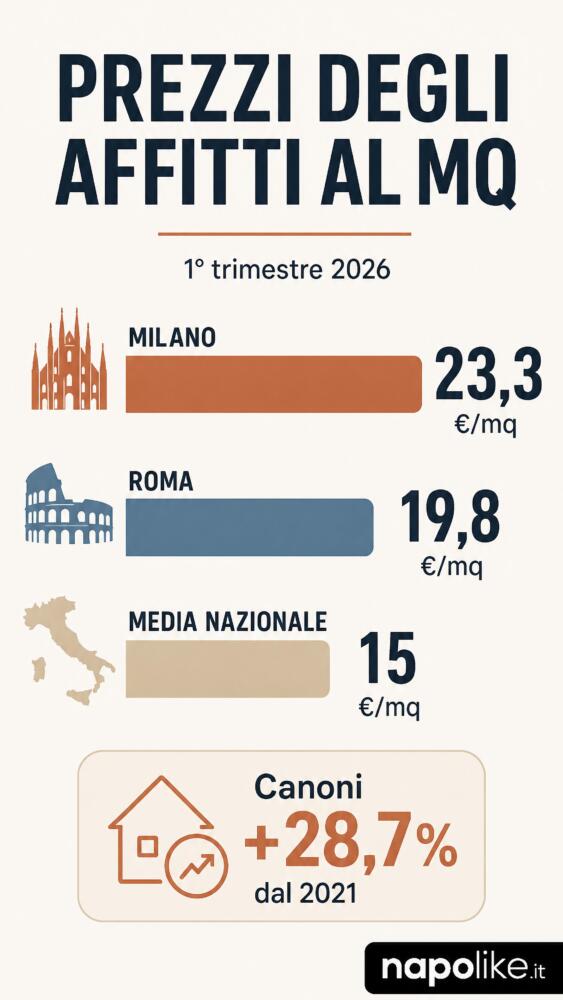
If buying is difficult, renting is becoming prohibitive. In the first quarter of 2026, rents increased by +4% compared to the previous quarter, bringing the national average price to 14,8 euros per square meter, one step away from the all-time high of 14,9.
That maximum was already exceeded in April: the national average rose to 15 euros per square meter, an absolute record.
In the major cities, the numbers are staggering. Milan is the most expensive at €23,3 per square meter , while Rome hit a record high of €19,8 , up 5,7% in a single quarter. But the real news is something else: the increase is no longer limited to the metropolises. Among the most significant quarterly increases are Barletta (+11,3%), Padua (+8%), Caserta (+7,7%), Lucca (+7,3%), and Viterbo (+7,2%) . The pressure has spread to the intermediate urban network, including Campania.
Even more telling is the underlying trend: according to data from the first half of 2025, rents have increased by 28,7% since 2021. This trend hasn't been matched by entry-level salaries, which explains why the problem is particularly acute in university towns and high-employment areas.
Why are rents rising so much?
To understand the rental crisis, we need to look at supply, not just demand. Over the last ten years, a significant portion of private housing has been reallocated towardstourist hospitality (short-term rentals, holiday homes), which yields more than ordinary residential rentals.
In university cities, the market for temporary and single room contracts, more flexible and more profitable for owners.
The result is that the supply of long-term rental accommodation has dwindled precisely where demand is highest, and prices have risen accordingly. Added to this is another factor: the shortage of student housing.
The European Parliament study quantifies in 3 million hospital beds are missing to accommodate all out-of-town students from European countries, and in Italy affordable student residences are now very rare.
Why young people don't leave home: the data
Let's return to the starting point, because it's the crux of the matter. In Italy, young people leave home at 30,1 years old , four years later than the European average. And staying home for a longer period is no longer a free choice: it's increasingly the only option, given the gap between housing costs and income from work.
Confirmation comes from an indicator that at first glance might seem to absolve Italy. According to Eurostat data, in 2025, only 4% of young Italians between the ages of 20 and 29 lived in households that allocated at least 40% of their income to housing costs, compared to the European average of 10,3%. This may seem like a good result, but it's a statistical illusion: the percentage is low precisely because young Italians don't directly cover housing costs , continuing to live with their parents.
The counter-proof comes from overcrowding: the 39,1% of young Italians live in overcrowded housing, against an EU average of 25,3% and percentages of 11,6% in Norway or 9,3% in the Netherlands.
In practice, young Italians are "protected" from the cost of housing at the cost of giving up their own space, often in full and shared homes.
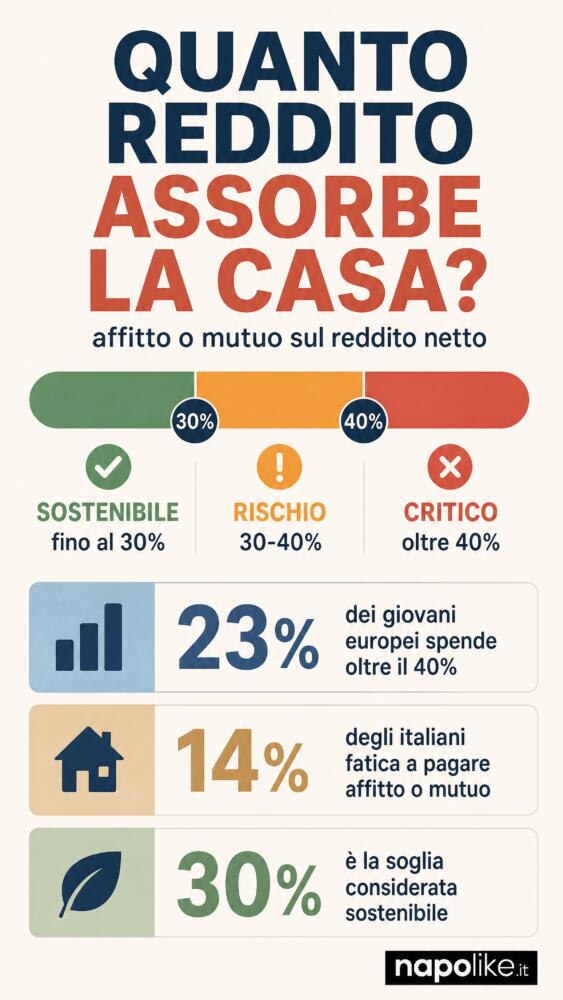
And those who leave home pay a high price: 23% of young Europeans between the ages of 20 and 29 who live alone spend more than 40% of their income on housing. In Italy, 14% of people report struggling to pay rent or mortgage payments (compared to the European average of 10%), and 7% expect to have to leave their home in the next two or three months because they can no longer afford it.
The issue is income, not just house prices.
There is a point that experts have been repeating for years and that the data confirms: the problem is not so much the cost of the house itself, but the relationship between that cost and how much you earnThe European Parliament study states it explicitly: a gap has opened up between where young people can afford to live and where jobs are available.
The cities with the most opportunities are the most expensive and entry-level wages aren't keeping pace.
This intertwining of housing and income is the same one we discussed in the article on inflation and wages in Italy : if real wages have stagnated for twenty years, any increase in prices or rents weighs disproportionately on those just starting out. And those lucky enough to buy often can't afford it alone: young couples with two incomes, or those who can count on an inheritance or parental support, are especially successful.
The result is also measurable in perceptions. 35% of those who do not have a home say that he will never be able to buy it. And when asked how worried they are about not being able to find or keep housing, the 60% of Italians between 18 and 24 years old responds that he is worried or very worried, compared to 43% of people between 25 and 65 years old.
Housing concerns have become a constant in young people's lives, not an exception.
Mortgages: Rates, Down Payments, and Why Buying Is Harder
Even those with a stable income who want to buy face financial obstacles. The first is the down payment : banks typically ask for up to 20% of the property's value as equity, not financed by the mortgage. For a €200.000 home, that's €40.000 to put down, plus taxes, a notary, appraisal, brokerage fees, and often renovation or furnishing costs. In practice, to buy a small home, you sometimes need at least €60.000 in cash.
Then there are the rates. The European Central Bank had raised them above 4% in 2023 to stem inflation and then reduced them to just above 2%, where they have been stable since the summer of 2025. But beware of the peculiarity of this phase: while variable-rate mortgages have faithfully followed the ECB's decisions (and now cost less), fixed-rate mortgages have become more expensive.
The reason is that Fixed rates are pegged to the IRS, a long-term rate that depends on investors' expectations, and those expectations have risen due to economic uncertainty and large government spending programs.
The paradox is that today almost all new mortgages are fixed-rate, precisely when they cost the most . Added to this is the duration: the average mortgage lasts 20-30 years, and the average age for purchasing a first home in the European Union has reached 34.
The First Home Guarantee Fund: How it works
Politicians have attempted to respond with public instruments. The main one is the First Home Guarantee Fund , managed by Consap: the State guarantees up to 80% of the mortgage principal , for loans up to €250.000 . Young people under 36, single-parent families with at least one minor child living with them, and young couples are eligible, provided the family's ISEE is less than €40.000.
The tool is working: in 2025, approximately one-sixth of new mortgage disbursements were backed by the state guarantee, and one in five was granted to borrowers with a gross annual income of less than €26.000. But it has structural limitations.
The first is that the ceiling of 250.000 euros barely covers the value of a two-room apartment in the big cities.
The second is that the fund has been significantly downsized since 2024.
The third, more profound, is that the public guarantee does not create a stable income, does not reduce property prices, and does not protect against the risk that a sustainable instalment at the time of signing the contract becomes too burdensome after a job loss.
Public housing: the Italian paradox
When it comes to the housing crisis, public housing is rarely mentioned in Italy. And the numbers explain why: public housing barely covers the 2,3% of the national housing stock, compared to 24% in Sweden, 29% in the Netherlands and 17% in France.
The comparison is merciless and the existing heritage is also poorly maintained: according to the Federcasa-Nomisma Observatory, 61.300 public housing units (7,7% of the stock) are vacant because they require extraordinary maintenance and to these are added 22.700 illegally occupied dwellings.
The result is that public housing in our country doesn't play the same role as a safety net that it does elsewhere: those who can't afford the private market have very few alternatives, and waiting lists for social housing are getting longer in all major cities, including Naples.
The paradox of empty houses
There is also an Italian paradox that is worth knowing. In the country there are millions of homes not permanently occupied, but empty houses are almost always found in the wrong places with respect to demand: small towns with demographic decline, inland areas, areas far from universities and job opportunities.
Others are unusable without restructuring, or blocked by inheritances, disputes and co-ownership, or even kept empty as an asset reserve.
In practice, two parallel markets coexist: that of urban areas, where demand is high and supply is scarce, and that of depopulated areas, where homes are worth next to nothing and no one wants them. The Italian housing crisis, in short, is not a problem of quantity, but of distribution, affordability, and quality of the existing housing stock.
What to Expect in 2026: Predictions and Scenarios
Looking ahead, forecasts for 2026 indicate continued growth, but with varying degrees of intensity depending on the region. In the first quarter of 2026, house prices rose by 4,3% and rents by 3,6%, supported by strong demand and favorable credit conditions compared to the previous two years.
The North is leading the way, the South is growing less, and small-to-medium-sized cities are catching up with the growth they experienced in recent years.
The most concrete risk for those looking for a home is that the gap between income and costs will remain open for a long time: prices continue to rise, real wages are stagnant, and public tools, while useful, are insufficient to bridge the gap. There are no easy solutions, but understanding the mechanisms helps make better decisions.
What to do if you're looking for a house: practical advice
We'll end with the practical part, which is perhaps the one that interests you most if you're looking for a home right now.
Start from your real budget: calculate how much you can allocate to the house without exceeding 30% of your net income and do some honest calculations on your down payment and incidental expenses before even looking at the ads.
Compare rent and mortgage in the same area: in Italian cities, mortgage payments are often comparable to rent , and those with a down payment (even a small one, supported by the Guarantee Fund) can find protection from rent increases by purchasing. Consider lesser-known areas: smart working has made areas outside historic centers more livable, with lower prices and larger spaces, often better connected than you might think.
Also consider alternative options: co-housing, bare ownership, and leases with a future right of sale. And if you're a student away from home, inquire about student residences and university housing in advance: demand explodes in September , and those who look late pay more.
FAQ on the housing crisis in Italy
Why are house prices rising in Italy?
House prices in the first quarter of 2026 grew by 5,2% year-on-year (Istat). This increase is due to sustained demand in urban areas, a reduction in long-term rentals (shifting toward short-term and tourist rentals), and improved credit conditions compared to 2023-2024. Growth in the North is faster than in the South, with peaks of up to 7,3% expected in Milan.
How much does a house cost on average in Italy in 2026?
The average price per square meter recorded by real estate portals in April 2026 is approximately €2.188. However, this is a national average: Milan's central areas well exceed €5.000 per square meter, while many southern and inland areas remain well below the average.
Why do young Italians leave home so late?
Because the cost of housing has risen faster than income. Young Italians leave home at 30,1 years old (EU average 26,2), and 79% of 20- to 29-year-olds still live with their parents. It's not (just) culture: it's the gap between starting salaries and rent and property prices, especially in cities with the highest employment rates.
Should you buy or rent a house in 2026?
It depends on the city and your situation. In large cities, mortgage payments are often comparable to rent, so those with a down payment can find protection from rent increases by purchasing. However, you'll need a 20% down payment plus incidental expenses, a stable job, and the ability to pay the payments over the long term.
What has changed for mortgages with ECB rates unchanged?
ECB interest rates have been stuck at just above 2% since the summer of 2025. Variable-rate mortgages (pegged to the Euribor) are now cheaper, while fixed-rate mortgages (pegged to the IRS) have risen because future inflation expectations have risen. Today, almost all new mortgages are fixed-rate, precisely at the time when they are most expensive.
How does the First Home Guarantee Fund work?
It is a public guarantee managed by Consap that covers up to 80% of the mortgage principal amount, for loans up to €250.000. It is intended for under-36s, single-parent families with a minor child, and young couples with an ISEE (Equivalent Economic Situation Indicator) of less than €40.000. In 2025, it covered approximately one-sixth of new mortgages issued.
How much can you spend on a house without getting into trouble?
The threshold considered sustainable is 30% of net monthly income: it's also the metric banks use to assess mortgage approval. Statistically, those above 40% are in difficulty: in Europe, 23% of young people living alone exceed this threshold.
Can social housing be a solution?
In theory, yes; in practice, Italy has the poorest public housing stock in Europe: 2,3% of the housing stock, compared to 24% in Sweden or 29% in the Netherlands. And nearly 8% of existing housing is vacant because it requires maintenance. The buffering role that public housing plays elsewhere is almost nonexistent here.
Find out more from Napolike.com
Subscribe to receive the latest articles sent to your email.