
Eclipse on August 12, 2026, in Campania: Areas where the sun will be obscured by mountains and hills
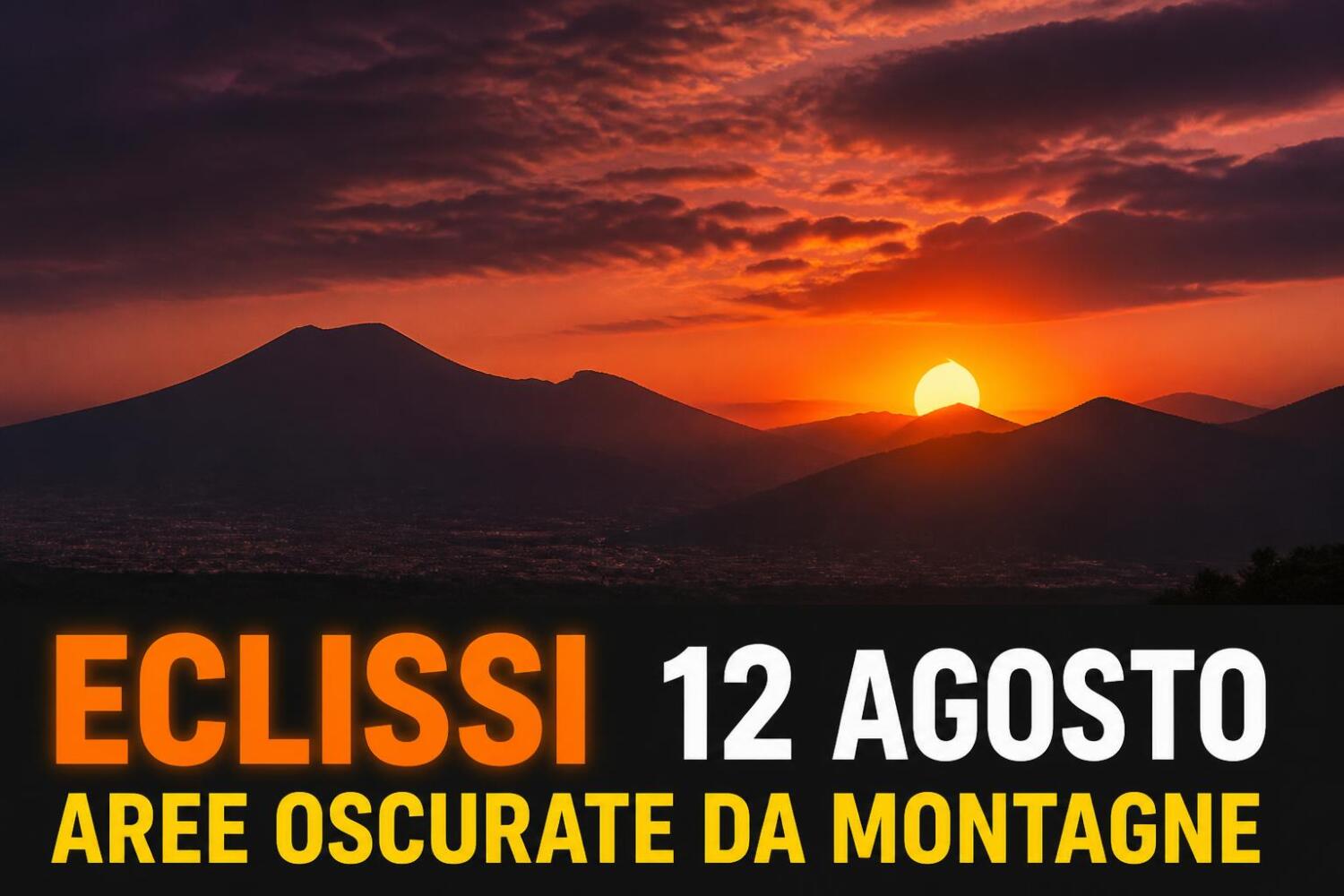
Image created with AI

The partial solar eclipse of August 12, 2026, will be visible at sunset throughout Campania, but with a peculiarity that few astronomical events have: the sun will be so low on the horizon that mountains, hills, and promontories could hide it entirely. A detailed visibility map shows the areas where the horizon is blocked by natural relief. Here's where the sun will be obscured and why.
To better understand the event, we recommend reading the general article on the times and visibility of the eclipse in Campania and the guide to the best areas to see it in Naples.
Why some areas are “blind” to the eclipse
On August 12th, the Sun will set in a west-northwest direction , with an azimuth of about 290-300 degrees. Simply put, to see the eclipse, you need to face that direction and have a clear horizon. If there's a hill, promontory, or mountain in the way, the Sun will have already disappeared before it even officially sets.
The visibility map classifies areas based on the percentage of clear horizon at sunset, on a scale from 0% (completely covered by mountains) to 100% (completely clear horizon). The black and dark purple areas are those with the greatest obstruction.
Critical areas in Campania
Campi Flegrei and western Naples: the blockage of the craters
The most affected area in the province of Naples is the triangle between Quarto, Cigliano, and Pozzuoli . Here, the craters of the Campi Flegrei ( Astroni, Solfatara, Monte Gauro ) and the surrounding hills create a natural barrier to the northwest.
The areas of Qualiano, Marano, Mugnano , and the western part of Giugliano are partially covered. Coroglio and the coastal strip below Posillipo also show dark areas: the Posillipo promontory itself could obstruct the view from below.
The internal Vesuvian area: the volcano as a shield
Mount Vesuvius, at 1.281 meters, is a formidable obstacle for observing the eclipse. All areas to the east and southeast of the volcano are heavily obscured: Ottaviano, San Giuseppe Vesuviano, Terzigno, and Boscoreale are among the worst areas in the region.
Further south, Poggiomarino, Sarno, San Valentino Torio and San Marzano sul Sarno also show large black spots on the map, due to the hilly reliefs that block the horizon to the north-west.
Mount Procida, Miseno and the Phlegraean Coast
At Miseno and Monte di Procida, the map shows dark, pinpoint areas due to promontories blocking the view out to sea. Be careful: even on the coast, not all spots are the same. Rocky promontories can block the sun even a few meters from the sea.
Nolano and Vallo di Lauro: the shadow of the Pre-Apennines
The entire area between Nola, Cimitile, Avella, and Mugnano del Cardinale is highlighted in dark. Here, the Partenio and Vallo di Lauro mountains form a continuous barrier to the northwest. The towns of Lauro, Quindici, and Moschiano are among the most heavily shaded in the province.
The Caserta and Caudino mountains
The largest area of obscuration is in the area between Cervino, Santa Maria a Vico, San Felice a Cancello , and the Caudina Valley . The Partenio and Taburno mountains, with their peaks exceeding 1.300 meters, almost completely block the horizon.
Places like Arpaia, Airola, Rotondi, Cervinara, and San Martino Valle Caudina are completely in the black zone on the map. For those living in these areas, the only option is to move to a higher point with a clear view to the northwest or the Caserta plain.
Summary map of the obscured areas
- West Naples: Fourth, Cigliano, Pozzuoli, Coroglio, Qualiano, Marano, Mugnano
- Vesuvius inside: Ottaviano, St. Joseph Vesuvius, Terzigno, Boscoreale, Sarno, Poggiomarino
- Phlegraean Coast: Miseno, Monte di Procida (point areas)
- Nolan: Nola, Cimitile, Avella, Lauro, Quindici, Moschiano
- Casertano/Caudino: Matterhorn, S.Maria a Vico, Arpaia, Airola, Rotondi, Cervinara, S.Martino VC
Can it be remedied?
Absolutely. Living in one of these areas doesn't mean you're doomed to miss the eclipse. Here are some tips:
- Moving to the coast: It only takes a few kilometers to go from a blocked horizon to a free marine horizon
- Look for high points: a hill with a view to the northwest can solve the problem
- Check with Google Maps: Check the direction of the sunset (NW) and find a spot with a clear view
- Using PeakFinder: The app shows mountain profiles on the horizon from any location
FAQ
Q: If I'm in a dark area, can I see nothing?
A: Not necessarily. It depends on the exact location. The map gives an overview, but there may be spots with a better view on site, especially if you move a few hundred meters.
Q: Do the dark areas change if I move up?
A: Yes, gaining altitude can help overcome the obstacle of nearby hills. A panoramic viewpoint or overlook could be the solution.
Q: How much coverage is there in Caserta?
A: Caserta city has 46% coverage, but be careful of the areas at the foot of the Partenio which could be obscured.
Q: And at the beach, am I always safe?
A: Not always. Some coastal promontories (Miseno, Monte di Procida) can block the sun even from the sea. Always check the exact direction of the sunset.
Q: What happens if the sun is covered by a mountain?
A: The eclipse won't be visible from that spot. The Sun will disappear behind the relief before official sunset, taking the eclipse with it.
Find out more from Napolike.com
Subscribe to receive the latest articles sent to your email.