
Foliage in Campania: where to see autumn
Image created with AI

From mid-October to early November , Campania changes color. The beech forests above 900 meters turn from green to yellow ochre and burnt brown, the chestnut groves glow with rust, and the mountain roads fill with leaves.
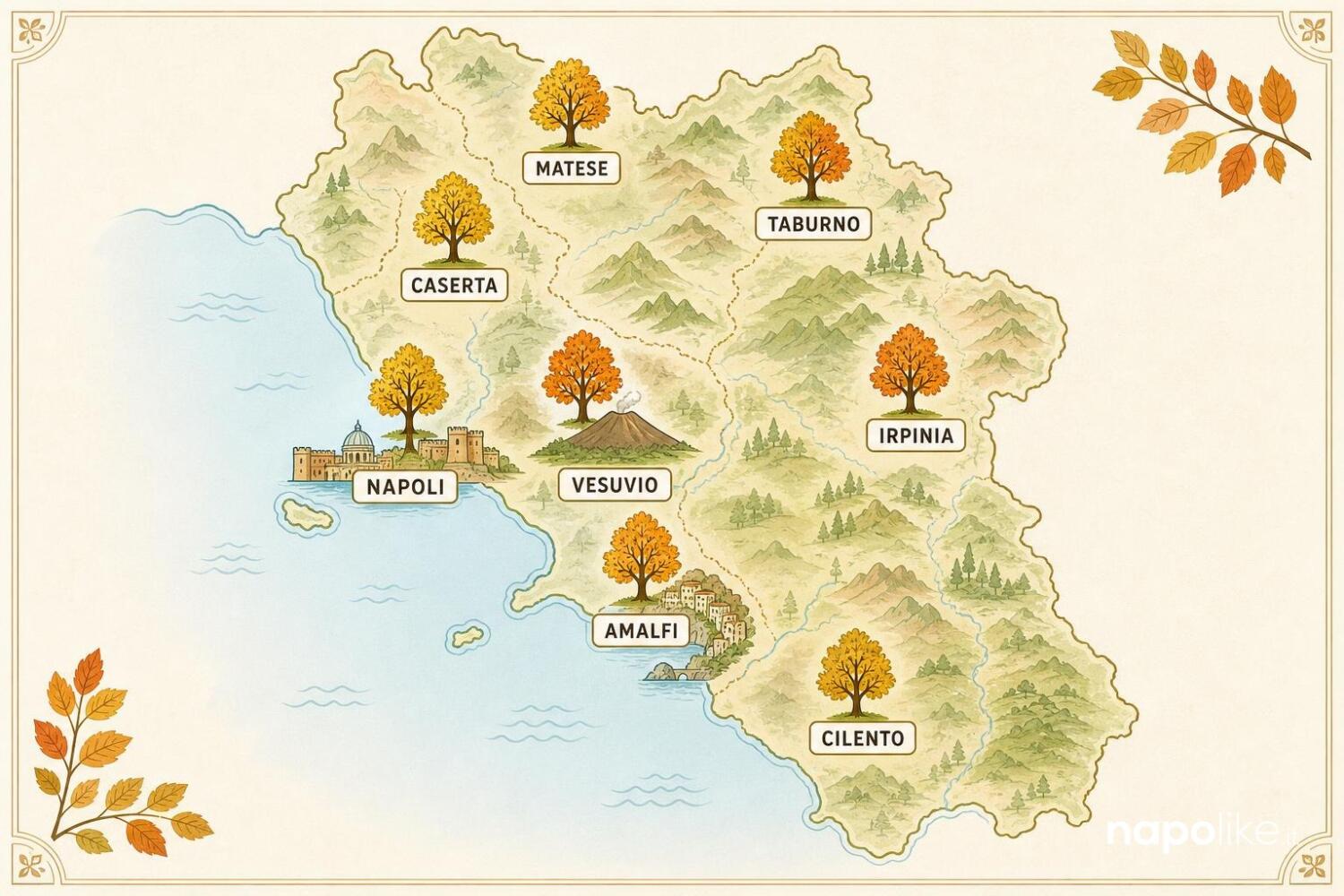
You don't need to go to the Alps. From Naples, it's just an hour and a half's drive to find dense forests, silence, and the crisp sound of leaves underfoot. This guide collects 14 authentic destinations in Campania, with the best time of year, difficulty levels, and practical advice.
The beech forests of Matese and Sannio
1. Beech Forest of Parco d'Amore, Lake Matese
It's the most famous foliage in the region. The trail starts near Lake Matese , in San Gregorio Matese , and climbs from 1.015 to 1.200 meters among tall beech trees and moss.
It's about 5 kilometers and a 2-hour walk, with a 200-meter elevation gain . The forest is called the Park of Love because of the legend of the shepherdess Marianella , and many have carved hearts into the trunks.
- Pro: easy route, almost entirely in the shade, also suitable for children aged 6 7-years.
- Against: Poor signage and limited parking on peak weekends.
Practical tip: Fill your water bottle at the fountain at the start of the trail; the water is drinkable. Start early in the morning and keep your dogs on a leash; flocks of sheep graze in the area.
2. Fontegreca Cypress Grove
In the Matese Regional Park , among the gorges at the foot of Gallo Matese , grows a 70-hectare forest that is unique in the world: the horizontal cypress survives here and almost nowhere else.
The trail begins at the Sanctuary of the Madonna dei Cipressi and runs alongside the Sava River , past small waterfalls and natural pools. In autumn, the undergrowth is red and gold.
- Pro: picnic area equipped with tables, kiosk and toilets, the Zappini Woods it is within everyone's reach.
- Against: Tables and braziers are subject to charges and open fires are prohibited; rates change seasonally.
Practical tip: Book a table and check the latest opening hours and prices on the Cipresseta website before you leave; the Arboretum with children's playground is 500 meters from the entrance.
3. Camposauro Beech Forest, Taburno-Camposauro
The Taburno-Camposauro Regional Park , in the Benevento area, is a candidate for UNESCO recognition and in autumn offers beech, oak and chestnut trees on steep slopes.
The Camposauro beech forest can be reached via trails marked by the CAI Benevento , starting from Sant'Agata de' Goti and the hamlets of Vitulano. The highlight is the ridge, where the forest opens onto the valley.
- Pro: Catalogued trails and maps available on the park authority website.
- Against: Some sections are exposed and slippery with wet leaves.
Practical advice: choose the lower routes if it rains in the previous days and download the track before climbing, as coverage at high altitudes is sometimes lacking.
The colors of Irpinia and the Picentini Mountains
4. Laceno Lake Ring
Lake Laceno , at around 1.100 metres in the municipality of Bagnoli Irpino , is the most convenient base for foliage in Irpinia.
The loops around the basin pass through beech forests and clearings: you can do it in half a day or a full day, extending towards the highest altitudes of the Picentini Mountains.
- Pro: Modular routes, ideal for those who just want to walk in the woods.
- Against: mud in areas with little sun and reduced daylight hours in November.
Practical tip: start from the lake area and make a loop, so you don't go over the same stretch twice; poles are useful for the descent.
5. Verteglia Plan, Bagnoli Irpino
The Piano di Verteglia plateau alternates chestnut and beech groves, with wide forest roads and gentle slopes. It's the perfect choice for families and first-time hikers.
The change in vegetation is the best clue to orient yourself: the chestnut tree gives an airier forest, the beech tree a more humid air and low light already in the afternoon.
- Pro: regular bottom and ample possibilities for circular turns.
- Against: landscape less spectacular than the ridges, many points resemble each other.
Practical tip: use a plateau or clearing as a reference point and set a turnaround time for your return; darkness comes early.
6. Hunting Valley and Senerchia Waterfalls
In Senerchia , in the province of Avellino , the foliage sounds like water. The Valle della Caccia is a shady valley with waterfalls as a constant backdrop to the walk.
Here the vegetation is thick and the trail remains wet for a long time: stone, moss, and slippery sections. The view is internal ; you don't look far, you look close.
- Pro: unique atmosphere, bright colors even on overcast days.
- Against: to be postponed after heavy rains, the fords are loaded.
Practical advice: Wear shoes with grippy soles and a short stride on wet sections; a stable day after a few sunny days is best.
7. Montevergine Beech Forest, Partenio Park
The Partenio Regional Park covers the mountains above Mercogliano and Avella . Above the Montevergine Sanctuary , at about 1.270 meters , the beech trees form a dense, silent beech forest.
From the sanctuary, paths lead to Campo Maggiore and the Sedia della Madonna , with views of the gulf on clear days.
- Pro: easy access to the sanctuary, woods reachable in a short time.
- Against: crowded on Sundays in October and November.
Practical advice: leave your car at the sanctuary and walk upwards, the best colours are in the range between 1.300 and 1.450 metres.
The foliage in Cilento
8. Alento River Oasis, Prignano Cilento
In Prignano Cilento , along the SS18 at the Diga Alento exit, the Oasi Fiume Alento is the most organised starting point for the Cilento foliage.
The area offers lakeside trails, a restaurant, and accommodations. The 2026 season restarted in March , and activities continue in the fall with guided tours and walks.
- Pro: complete services, easy routes suitable for children.
- Against: Entrance fees and activities are subject to a fee, with reservations recommended.
Practical tip: call 0974 837003 or book online to confirm opening times for your chosen day.
9. High beech forests of Mount Cervati
Mount Cervati , 1.898 meters , is the highest peak in Cilento . Above the Turkey oak and chestnut forests, beech forests and pastures open up, with classic access from Sanza and the Piaggine plain.
In autumn, the shadier slopes retain their color longer, while the ridges lose their leaves earlier. The days are short and the weather changes quickly.
- Pro: Open landscapes and true altitudes, a complete mountain experience.
- Against: long approach by car and little-used paths during the week.
Practical advice: leave early, bring a rain jacket even in sunny weather, and share your itinerary; phone reception is patchy at high altitude.
The foliage near Naples and Caserta
10. Vesuvius National Park
Vesuvius isn't just a crater. On Mount Somma and along the Valle dell'Inferno, the chestnut and downy oak forests turn yellow between October and November.
The most famous trail remains the Gran Cono , with tickets and reservations required on weekends. The low altitudes and mild climate make the season longer than in the Apennines.
- Pro: Half an hour from Naples, an unrepeatable volcanic landscape.
- Against: regulated access and crowding during peak hours.
Practical tip: book your ticket online and go up between 8:00 and 10:00 , you'll find fewer people and better light for photos.
11. Royal Wood of Capodimonte
In Naples , the Real Bosco di Capodimonte is the urban foliage par excellence: over 100 hectares of holm oaks, plane trees and historic gardens above the Museum and Real Bosco.
The wide avenues and panoramic climbs make walking easy even with children or a stroller.
- Pro: Free admission, accessible by public transport, no equipment required.
- Against: it's not a mountain beech forest, the colors are more discreet.
Practical advice: enter from the Porta Grande portal and go up towards the Real Fagianeria , then finish at the belvedere overlooking the gulf.
12. Park of the Royal Palace of Caserta
The park of the Royal Palace of Caserta measures approximately 120 hectares : tree-lined avenues, woods and the English Garden with exotic plants that turn red in autumn.
The path between the Diana fountain and the upper pools is long but entirely flat or slightly uphill, with benches and rest areas.
- Pro: UNESCO heritage site, perfect to combine with a visit to the royal apartments.
- Against: The park ticket is paid separately, the walking distances are considerable.
Practical tip: rent a bike at the park entrance: cover the long avenues without missing the English Garden.
The foliage on the coast
13. Valley of the Ferriere, Amalfi
The Valle delle Ferriere is a nature reserve between Amalfi and Scala , with prehistoric ferns such as Woodwardia radicans and perennial waterfalls.
You can enter on foot from Pontone or from the center of Amalfi, with circular itineraries that touch on the ancient ironworks and cultivated terraces.
- Pro: humid microclimate, greenery that remains alive even in November.
- Against: regulated access and steep paths, with temporary closures possible.
Practical tip: Check locally which itineraries are open and depart from Pontone to avoid the most crowded Amalfi stairways.
14. Mount Faito and the Lattari Mountains
Mount Faito , 1.131 meters high , dominates the Sorrento Peninsula. It can be reached by car or public transport from Castellammare di Stabia and offers beech and chestnut groves and views of the gulf.
The plateau is full of easy trails and scenic spots, so it's a quick destination for an autumn afternoon.
- Pro: viewpoints accessible even without walking far.
- Against: Many businesses and shelters close out of season.
Practical advice: leave in the early afternoon to arrive at sunset, as fog is common at high altitude and slows the descent.
How to organize a foliage trip
For autumn 2026, the best time is from mid-October to the first half of November . Above 1.200 meters, the peak arrives earlier, between late September and October, while lower altitudes maintain their color until early November.
Always check the weather forecast, choose hiking shoes with grippy soles, and pack a warm layer and a rain jacket. November days end early: plan your return with plenty of daylight.
To complete your day in the area, you can combine it with a visit to Campania's educational farms or a stop at a winery along the wine routes.
FAQs about foliage in Campania
What's the best time for foliage in Campania?
The peak season lasts from mid-October to the first half of November . In the Matese and Cilento areas , the color begins earlier, around the end of September, because the beech forests are higher up.
Where can you see the foliage closest to Naples?
The quickest destinations are Vesuvius National Park , the Royal Forest of Capodimonte , and the Partenio Park above Mercogliano. All can be reached in less than an hour.
Do you need a car for foliage viewing in Campania?
For Capodimonte and the Royal Palace of Caserta , no; regional trains are sufficient. For Matese , Irpinia , and Cilento, a car is practically essential, preferably shared.
What to pack for a fall hike?
Hiking shoes, a warm layer, a rain jacket, water, snacks, and a flashlight. Hiking poles are also useful , especially with wet leaves.
Is foliage in Campania suitable for children?
Yes, with the right destinations: Parco d'Amore , Piano di Verteglia , Oasi Fiume Alento , and Capodimonte have short trails and smooth surfaces. It's best for children aged 6-7 years old to follow the beech forest trails.
Read also
If you want to stay on the nature theme , read the guides on the Picentini Mountains , the Taburno Park and the Gran Cono trail.
To broaden your horizons, here are 10 natural parks in Campania and the most beautiful trails in Campania ; if you love water and gorges, discover the Montella and Cassano Irpino waterfalls.
For the table, here's how to recognize real DOP buffalo mozzarella.
Find out more from Napolike.com
Subscribe to receive the latest articles sent to your email.