
Navigard 2027: New highway controls are coming: how they work and what fines you risk.
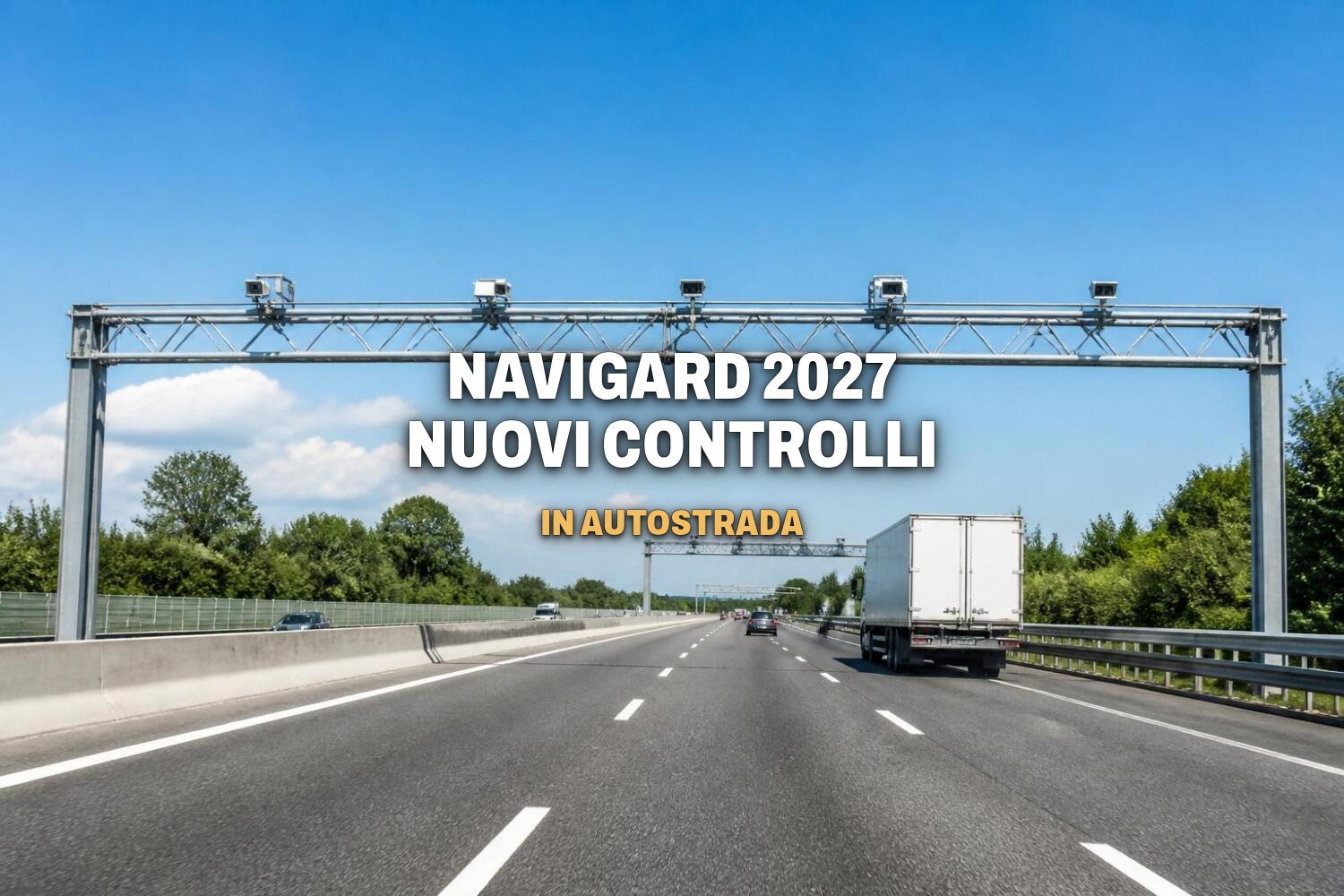
Image created with AI

Navigard is the platform with which Autostrade per l'Italia and the State Police intend to change the way highways are controlled. It's not a single speed camera, but a system that integrates radar, cameras, sensors, and artificial intelligence. Its rollout is planned gradually starting in 2026 , with an extension to the ASPI network by 2027.
What is Navigard?
Navigard is a technology platform developed by Movyon , the technology hub of the Aspi group. It was born from the collaboration between Autostrade per l'Italia and the Italian State Police and was presented on December 9, 2024. Its purpose is to collect and cross-reference data from various devices to report dangerous behavior and violations.
The system doesn't replace officers, but it does provide traffic police with a more comprehensive view of what's happening on a stretch of highway. The logic is that of a digital eye that works continuously, even when no patrols are visible.
When it comes into operation
The rollout will not be immediate and will not cover all Italian motorways at the same time. The plan calls for the first sections to be active in 2026 and coverage of the network managed by Autostrade per l'Italia by 2027. Sections operated by other concessionaires remain outside this timetable, unless otherwise agreed.
It's important to distinguish between the installation and operation phases. A system can be assembled and tested without being immediately operational due to sanctions. Therefore, the dates should be interpreted as a progressive process, not as a single switch flipped on across the entire peninsula.
How it works
The platform combines radar, cameras, edge servers, and a central system . The collected data is analyzed by algorithms that reconstruct the vehicle's speed, location, and behavior. The result is a report that the police can verify and contest.
Navigard calculates both the average speed over a stretch of road and the instantaneous speed at specific points. This means that simply slowing down at a gate isn't enough: it also takes into account the driving behavior along the entire monitored route. The system can also verify lane compliance and the requirement for heavy vehicles to keep to the right.
Another function concerns tunnel safety . By 2026, sensors and cameras with artificial intelligence algorithms should detect wrong-way vehicles and obstacles in tunnels longer than 500 meters . These are scenarios where a few seconds of delay can make a difference.
Then there are checks on heavy vehicles. Using dedicated antennas, Navigard collects tachograph data and verifies compliance with weight limits. The system can also track vehicles carrying dangerous goods and report any deviations from permitted routes.
What can it detect?
The duties indicated by official and industry sources primarily concern speed , lane compliance , overtaking heavy vehicles , driving in the wrong direction , and the presence of obstacles or stationary vehicles . These also include checks on mass, tachographs, and dangerous goods.
Some newspapers have also attributed Navigard with detecting cell phone use and seatbelt use. Caution is warranted here: these functions are often associated with intelligent speed cameras and systems like SafeDrive, but they have not been confirmed with the same level of detail for Navigard. We discuss this in detail in a dedicated article.
What fines are at risk?
Navigard doesn't invent penalties: it applies the Highway Code . Article 142 establishes specific speeding limits. For speeding up to 10 km/h over the limit, the fine ranges from 42 to 173 euros . Between 10 and 40 km/h, the fine increases to 173 to 695 euros , with 3 points deducted from your license.
If you 're going 40 to 60 km/h over the limit, the fine ranges from €543 to €2.170 , with six points and a license suspension of one to three months. If you're going over 60 km/h , the fine goes up to €845 to €3.389 , with ten points and a license suspension of six to twelve months. These fines make it worthwhile to stay within the speed limit for the entire trip, not just at the speed limit gate.
For heavy vehicles, overtaking and driving in unauthorized lanes can be contested according to specific regulations. Overtaking generally carries a fine ranging from €167 to €665 and the deduction of three points . Driving against the flow of traffic is among the most serious violations and can result in very high fines, as well as license suspension in certain cases.
What changes for drivers
The main change is the continuity of control . Those accustomed to slowing down near speed cameras will have to adopt a regular driving style for the entire duration of their journey. Average speed, lanes, and the behavior of heavy vehicles are interpreted as a whole, while the page on traffic and transport in Naples remains useful for local updates.
Another factor is tolerance . A 5% margin is generally applied to speed, with a minimum of 5 km/h. This is not an invitation to exceed the limit, but a technical correction related to the measuring instruments. Responsibility always remains with the driver.
Finally, there's the issue of transparency . Images and data must be treated in accordance with privacy regulations and retained for the time necessary for the investigation. Anyone receiving a fine can request to see the supporting evidence and consider appealing if they believe the detection was incorrect.
FAQ
Navigard replaces the Tutor
Yes, on the routes managed by Autostrade per l'Italia it is expected to replace the Tutor, integrating the functions of the old system.
When it will be active on all highways
ASPI network coverage is expected to be completed by 2027. Motorways operated by other concessionaires are not automatically included in this timetable.
Navigard fined for cell phone use too
The technology can capture images of the passenger compartment, but automatic fines are not permitted for cell phones and seat belts: a direct inspection by an officer is required.
How much do you pay for speeding?
From 42 to 173 euros up to 10 km/h, from 173 to 695 euros between 10 and 40 km/h, with higher amounts and license suspension above 40 km/h.
You can appeal a Navigard fine
Yes, as with any administrative penalty. It's a good idea to check the report, images, and the instrument's approval before appealing.
Find out more from Napolike.com
Subscribe to receive the latest articles sent to your email.