
Why do we drink new wine on St. Martin's Day?
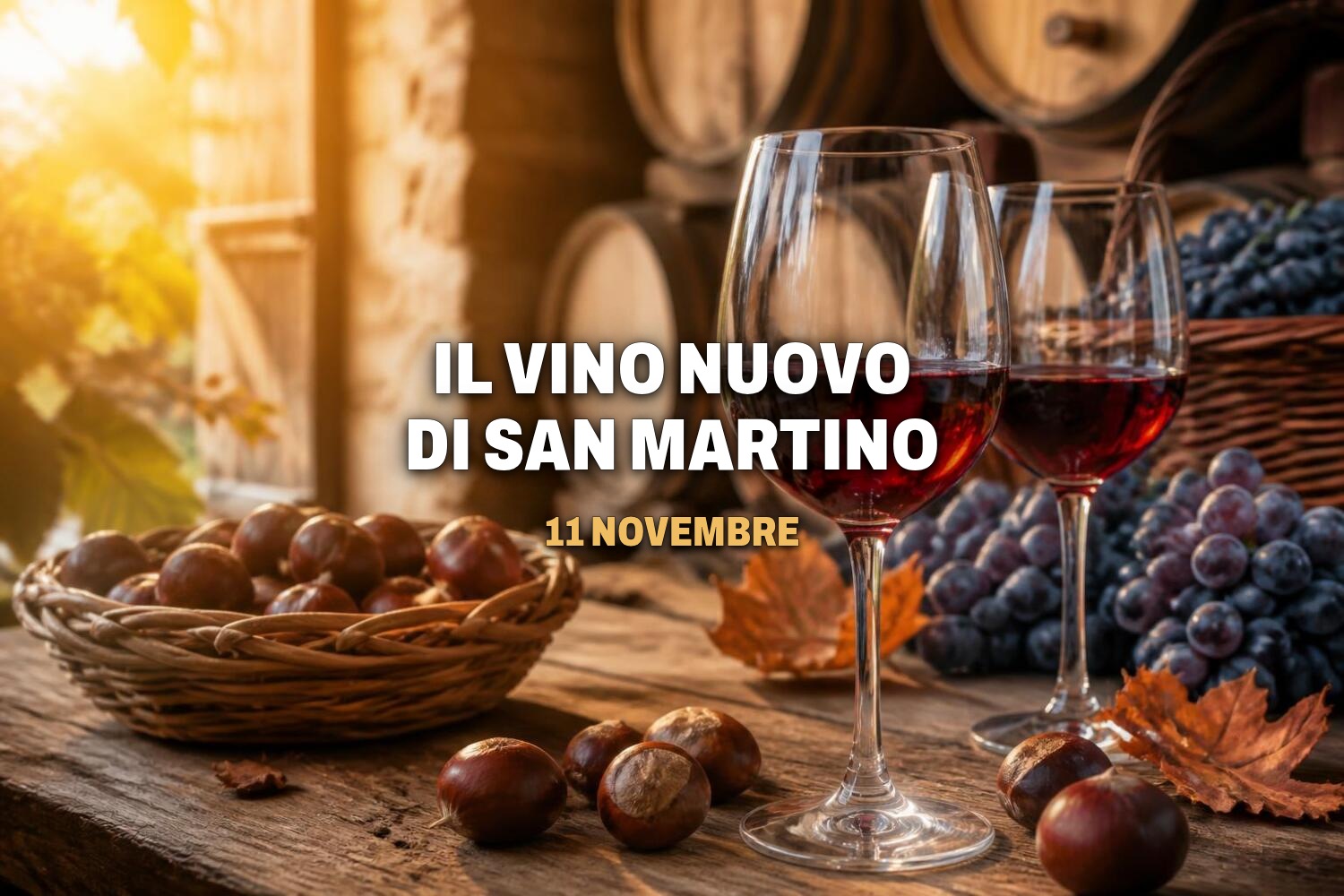
Image created with AI

Every November 11th, in the Italian countryside, the same scene repeats itself: the barrel is opened, the glass is filled, and the new wine is toasted. The proverb sums it up perfectly, because on San Martino, all must becomes wine. It's not a magic formula, but rather the moment when autumnal fermentation reaches completion. In Campania, where Aglianico ripens late, the date has a very special meaning.
Why the Wine Festival falls on November 11th
The date was not chosen at random. Martin of Tours died in Candes on November 8, 397, and was buried in Tours three days later, on November 11: ever since, the Church has commemorated him on that day. He was born around 330 in Pannonia, now Hungary, to pagan parents, and from 371 he was bishop of Tours. His figure became immensely popular throughout Europe, so much so that his name was linked to one of the most heartfelt autumn holidays.
The story everyone knows is that of the cloak. Outside Amiens, the young soldier saw a poor man shivering with cold and cut his own military cloak in two with his sword to cover him. The next night, according to the story, Christ appeared to him in a dream, wrapped in that half of the cloth. This episode is reported by Sulpicius Severus in his Vita Martini , a hagiographical text: it should be read as a traditional account, not as a chronicle.
The sun rising after the cloak
The expression "Saint Martin's Summer" has also been linked to the legend. Around November 11th, a rising high pressure often brings clear, mild days to the Mediterranean, with temperatures above the seasonal average. The phenomenon has a precise meteorological explanation—the anticyclone—but the name remains linked to the tale of the cloak and the sun that, according to tradition, returned to warm the saint after his charitable act.
What really happens inside the barrel
At the end of the harvest, the must is a sweet, cloudy liquid, rich in sugars. The yeasts convert it into alcohol and carbon dioxide, and alcoholic fermentation usually concludes within two or three weeks of pressing. This is the time for the first racking, when the wine separates from the lees and begins to reveal its character. Those who work in the cellar know this: November is the month to taste the result.
This is why the proverb isn't merely poetic. The November 11th deadline naturally fell at the end of the cycle, when the must had stopped boiling and the first wine of the year could be drunk. Before refrigeration and selected yeasts, timing was dictated by the climate: a cold October slowed everything down, a mild autumn sped it up. The date of Saint Martin thus served as a collective reference point, the same for everyone.
New wine and novello wine are not the same thing
In everyday language, the two expressions are used synonymously, but from a regulatory perspective, they are not. New wine is simply the wine from the latest harvest, freshly made. Novello wine, on the other hand, is a specific type, regulated by the decree of the Ministry of Agricultural Policies of August 13, 2012. Only wines with a designation of origin or geographical indication that require such mention in their specifications can use the term.
The rules are strict and worth knowing. Vinification cannot last less than ten days , at least 40 percent of the batch must be made from fermentation with carbonic maceration of the whole grapes, the minimum alcohol content is 11 percent , and residual sugars cannot exceed 10 grams per liter . Release for consumption is set at 0,01 on October 30th , and the product must be packaged by December 31st of the harvest year.
Carbonic maceration, explained simply
In carbonic maceration, the whole bunches of grapes are placed in a tank saturated with carbon dioxide, without being pressed. Deprived of oxygen, the grapes ferment internally and develop aromas of red fruits, banana, and caramel. This method gives Novello its immediate and fragrant profile, but also its poor aging potential. The result is a wine best enjoyed young, not cellared for years.
The agricultural new year that explained the celebration
For centuries, November 11th wasn't just a religious holiday. It was the day when agricultural contracts expired, farm leases were renewed, and accounts were settled between owners, sharecroppers, and workers. The agricultural year ended with planting and began again immediately afterward, and Saint Martin marked the watershed. For many peasant families, it meant changing house, land, and owner on the same day.
This is where the convivial nature of the holiday comes from. Those who stayed celebrated the end of the work, those who left did so with a glass in hand, and the table was filled with what autumn had to offer. Sharecropping was abolished by Law 756 of September 15, 1964 , which prohibited the signing of new contracts, but the custom of toasting San Martino remained. Today, the holiday has lost its contractual function and retained its social one.
What people drink in Campania around San Martino
Campania arrives in November with the wineries still buzzing. Falanghina and Coda di Volpe are harvested as early as late August, while Aglianico, especially in Irpinia and the Taburno area, ripens between October and November. In the hilly areas, the harvest is extended, and the first wine arrives later, right around the time of the festival. The farming and winemaking calendars thus end up coinciding, as our guide to the grape harvest in Campania explains.
Regional regulations also specify the type. The Campania Typical Geographical Indication regulations specify "Campania" Novello , with a minimum alcohol content of 11,5% . Alongside the reds made from Aglianico and Piedirosso, there are the lighter and more fragrant whites made from Falanghina. In the Sannio area, in Castelvenere, the tradition of Novello is accompanied by chestnuts and grottone, the town's typical cured meat, as in the Castelvenere Novello festival.
The right glass for the novello
The Novello Rosso is served at around 14-16°C , slightly chilled, in a large glass that allows the fruit to breathe. The white wine is best served between 10 and 12°C . It should be drunk within a few months, because the tannins and acidity are low and the wine oxidizes quickly. At the table, it works well with roasted chestnuts, cured meats, fresh cheeses, and traditional autumn dishes.
Why Italian Novello Arrives Before Beaujolais
Italian new wine has an earlier release date than its French cousin. In France, Beaujolais nouveau arrives on the third Thursday of November, a few days after San Martino. In Italy, the deadline is October 30th, which explains why wine shops display the first bottles as early as the beginning of November. Anyone wanting to taste it on San Martino, in short, has almost two weeks to spare.
Frequently asked questions about San Martino wine
When can you drink new wine?
From October 30th , at 12:01 a.m., for wines listed in the specifications. November 11th is the traditional date for the celebration and the first toast, but the bottles have already been on sale for almost two weeks.
What is the difference between novello wine and new wine?
New wine is any wine from the latest harvest. Novello is a regulated category, with vinification times, carbonic maceration, and alcohol and sugar limits established by law.
How much alcohol does new wine have?
The national minimum is 11 percent . The "Campania" Novello starts at 11,5 percent , a moderate alcohol content that makes the glass easier to drink.
Why is it said that on San Martino the must becomes wine?
Because in November, alcoholic fermentation is complete and the wine can be racked. The saying comes from a specific agricultural calendar, not from a miracle of the saint.
New wine can be aged
No, it should be drunk within a few months of harvest. Carbonic maceration enhances fruitiness and freshness, but leaves the wine low in tannins and therefore unsuitable for storage.
Because St. Martin's Day was the agrarian New Year
Because on November 11th, sharecropping and farm lease agreements expired. The farmers renewed their agreements or moved, and in the evening they celebrated with new wine and chestnuts.
For those who want to continue their journey through the vineyards, the map of Campania's wine routes is the perfect starting point for organizing a winery visit on weekends in November.
Find out more from Napolike.com
Subscribe to receive the latest articles sent to your email.