
The Neapolitan Republic of 1799: the five-month dream of freedom
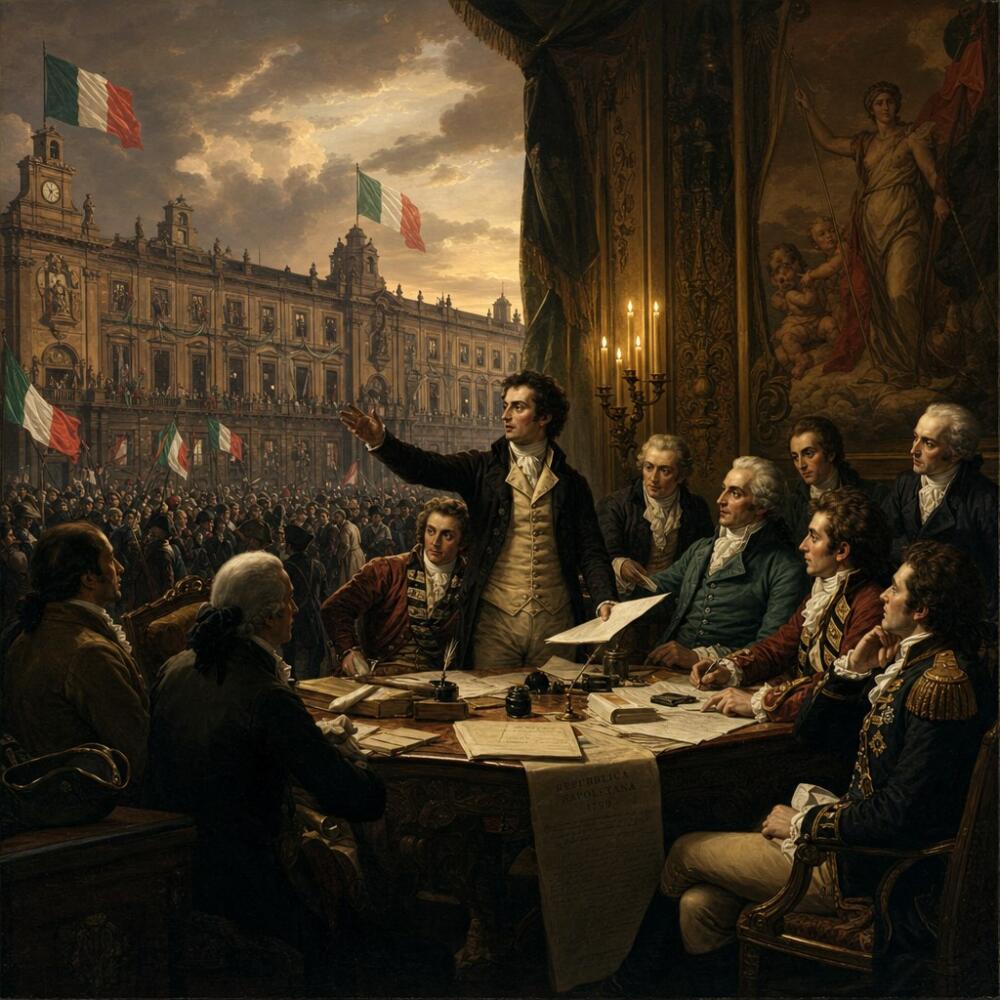
Image created with AI

A revolutionary experiment in the heart of the Mediterranean
The Neapolitan Republic of 1799 represents one of the most extraordinary and tragic chapters in Italian history. For just five months , between January 23 and June 13 , Naples existed as an independent state, governed by enlightened intellectuals, progressive nobles, and democratic artisans.
The historical context: when the French Revolution came to the South
On January 8, 1799 , French troops led by General Championnet entered Naples after months of siege. King Ferdinand IV of Bourbon and his wife Maria Carolina had already fled to Palermo, protected by Lord Nelson's British fleet.
On the same day, in the ancient Palazzo San Carlo (now the Prefecture), the Parthenopean Republic was proclaimed . Its founders were mainly:
- Julius Castles, doctor and Jacobin patriot
- Vincenzo Cuoco, philosopher and essayist
- Michael Rebecchini, lawyer and representative of the bourgeoisie
- Achille de' Ralli, Greek-Neapolitan shipowner
- Filippo Miura, noble reformer
The five months of republican life
The Republic adopted a constitution inspired by the principles of the French Declaration of the Rights of Man and of the Citizen of 1789. The main innovations included:
- Abolition of feudal privileges
- Freedom of the press and of worship
- Establishment of a central government
- People's courts for justice
- Public education system Free
The monarchist opposition: Sanfedists and barricades
While the intellectual class supported the Republic, much of the Neapolitan population was hostile. Religious worship , closely linked to the Bourbons, made the population resistant to the "atheistic" French revolutionary ideas.
Cardinal Ruffo , Archbishop of Santa Severina, organized the Sanfedista Armata (or “Holy Faith”), an army of peasants, shepherds, and fishermen led by Franciscan monks. Between April and May 1799 , these groups laid siege to the Republican neighborhoods.
The Fall and the Repression: Blood on the Streets of Naples
On June 13, 1799 , after months of house-to-house fighting, the Republic fell. The revenge was bloody:
- Over 200 Republicans executed publicly
- Palazzo San Carlo looted completely
- Archives destroyed with unique historical documents
- Naples under total military control
Francesco Pignatelli , a Bourbon general, ordered summary executions in Piazza del Plebiscito and in the Borgo Carità district . Among the famous victims were:
- Dominic Cirillo, director of the Royal Botanical Garden
- Roberto Fioretti, jurist and philosopher
- Angelo Portanova, lawyer
- Don Michele Morelli, priest and patriot
Nelson's Treason: When England Betrayed the Republicans
Admiral Horatio Nelson , an ally of the Bourbons, played a controversial role. He promised amnesty to the republicans who had taken refuge on the English frigate Minerva , only to later deny them asylum and hand them over to their deaths. This gesture is still the subject of historical debate among English and Italian scholars today.
The Forgotten Legacy: Why Study the Neapolitan Republic?
Many school textbooks completely ignore this period. Yet, the Neapolitan Republic was:
- The first attempt at modern democracy in the South
- An experiment of advanced social for the time
- A moment of national consciousness pre-unification Italian
Furthermore, the ideas promoted during those five months — equality of citizens , separation of powers , public education — anticipated by decades what would become the basis of the unitary Italian state.
Places of the Republic in Naples today
Some places remain linked to that historical experience:
- San Carlo Palace — seat of the Republic; today it houses the Prefecture
- Borgo Santi Apostoli —neighborhood where the Republicans concentrated
- Monastery of the Poor Clares —where the defenders of the Republic took refuge
- Cemetery of the Fontanelle — burial place of some martyrs
HISTORICAL CURIOSITIES
The Republican Press
The Republic published newspapers such as “ Il Monitore Napoletano ” which spread news in real time. It was the first experience of modern journalism in Naples.
Symbols and colors
The Republicans adopted a flag with three colors: white, green, and red — already present in previous centuries, but which here symbolically anticipated the Italian tricolor of 1848.
The female figure
Women played a significant, albeit unofficial, role. Antonia Tonini , Pia Sacco , and other women actively participated in the defense and organization of military hospitals.
Vincenzo Cuoco and the “Historical Essay”
After the fall, Vincenzo Cuoco wrote " Historical Essay on the Neapolitan Republic of 1799 ," one of the first historical essays in Italian. The book remains fundamental to understanding that experience.
FAQ — Frequently Asked Questions
How long exactly did the Neapolitan Republic of 1799 last?
Five months and nineteen days: from January 23, 1799 (official proclamation) until June 13, 1799 (final fall).
Why did the Neapolitan Republic fail so quickly?
The main causes were: lack of popular support , hostility of the clergy , lack of a professional army , Nelson's treason , and internal divisions among the republicans themselves.
What is the human toll of repression?
Historical estimates indicate around 200-400 summary executions , in addition to thousands of arrests and imprisonments without trial. Many republican families lost everything.
Is there a street or monument in Naples dedicated to the Republicans?
Yes: there is Via dei Repubblicani in the San Giuseppe neighborhood, and a plaque was recently dedicated to the Monument to the Martyrs of '799 in Piazza Dante.
Which Republicans survived the repression?
Vincenzo Cuoco , Gennaro de Crescenzo , and Giovanni Maria Angioy managed to escape abroad. Others hid for years in the Campania countryside.
Was French influence important in the birth of the Republic?
Absolutely. The French Revolution of 1789 directly inspired Neapolitan patriots, many of whom had been educated in Paris or through French texts.
Are there any surviving original documents from the Republic?
Yes: several copies of Cuoco's Historical Essay , some private correspondence, and fragments of republican newspapers are preserved at the National Library of Naples.
Can the Neapolitan Republic be considered a precursor of the Risorgimento?
Many historians agree that she was an ideal bridge between the Enlightenment and the Risorgimento. Mazzini himself cited her as an example of patriotic sacrifice.
Why is this episode little known at school?
For reasons of post-unification political balance : the new Italian state preferred to celebrate Italian unity rather than anti-monarchical revolutionary experiences. Furthermore, many sources were lost.
Find out also
Find out more from Napolike.com
Subscribe to receive the latest articles sent to your email.