
The Terra District of Pozzuoli: How to Visit It
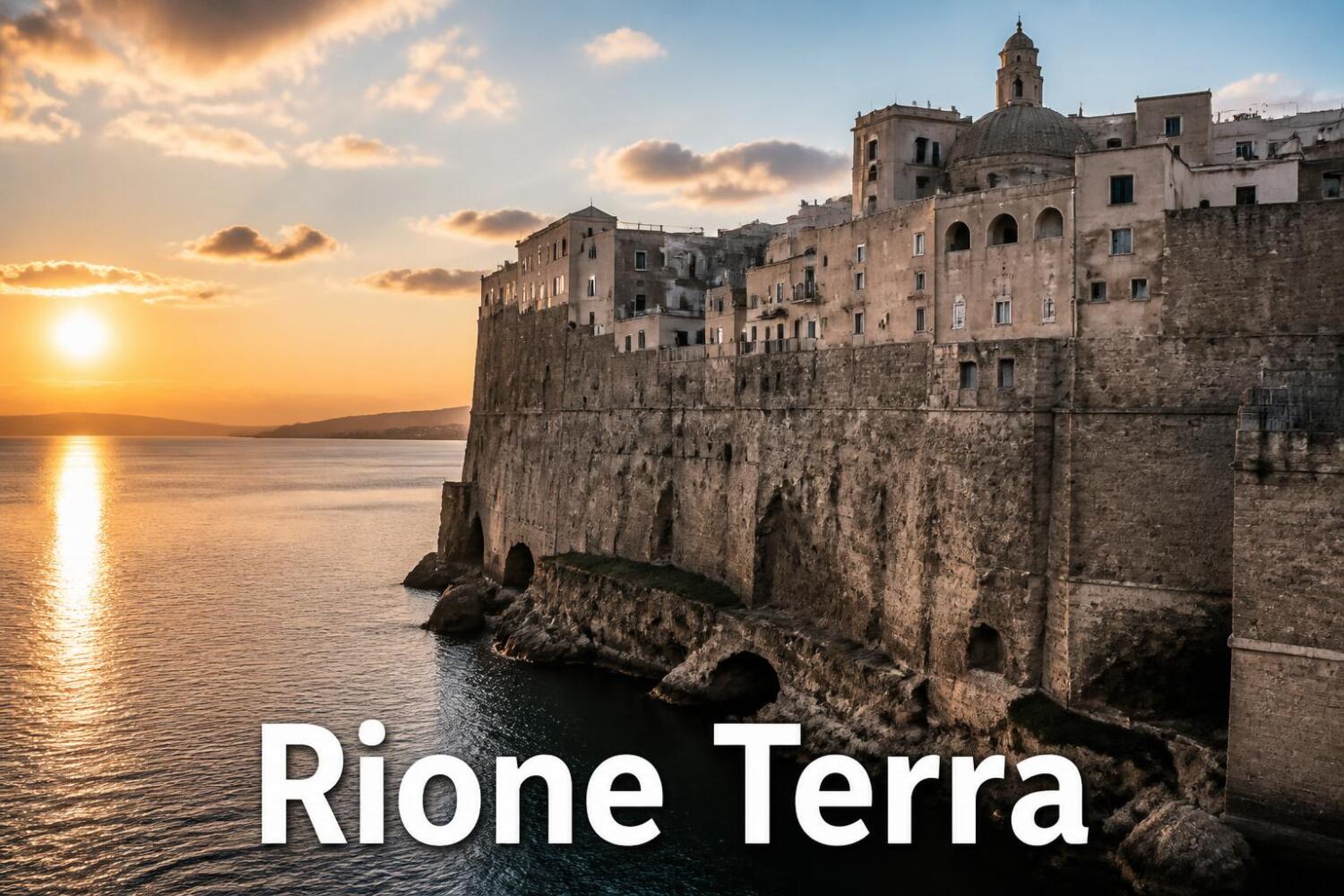
Image created with AI

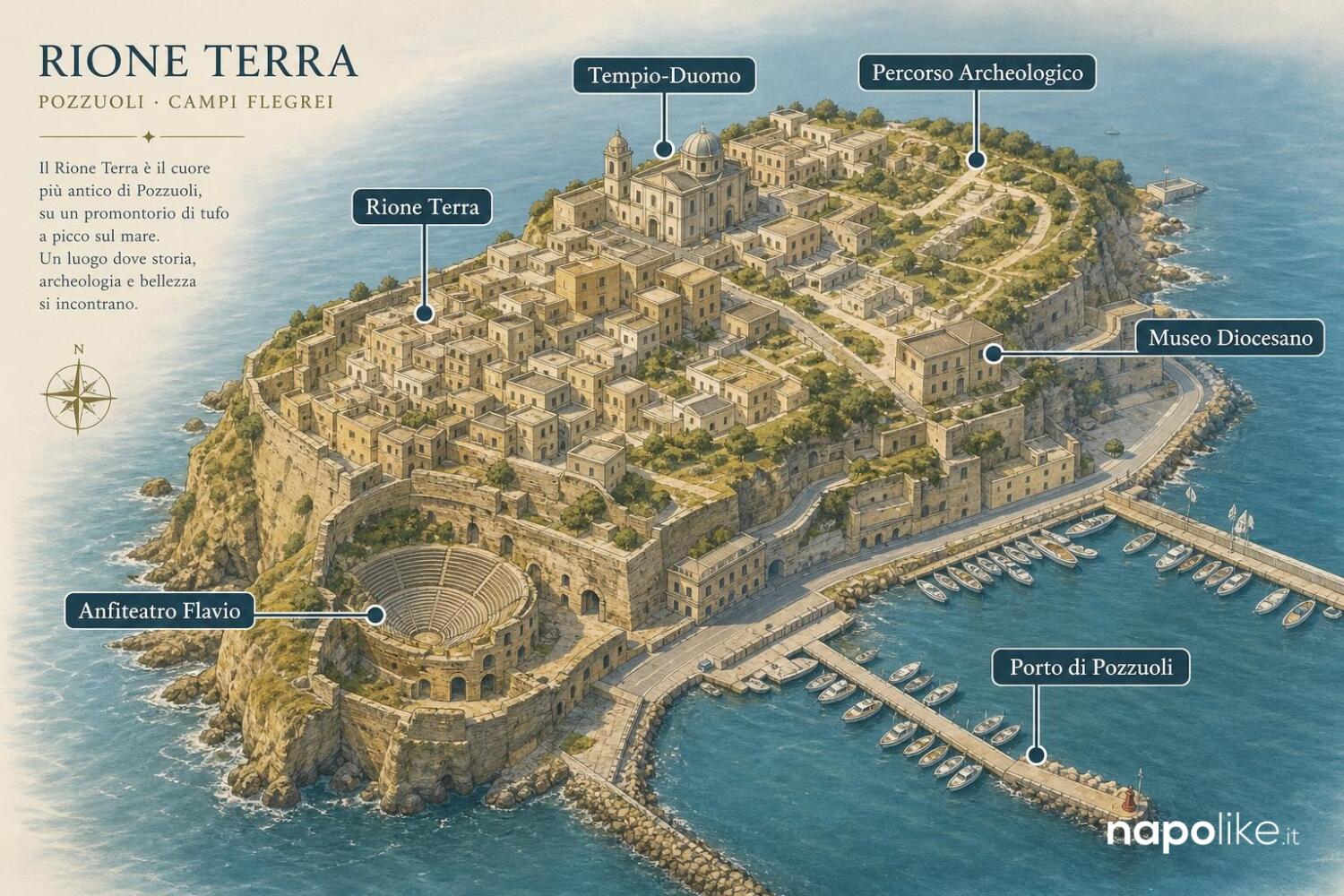
The Rione Terra is the oldest heart of Pozzuoli : a tuff rock that stretches out over the sea and which, seen from the port, seems like a village suspended in time.
The city was born here: first the Greek acropolis of Dicearchia , then the Roman colony of Puteoli , the commercial port that supplied Rome.
Today the neighborhood has been uninhabited since 1970, but it houses an underground archaeological route, the Temple-Cathedral of San Procolo and the Diocesan Museum.
This guide explains what to see, how to get there, and how visits work, with an important update on the current situation.
Update: Is Rione Terra open or closed?
Update September 2026: After the strong seismic swarm of July 31, 2026, the Rione Terra is closed to the public.
Inside, the former town hall, the Tempio-Duomo and Palazzo Migliaresi , the building that hosted exhibitions and cultural events, have been declared unfit for use .
Guided tours of the Puteoli Sacra project are therefore suspended, along with those of the municipal archaeological trail.
Pozzuoli is facing a serious emergency, with thousands of displaced people and hundreds of buildings requiring inspection: the reopening of the Rione Terra district will only occur after security checks.
Before planning your trip, always check the official channels of the Municipality of Pozzuoli and Puteoli Sacra.
All the information on opening hours, routes, and tickets below refers to normal opening hours and is useful for planning your visit as soon as the site is accessible again.
What is Rione Terra: a brief history
The Rione Terra occupies the tuff promontory that separates the port of Pozzuoli from the Via Napoli seafront, surrounded by the sea on three sides.
The Roman urban layout followed an orthogonal grid, with the decumanus maximus on the current Via Duomo and the cardo maximus on Via del Vescovado.
Puteoli was long the most important port in Italy: ships carrying Egyptian grain and goods destined for Rome passed through here, before Ostia took over.
The neighborhood enjoyed centuries of wealth, with shops, warehouses, and stately homes built directly on the tuff.
The city was evacuated on March 2, 1970 during a bradyseismic crisis, and definitively after the 1980 Irpinia earthquake.
Since then, the village has remained walled and empty, while the ground continued to rise: at the Rione Terra GNSS station, the rise since 2005 has exceeded one and a half meters.
The restoration of recent years, financed with European, regional and state funds, aimed to transform the village into a widespread hotel and to prepare it for major city events, such as the America's Cup sailing event scheduled in Bagnoli in 2027.
The earthquake of July 2026 slowed this process, bringing the issue of building safety back to the forefront.
To understand the phenomenon, read our guide to bradyseism in the Phlegraean Fields.
What to see in Rione Terra
Rione Terra is an open-air museum, where eras overlap like the pages of a book. Here are the must-see stops.
1. The underground archaeological trail of Puteoli
Descending below the fortress you walk through the streets of ancient Puteoli , between cardini and decumani still paved.
The route passes through shops, warehouses, grain depots and a pistrinum , the oven with the millstones almost intact.
The visit is completed by the cryptoporticos and some multimedia installations that tell the story of daily life in the Roman port.
- Pro: A rare and evocative experience, with expert guides and two thousand years of history in just a few meters.
- Against: The route is underground and steep in some sections, making it unsuitable for those with mobility difficulties.
2. The Temple-Cathedral of Saint Proculus Martyr
The cathedral of Pozzuoli is one of the most surprising buildings in Italy: a baroque church built inside a temple of Augustus.
The building is a palimpsest that combines a Republican temple, the Augustan-era temple and the seventeenth-century church.
The Roman temple is a rare example of a pseudoperipteral , the same model as the Maison Carrée in Nimes.
Reopened for worship in May 2025 after the 1970 fire, it is now closed again due to earthquake damage.
- Pro: a unique monument in the world, where classical and baroque architecture coexist within the same walls.
- Against: It can only be visited during liturgical hours or with a guided tour, when the site is accessible.
3. The Diocesan Museum and the Artemisia Gentileschi Hall
The Diocesan Museum of Pozzuoli is located in the Bishop's Palace , one of the most important collections of Christian art in Southern Italy.
The most famous room is dedicated to Artemisia Gentileschi , with three canvases created in the seventeenth century for the cathedral.
They are the Adoration of the Magi , Saints Proculus and Nicaea and San Gennaro in the Amphitheatre of Pozzuoli.
- Pro: allows you to admire up close masterpieces often on loan from international museums.
- Against: compact exhibition, can be visited in a short time and only with a guide.
4. The diocesan hypogea
Beneath the bishop's palace lies a network of underground spaces linked to the history of the Phlegraean diocese.
The route connects the underground spaces to the cathedral and completes the stratigraphic reading of the site.
- Pro: A little-known stop, perfect for those who love Christian archaeology.
- Against: Access is limited and by reservation only.
5. The belvedere and the views over the gulf
From the high alleys of the Rione Terra the gaze embraces the Gulf of Pozzuoli , Nisida and the coast of Baia.
The most photographed point is the viewpoint on the rock, above the port and the dock drained by the rising ground.
- Pro: open and free view, ideal at sunset.
- Against: When the neighborhood is closed, access is only from the outside road, with limited visibility.
6. The alleys and the fortress
Strolling through the cobbled streets of the empty village is part of the experience, among tuff houses and ancient doorways.
From here you can also reach Porta Napoli and the steps leading up from the historic center.
- Pro: unique atmosphere, with the village suspended between memory and restoration.
- Against: Many areas remain cordoned off or under construction; please only follow the marked routes.
What to visit nearby while Rione Terra is closed
While the Rione Terra is not accessible, the Phlegraean Fields still offer many open and nearby archaeological alternatives.
Flavian Amphitheater of Pozzuoli
Just a few minutes from Rione Terra, the Flavian Amphitheatre is the third largest entertainment complex in Italy, after the Colosseum and the Capua Amphitheatre.
The arena measures 75 by 42 meters, and the cavea could accommodate up to 20.000 spectators; it is open with limited entry.
- Pro: spectacular underground and tickets can be purchased online on the Musei Italiani portal.
- Against: Limited access, the underground areas remain closed on certain days.
Seafront, port and fish market
The Pozzuoli seafront and port are the best way to see the rock from below and observe bradyseism firsthand.
At the fish market you can buy the catch of the day: for addresses and places to eat, read the guide on where to eat fish in Pozzuoli.
The other open Phlegraean sites
The Baia Castle with the Archaeological Museum , the Cuma Archaeological Park and the Baia Thermal Baths remain open.
The Underwater Park of Baia and the Campi Flegrei thermal baths can also be visited.
However, the Macellum (Temple of Serapis) is excluded , as it is closed for works, and the Solfatara , inaccessible since 2017.
To build a complete itinerary, start with our guide on what to see in the Phlegraean Fields.
The recommended visit route
When the site is accessible again, the classic itinerary starts from the information point at the entrance to the fortress.
We then go up towards the internal square and enter the Temple-Cathedral , where we can recognise the columns of the Temple of Augustus incorporated into the church.
After the cathedral, you descend into the diocesan hypogea and cross the Diocesan Museum , with a stop in the room of Artemisia Gentileschi.
The last part is the most scenic: the underground archaeological route among Roman roads, ovens and cryptoporticos.
It ends with a stroll through the alleys and a view of the gulf from the belvedere, the best way to say goodbye to the fortress.
If you're short on time, ask for a short tour of just the cathedral and museum, which is quicker but still packed with interesting insights.
How to get to Rione Terra
The Rione Terra is located in Largo Sedile di Porto , a stone's throw from the port of Pozzuoli.
By metro, the most convenient stop is Pozzuoli Solfatara (Line 2), which can be reached on foot in about fifteen minutes.
Take the Cumana train to the Pozzuoli or Cappuccini stops ; the new EAV station in Pozzuoli will also be operational from September 11, 2026.
By car, it is best to park at the Caligoliano pier , at the port, or in the car parks on Via Napoli, all within walking distance.
Opening hours, tickets and guided tours
Under normal conditions, visits are only possible with a guide, as the archaeological route is not free.
The Puteoli Sacra project , managed by the Regina Pacis Cooperative, organizes visits to the cathedral, the museum and the underground route.
The typical schedule includes visits on Saturdays and Sundays every hour, with departures in the morning and last admission around midday, at a cost of around 8 euros.
During the warmer months, an evening aperitif is offered on Fridays, Saturdays, and Sundays, with a guided tour and a final aperitif, for around 10 euros.
The old municipal route instead offered 5 euro tickets, with reduced prices for groups and under 25s, and mandatory telephone reservations.
The historical information point is located in Via Marconi 2/A, at the entrance to the Rione Terra, and the references were the numbers 081 19936286 and 081 19936287.
Please note: All this information must be rechecked upon reopening, as the earthquake has changed access and routes.
Practical tips for your visit
Wear comfortable shoes: the route is uphill, with steps and uneven paving.
Bring water on hot days, as the fortress is exposed to the sun and there are no refreshment points inside.
Allow about an hour and a half for the complete guided tour, including the underground, cathedral, and museum.
The site is not recommended for those suffering from claustrophobia, given the underground section, nor for strollers or wheelchairs.
Book early on weekends and long weekends, when available spaces fill up quickly.
Before leaving, also consult our guide to the beaches of the Campi Flegrei and the one to the wineries of the Campi Flegrei , to complete your day.
FAQs about the Rione Terra in Pozzuoli
Is Rione Terra open to the public?
Not at the moment. After the earthquake swarm of July 31, 2026, the neighborhood is closed and some areas are unusable. Reopening will depend on safety checks.
How much does a visit to Rione Terra cost?
In recent years, the guided tour has cost around 8 euros, with evening options costing around 10 euros. Prices will be confirmed upon reopening.
How long does the guided tour last?
About an hour and a half for the complete tour of the underground, the Temple-Cathedral, and the Diocesan Museum, with specialized guides.
Can you visit Rione Terra without a guide?
No, access to the archaeological trail is permitted only with limited guided tours and reservations.
How do you get to Rione Terra from Naples?
Take Line 2 to Pozzuoli Solfatara or the Cumana line to Pozzuoli or Cappuccini, then a few minutes' walk to the port.
What to see if Rione Terra is closed?
Head to the Flavian Amphitheater, Baia Castle, the Cumae Archaeological Park, and the Pozzuoli seafront, all open and nearby.
Can you visit Rione Terra with children?
The guides also welcome families, but the underground section with steps and narrow spaces requires caution with little ones.
Where can I park near Rione Terra?
The most convenient options are the Caligoliano pier, the port area and the car parks on Via Napoli, all within walking distance.
Is Rione Terra suitable for those with mobility difficulties?
The entire route is challenging due to elevation changes and steps. Please indicate your needs when booking so we can discuss alternatives.
Other useful guides on the Phlegraean Fields
To complete your day in the Phlegraean Fields, we've collected other guides from the series, From Sea to Table.
- What to see in the Phlegraean Fields: an archaeological itinerary
- Bradyseism and the Phlegraean Fields: what to know before visiting them
- Baia Castle and the Archaeological Museum
- The Underwater Park of Baia: How to Visit It
- The most beautiful spas in the Phlegraean Fields
- Where to eat fish in Pozzuoli
- The most beautiful beaches in the Phlegraean Fields
- Mozzarella in Capaccio Paestum: the best dairies
Find out more from Napolike.com
Subscribe to receive the latest articles sent to your email.