
The Lemon Trail: a hike through the lemon groves of the Sorrento Peninsula
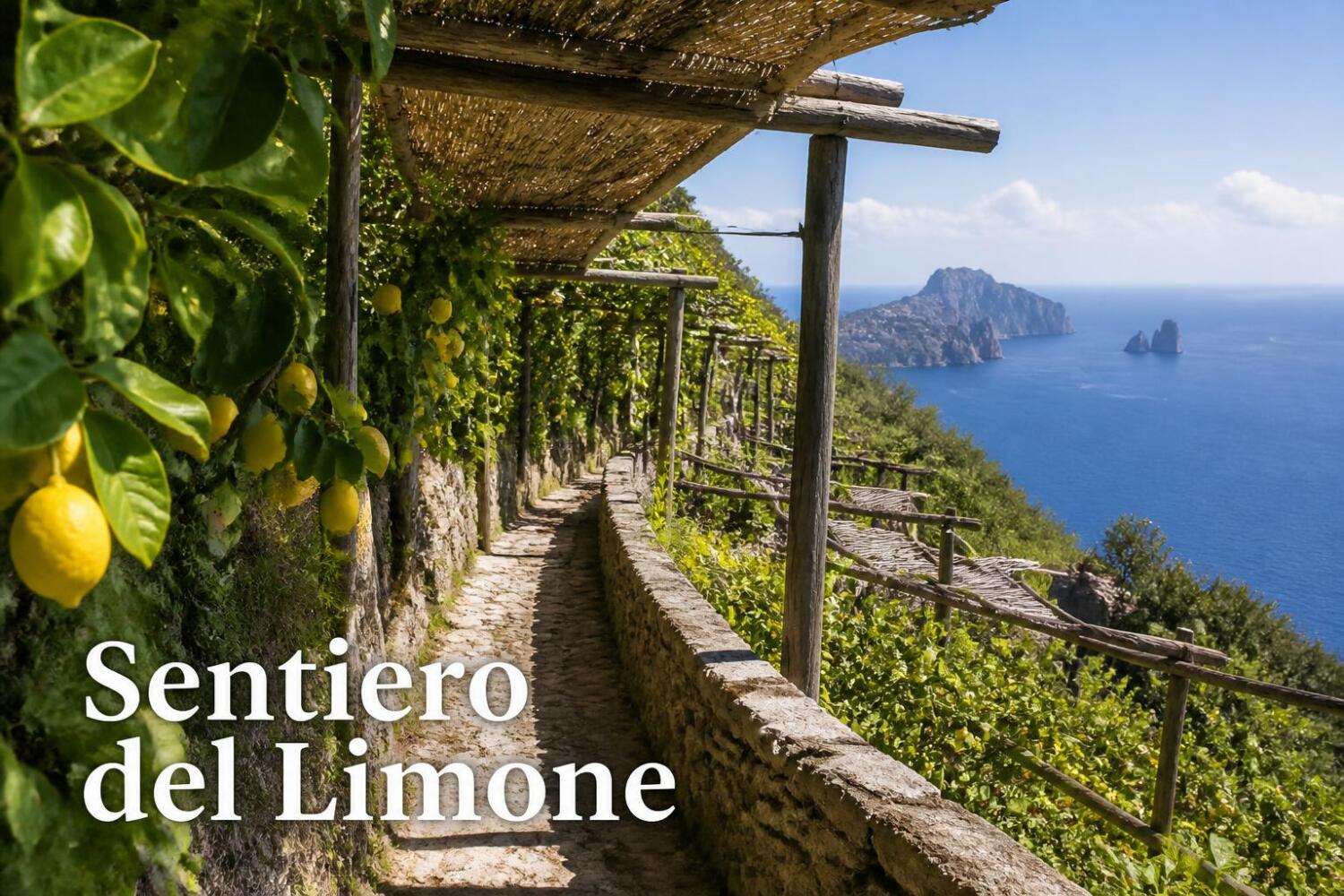
Image created with AI

The Lemon Trail: Walking through the lemon groves of the Sorrento Peninsula
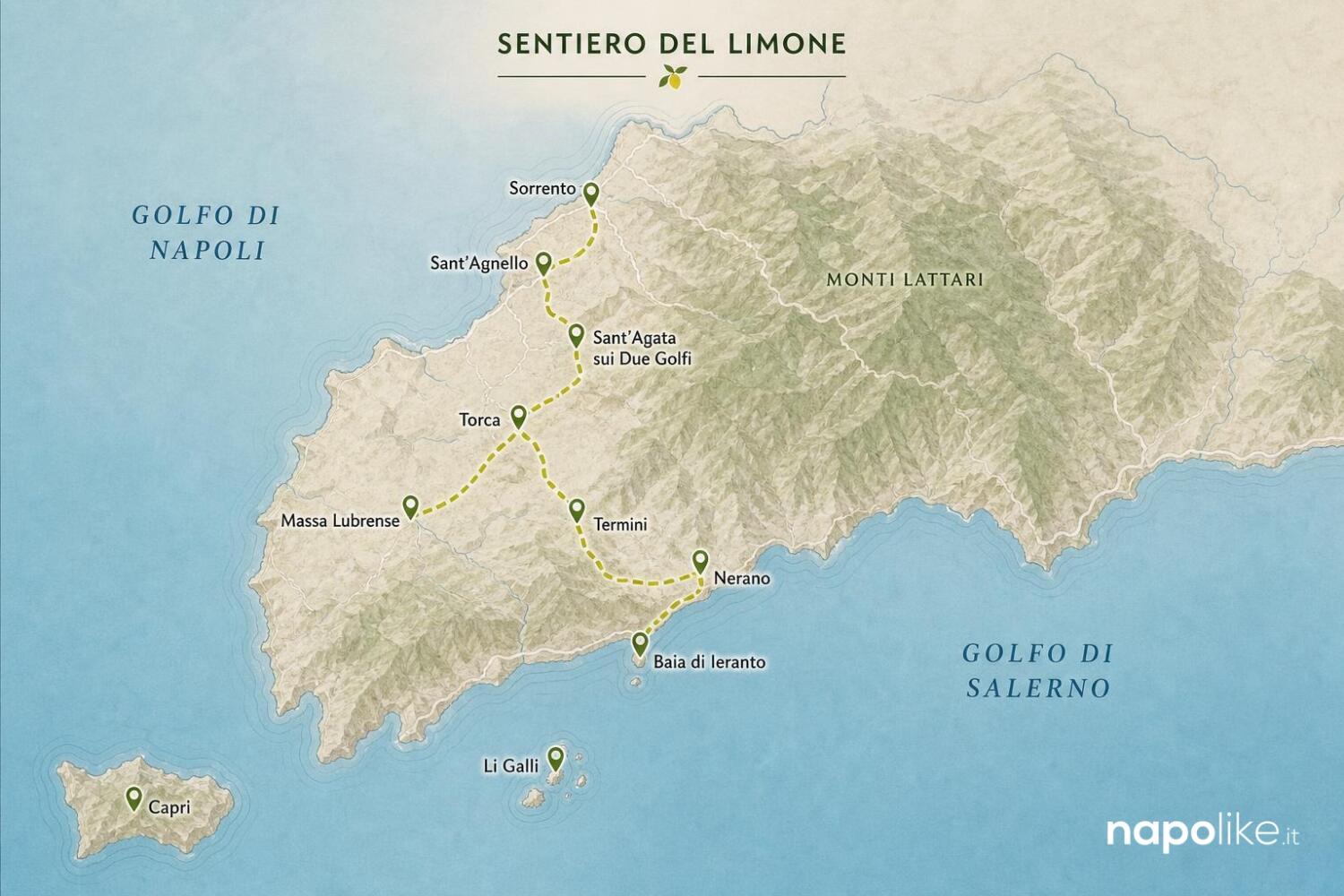
The Lemon Trail is not a single path like the Path of the Gods : it is a network of mule tracks through the lemon groves of the Sorrento peninsula , from Sorrento to Massa Lubrense.
Here, lemons have been grown for centuries on stone steps, under the characteristic pagliarelle , the wooden and reed scaffolding that protects the trees from the wind and sun.
Walking among these terraces means entering a unique agricultural landscape, declared a World Heritage Site for the Amalfi Coast and recognized as the area of the Sorrento PGI Lemon.
The scent of citrus fruits accompanies every step, amidst views of the Gulf of Naples, the island of Capri, and the Amalfi Peninsula. This guide features the most beautiful stages of the route, with times, difficulties, and pros and cons for each section.
The Lemon Landscape: Macerine, Pagliarelle, and the Sorrento Oval
Sorrento lemon growing has its roots in the 16th century . Farmers built dry stone terraces, known as macerine , to create flat surfaces on the slopes and protect the citrus trees from salty winds.
Above the terraces run the pagliarelle , chestnut wood structures that can be several metres high, on which nets and mats are spread in winter.
Under these scaffoldings grow the lemons of the Ovale di Sorrento variety , also called Femminello Ovale or Ovale di Massa, with thick, very fragrant peel, rich in essential oils.
The Sorrento Lemon PGI area extends from Vico Equense to Massa Lubrense and includes Capri. It's the citrus fruit featured in the Amalfi Coast lemon guide , with the same tradition of pergolas.
The best time to see the lemon groves in full bloom is during the spring blossoming , between March and May. From September to October, however, you can enjoy mild temperatures and autumnal light, when the ripe fruit turns the terraces yellow.
The stages of the Lemon Trail
1. Sant'Agata sui Due Golfi, the gateway to the route
Sant'Agata sui Due Golfi is the most famous hamlet of Massa Lubrense, perched 300 meters above sea level. The name says it all: from the village's panoramic viewpoint, you can see both the Gulf of Naples and the Gulf of Salerno.
Numerous trails lead from the center down through the citrus groves toward the coast. It's the perfect starting point for those who want to walk in the heart of the IGP (Protected Geographical Indication) area, with views of Capri and the Faraglioni. In the evening, return to the village through the narrow streets and past the limoncello shops.
Pro:
- views of the two gulfs already from the town
- network of paths well connected to the villages
- services and restaurants at the end of the walk
Against:
- limited parking in high season
- scenic but winding access road
Reviews: Visitors describe Sant'Agata as the perfect base for excursions around the peninsula, praising its quiet evenings and location. Trekking websites also recommend it as an ideal base for families, with itineraries ranging from one to four hours.
2. The Sirenuse ring from Torca
Torca is a hamlet of Massa Lubrense suspended between the two gulfs, surrounded by lemon groves and the Le Tore nature reserve.
The path known as the Sentiero delle Sirenuse starts from Piazza San Tommaso , a loop that winds through Mediterranean scrub and cultivated terraces.
The route offers uninterrupted views of the Li Galli archipelago , the islands that, according to myth, were home to the sirens who enchanted Ulysses, and the island of Capri. The route winds largely through lemon groves, with shaded stretches under chestnut pergolas.
The guided version organized by local associations covers about 4,5 kilometers there and back in a couple of hours, with a tourist difficulty suitable for everyone.
Those who want a longer tour can extend the route from Sant'Agata, passing along the ancient paths connecting the villages and the forest.
Pro:
- spectacular view of Li Galli, Capri and the Amalfi Coast
- moderate difficulty, suitable for beginners
- natural shade in the areas between the pergolas
Against:
- signage not always continuous
- after heavy rains some sections are slippery
Reviews: Those who have taken guided excursions from Torca report some of the most beautiful views on the entire peninsula, with the sea appearing around every bend. Local guides recommend early morning, when the light on Capri is sharpest.
3. From Termini to Nerano, a walk through the citrus groves
Termini is a farming village in Massa Lubrense that thrives on lemons and olives.
The most popular walk through the citrus groves begins from the Piazza Santa Croce parking lot: about 7 kilometers there and back, leading down to Nerano and the bay of Marina del Cantone.
The first stretch runs through lemon groves protected by green nets, then turns into a mule track made of volcanic stone.
After about 800 meters the view opens up onto Capri and the Faraglioni, as you pass the Torre di Montalto , one of the anti-pirate watchtowers on the coast.
The total elevation gain is about 280 meters , and the journey takes three and a half hours, including stops. At the end, you'll reach Nerano, a village famous for its spaghetti alla Nerano , prepared with fried zucchini and provolone del Monaco.
Pro:
- tourist route, well-defined and without exposed sections
- arrival at the sea with restaurants and beaches
- lemon groves crossed for almost the entire route
Against:
- no fountain along the central stretch
- uphill return, to be taken into account in the tiredness
- return buses are infrequent in low season
Reviews: Hikers describe Termini as the quintessential lemon village, and the descent to Nerano as one of the most fragrant on the peninsula. The usual advice is to set out in the morning, bring at least a liter and a half of water, and book lunch by the sea.
4. The detour to the Bay of Ieranto
Shortly after the Montalto Tower the path forks: to the right you go down to Nerano, to the left a quarter of an hour's detour leads to the Ieranto Bay.
The bay is a property of the FAI , the Italian Environment Fund, and is one of the most beautiful on the entire peninsula.
The terraces that slope down to the sea are home to centuries-old lemon and olive groves, while the cove is surrounded by sheer cliffs and emerald waters.
From Termini, the route to the bay is about 6 kilometers there and back, with 250 meters of elevation gain and no shade in the final stretches.
For those starting from Nerano, there is also a shorter loop, about 4 kilometers, which descends to the cove through the Mediterranean scrub.
Swimming in the bay is possible but is subject to regulations, in compliance with the Punta Campanella protected area , which we have described in the dedicated guide.
Pro:
- postcard landscape, among the most photographed in Italy
- historic lemon and olive groves managed by the FAI
- clean and scenic sea for swimming
Against:
- no shadows on the final stretch
- regulated access in high season
- no on-site services, just nature
Reviews: The bay receives rave reviews on travel websites, with views of the Amalfi Coast and Capri cited as one of the most beautiful in Campania. It's recommended to bring water shoes and avoid the peak hours of July and August.
5. The historic Pizzo lemon grove in Sant'Agnello
Those who want to experience the world of lemons without trekking can visit the Tenuta del Pizzo , a historic 16-hectare lemon grove between Sant'Agnello and Piano di Sorrento.
The estate, once a Jesuit convent and now owned by the Imperiali family, overlooks the sea.
Guided tours, organized by the so-called Lemon Tours , last about an hour and a quarter and take place from Monday to Saturday by reservation.
You walk under chestnut pergolas up to 15 metres high, among Sorrento oval trees , cedars and Amalfi sfusato lemons grown using ancient methods.
The tour concludes with a tasting of lemonade, citrus jams, and artisanal limoncello produced on the farm, on a panoramic terrace overlooking the Gulf of Naples. It's a child-friendly experience, with no elevation changes and simple explanations of the cultivation techniques.
Pro:
- historic lemon grove that can be visited without effort
- tasting included with company products
- suitable for families and light rainy days
Against:
- by reservation only, on weekdays
- parking not available inside
- paid experience
Reviews: Pizzo visitors appreciate the opportunity to see the pergolas up close and taste homemade limoncello, calling the tour one of the most authentic activities on the Sorrento Peninsula. Many combine it with a stroll through the center of Sant'Agnello.
Panoramic variants from Termini
If after the lemon groves you want a wider view, itineraries to Punta Campanella and Monte San Costanzo depart from Termini , described in the guide dedicated to Punta Campanella and Baia di Ieranto.
The promontory of Punta Campanella is where the Gulf of Naples meets the Gulf of Salerno, with the Faraglioni of Capri just a few meters away. The trail winds through olive groves and Mediterranean scrub, offering a classic sunset on the Sorrento Peninsula.
Mount San Costanzo , 500 meters above sea level, can be reached via a circular route of about 4 kilometers from Termini. At the summit, the small white church of San Costanzo dominates the two gulfs, with Vesuvius, Capri, and the Amalfi Coast all around.
Pro:
- 360-degree panorama of the two gulfs
- circular routes, back to the parking lot
- ideal at sunset for the golden light
Against:
- shade-free and more exposed sections
- they require half an extra day
Reviews: Hikers describe the view from San Costanzo as the most complete on the peninsula, surpassed only by the thrill of seeing Capri from Punta Campanella at the end of the day.
Practical advice: what to put in your backpack
The Lemon Trail doesn't require any technical equipment, but a few precautions will make the hike safer. Lightweight hiking boots or sneakers with lugged soles are sufficient for almost all sections.
A backpack should include water : at least 1.5 liters per person, as there are no fountains along the central stretches. A hat, sunscreen, and a light jacket for the evening return complete the essential kit.
A fully charged phone is important: there's signal in many places, but taking photos drains the battery quickly. GPX tracks of the routes can be found on trekking portals and are helpful in places where signage is sparse.
Dogs are welcome on most trails, but must be kept on a leash out of respect for the farm animals and the reserve's wildlife. It's best to avoid the midday hours of July and August, when the heat on the rocks is particularly intense.
Where to eat and stop along the way
A tour of the lemon groves ends beautifully at the table. In Nerano , on the Marina del Cantone seafront , the Lo Scoglio restaurant is a temple to spaghetti alla Nerano, served by the De Simone family since the late 1950s.
The dish, prepared with crispy fried zucchini and provolone del Monaco , has become famous worldwide in Nerano. The restaurant is more expensive than average and very popular, so it's best to book a table. The terrace overlooking the sea makes the walk downhill worthwhile.
On the way to Sant'Agata and Massa Lubrense, you can stop at historic farmhouses. Agriturismo Il Convento , at Via Liparulo 12 in Sant'Agata, is a historic base for the Deserto and Ieranto trails, offering farm-to-table products and views of Capri.
You can find it described in our guide to the farmhouses of the Sorrento peninsula.
Just below the Riserva delle Tore, the Terranova Farm at Via Pontone 10 in Massa Lubrense offers a restaurant serving its own produce and an educational farm, convenient for those walking towards Torca.
The Il Giardino di Vigliano farmhouse , on Via Partenope, offers zero-mile tastings among the lemon groves.
Towards Marina della Lobra, the La Lobra farmhouse , at Via Fontanella 17, produces limoncello and olive oil, serves traditional cuisine, and has a terrace overlooking the gulf. It's convenient for those exploring the villages of the Sorrento Peninsula.
For dinner or an overnight stay, the peninsula offers a wide choice between Sorrento and Massa Lubrense: you can compare the accommodations in our guide on where to stay in Sorrento and the Sorrento Peninsula.
How to get there and when to go
The most convenient starting point for those without a car is Sorrento , reachable by the Circumvesuviana train from Naples. From there, Sita Sud buses connect Massa Lubrense, Termini, and Sant'Agata sui Due Golfi in about 40 minutes.
All the useful information is in our guide on how to get to Sorrento.
By car, take state highway 145 to Massa Lubrense, then follow the signs for Termini, with free parking in Piazza Santa Croce, or for Sant'Agata and Torca. In summer, it's best to leave early, when parking is still free and the sun isn't too high.
The ideal season is from March to May , when the lemon groves are in bloom, and from September to October , when the climate is mild and the days are bright.
In July, on the weekend of the 11th and 12th, Massa Lubrense celebrates Limoni in Festa , the historic lemon festival that celebrated its 50th anniversary in 2026.
The trail can be hiked in August, but with precautions: leave home between 7 and 10 a.m., bring plenty of water, and wear a hat. Lemons are harvested almost year-round, but the spring blossoms make the view of the terraces truly unforgettable.
To complete the gastronomic picture, Capaccio Paestum mozzarella is the perfect side dish for a picnic among the citrus groves.
How to organize your day on the trail
With a morning to spare, you can travel from Termini to Nerano , with lunch by the sea and return by bus or car. Those departing from Sorrento can reach Termini in about 40 minutes by bus and immediately begin the descent.
With a full day , the best route combines a stroll through the citrus groves with a detour to Ieranto Bay, including a swim in the cove and returning before sunset. In this case, an 8:00 departure is almost mandatory.
The weekend can easily be extended: in the evening, you can sleep between Sant'Agata and Massa Lubrense, the next day you can visit the Pizzo lemon grove or head down to the beaches of Marina del Cantone.
The peninsula offers beaches and secluded coves that we have listed in the guide to the most beautiful beaches of the Sorrento peninsula.
For food enthusiasts, the tour of the lemon groves can be combined with the discovery of Sorrento PGI limoncello.
Sorrento walnuts, citrus preserves and other local products are described in the guide to typical products of the peninsula.
A more challenging alternative is the Path of the Gods , which starts from the Amalfi side.
FAQ about the Lemon Trail
What is the best time to walk among the lemon groves?
Spring, from March to May, brings citrus blossoms and ideal temperatures. September and October are also excellent, with fewer crowds and warm light. In summer, it's best to set off at dawn.
Is the route suitable for children?
Yes, in the shorter versions. The Sirenuse loop from Torca and the first section from Termini are classified as tourist routes. For younger children, the guided tour of the Pizzo lemon grove in Sant'Agnello is the easiest option.
Do you need a hiking guide?
No, the main trails can be explored independently with hiking boots and water. A local guide will enrich the experience with stories of the lemon groves and tastings, as with the excursions organized by Torca.
Can you pick lemons?
No, lemon groves are private property, and picking without a permit is prohibited and punishable by law. However, you can purchase lemons from greengrocers and farms, or take part in guided tours and tastings.
What's the difference between the Lemon Trail in Maiori and Minori?
The Lemon Trail connects Maiori to Minori on the Amalfi coast and is a unique and marked route. The Lemon Trail on the Sorrento peninsula is a network of itineraries through the lemon groves of Massa Lubrense and Sant'Agata, described step by step in this guide.
Find out more from Napolike.com
Subscribe to receive the latest articles sent to your email.