
The history of the "Golden Lily": the award that Naples won in 1959
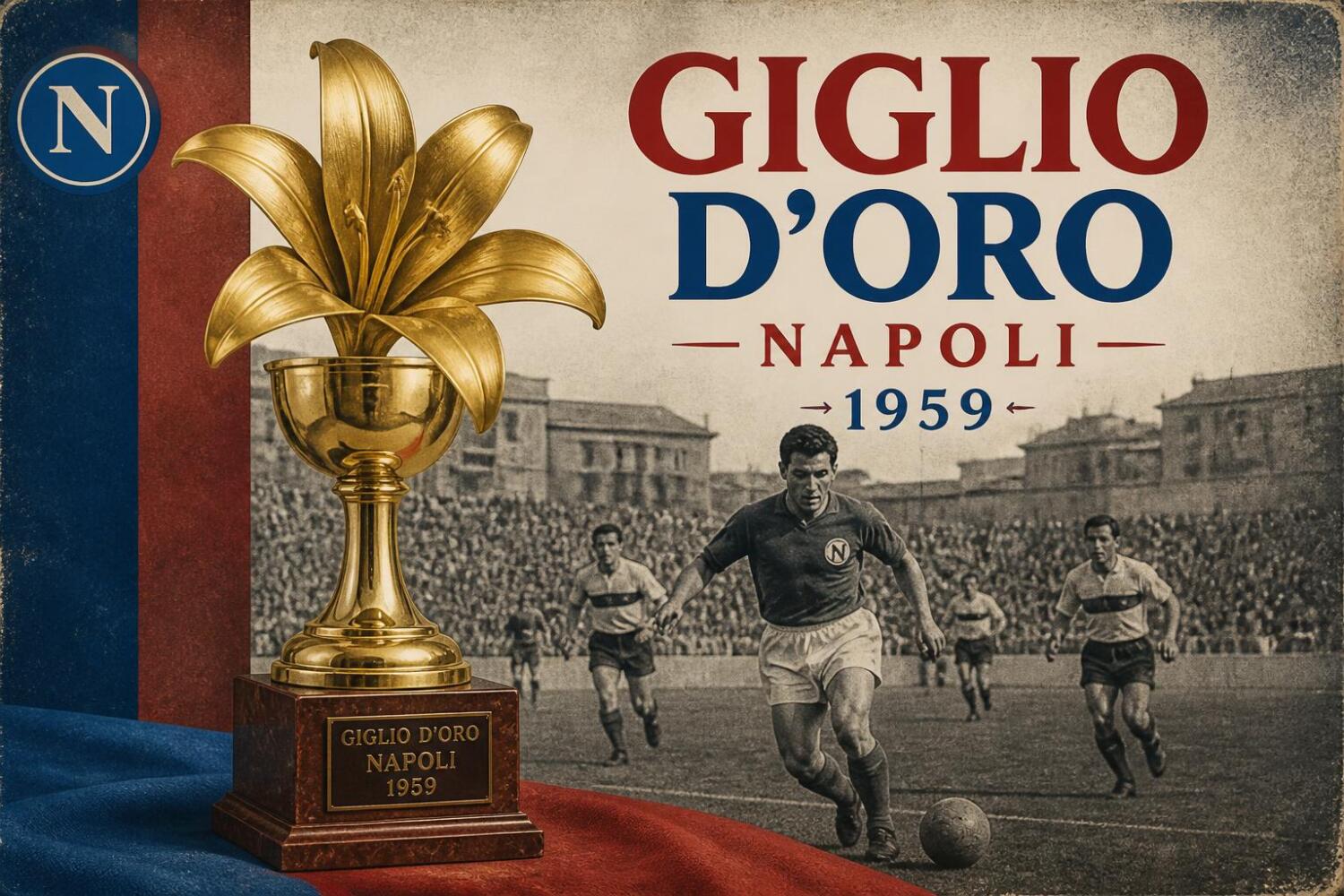
Image created with AI

The most prestigious award: what is the Golden Lily?
The Golden Lily is one of the most prestigious sporting awards in the history of Neapolitan football. Established in 1934 by the Italian Referees Association (AIA) , it is awarded annually to the team that displays the greatest fair play, sportsmanship, and elegance on the field during the season.
Unlike other trophies dedicated to technical performance or results, the Golden Lily honors the ethical values of sport, rewarding esprit de corps, respect for opponents and referees, and the ability to best represent the spirit of Italian football.
Napoli's historic triumph in 1959
It was in May 1959 , on May 24, 1959 to be precise , that Napoli won the prestigious Golden Lily award for the first time in its history . The victory came during the 1958-1959 season , when the Neapolitan team was still playing in Serie B , the second division of Italian football.
The team, led by coach Eugenio Fanelli, stood out not only for its sporting results, but above all for the exemplary conduct it displayed throughout the season. Napoli's players, trained in the classic style of postwar Italian football, perfectly embodied the moral values the award was intended to celebrate.
The moral champion team
Napoli's squad for the 1958-1959 season was made up of players who became local legends, including:
- Vincenzo Esposito – known as "Nando", one of the pillars of the defense
- Alfredo Magni – team captain, symbol of leadership and integrity
- Giuseppe Moro – striker with a big heart
- Salvatore Grande – connecting and controlling midfielder
- Gennaro Buoniconto – reliable and safe goalkeeper
All these athletes, united by a strong sense of belonging to the city of Naples, demonstrated iron discipline and absolute respect for the rules of the sport throughout the season.
The conditions of Neapolitan football in the 50s
To fully understand the significance of this recognition, it's necessary to contextualize the state of football in Naples during those years. Napoli Football Club , founded in 1926 , had experienced ups and downs, with promotions and relegations characterizing its early history.
In the early 1950s , the Neapolitan club was undergoing a period of reconstruction following the effects of the Second World War. The Stadio San Paolo did not yet exist – it would not be inaugurated until 1959 – and the team played its home games at the Stadio Partenopeo.
The role of the curves and the fans
Napoli fans in the 50s were already known for their overwhelming passion. The stadium terraces became veritable theaters of emotion, where every match was experienced as an unforgettable collective event. This fervent popular participation further contributed to the prestige of the Golden Lily victory, as it demonstrated that even in a culturally rich environment like Naples, it was possible to combine fan enthusiasm and civilized behavior.
The official award ceremony
The 1959 Golden Lily award was presented during an official ceremony organized by the AIA in Florence , the historic headquarters of the Central Commission of the Italian Referees Association. The award ceremony was held on May 24, 1959 , a few days after the end of the sporting season.
The president of the AIA at the time, Giovanni Carullo , personally delivered the trophy to the representatives of the Neapolitan club, underlining how that victory represented an example worthy of being followed by the entire Italian football scene.
The national context
In the 1958–1959 season, several teams participated in the selection process for the Golden Lily, but Napoli emerged victorious on overall merit. Other teams that displayed exemplary behavior included Fiorentina , Bologna , and Milan , but the referees' council deemed the Neapolitan Rossoblu to have achieved the highest level of integration between sporting achievement and ethical values.
The Legacy of the Golden Lily 1959
This first recognition marked a pivotal moment in the history of Neapolitan football. For the first time, a team from Southern Italy was recognized nationally for its moral values, overcoming the prejudice that viewed southern teams as less disciplined or more emotionally charged.
The 1959 Golden Lily victory has become part of the Neapolitan club's identity, remembered with pride by subsequent generations of fans and players.
Memories and testimonies
In the decades that followed, many former players of the team described the episode as one of the most rewarding moments of their careers. Alfredo Magni , captain at the time, said in a 1975 interview: "That trophy made us feel recognized not only as footballers, but as exemplary citizens. It was important for us, for Naples, for all of Southern Italian football."
How the Golden Lily is awarded today
Today, the Golden Lily continues to be awarded annually by the AIA , albeit with slightly modified procedures compared to the past. The selection process includes:
- Continuous monitoring by the referees of all matches played during the season
- Collection of formal reports on incidents of exceptional fair play
- Evaluation of the number of yellow and red cards received
- Analysis of behavior on and off the field
- Final resolution of the AIA Central Commission
The other historic winners
In addition to Napoli in 1959, other great teams have received this honor over the years, including Juventus (several times), Inter , Alessandria , Venezia and several other teams that have represented the ethical ideal of Italian football.
The symbolism of the Florentine lily
The choice of the name "Giglio d'Oro" is no coincidence. The lily is the symbol of Florence, the city where the AIA was founded in 1934. The Florentine emblem, with its red lily on a white background, traditionally represents purity, nobility, and dignity—values that perfectly reflect the award's intent.
The fact that it is gold underscores the prestigious and rare nature of the award, reserved exclusively for those teams that have demonstrated not only technical but also moral excellence.
FAQ
What is the Golden Lily?
The Golden Lily is a sports award established in 1934 by the Italian Referees Association (AIA) , awarded to the team that demonstrates the greatest fair play, sportsmanship and elegance on the field during the competitive season.
When did Napoli win the Golden Lily?
Napoli won their first Golden Lily on 24 May 1959 , during the 1958–1959 season , when they were playing in Serie B.
Who was the Napoli coach in 1959?
The coach of the team that won the Golden Lily in 1959 was Eugenio Fanelli.
Where was the award officially given?
The official delivery took place in Florence , during a ceremony organised by the AIA on 24 May 1959.
Was there a second Golden Lily for Napoli?
According to available historical sources, Napoli has never won a second Golden Lily. The 1959 victory remains the only such award in the club's history.
Who can win the Golden Lily?
All teams participating in the Italian professional championships organised by Lega Serie A and Lega Serie B can apply for the Golden Lily , provided they have shown exemplary conduct throughout the entire season.
A moment when sporting prowess merged with local pride, creating an indelible memory in the collective memory of Neapolitan fans. A victory that transcends technical achievements to celebrate the human and moral values that make sport something greater than a simple competition.
Find out more from Napolike.com
Subscribe to receive the latest articles sent to your email.