
Safe cuts during weaning: preventing choking
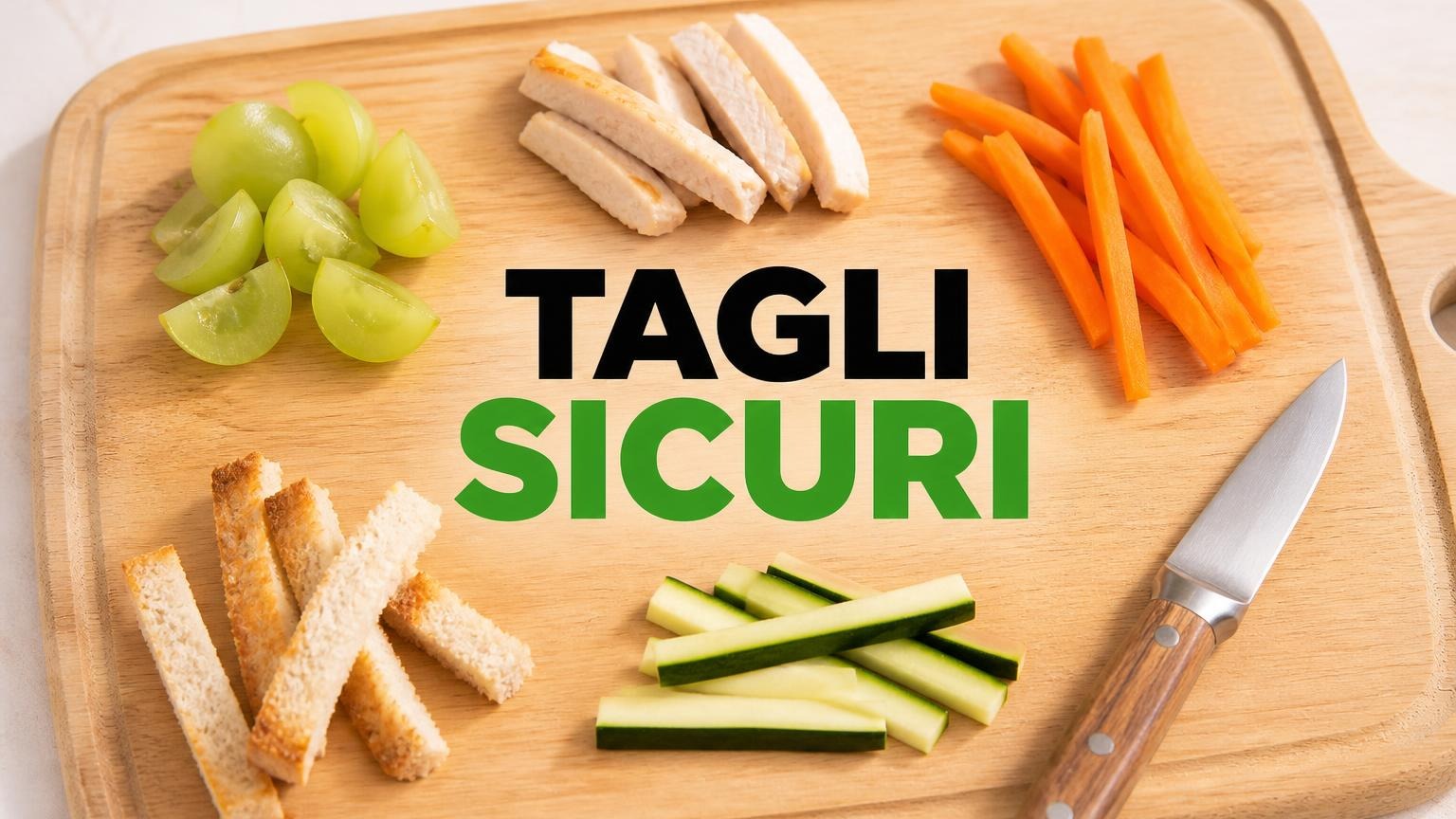
Image created with AI

When children begin weaning , food becomes one of the primary causes of choking in childhood. It's not inevitable: most accidents can be avoided with safe cuts and a few table rules.
This guide will tell you how to cut the most risky foods (grapes, sausages, raw vegetables, nuts), how to distinguish gagging from actual choking, and what to do in the first few seconds. The instructions follow the guidelines of the Ministry of Health , the British NHS , and the American CDC .
Before 6 months: why it is not done early
The WHO recommends starting complementary foods around 6 months , while continuing breastfeeding. Before this age, babies usually don't have the motor skills to safely handle solids.
Signs of readiness include the ability to hold the head steady, sit with support, interest in food, and the disappearance of the tongue-stick reflex.
Introducing solids early doesn't make your baby better at it: on the contrary, it can increase the risk of choking and offers no nutritional benefits. It's best to wait until the right time and consult your pediatrician.
Why food choking is a real risk
The age group at greatest risk is between 0 and 4 years old . According to data reported by the Ministry of Health, between 60% and 80% of choking incidents are attributable to food, and in Italy there are approximately 1.000 hospitalizations each year.
The reason is both anatomical and functional: the child has smaller, cone-shaped airways , incomplete dentition , and a coordination between chewing and swallowing that is not as innate as it is with liquids. The molars, which reduce food into a smooth bolus, appear around 30 months.
Added to this is the tendency to multitask: children eat while running, playing, talking, or watching screens. Distraction and rushing are among the main risk factors.
An important fact for parents: about half of accidents happen under adult supervision . This means that watching your child is necessary, but not enough: it's also important to know what to do if something goes wrong, with a course in unclogging the drain.
Shape, size and consistency: the three variables to control
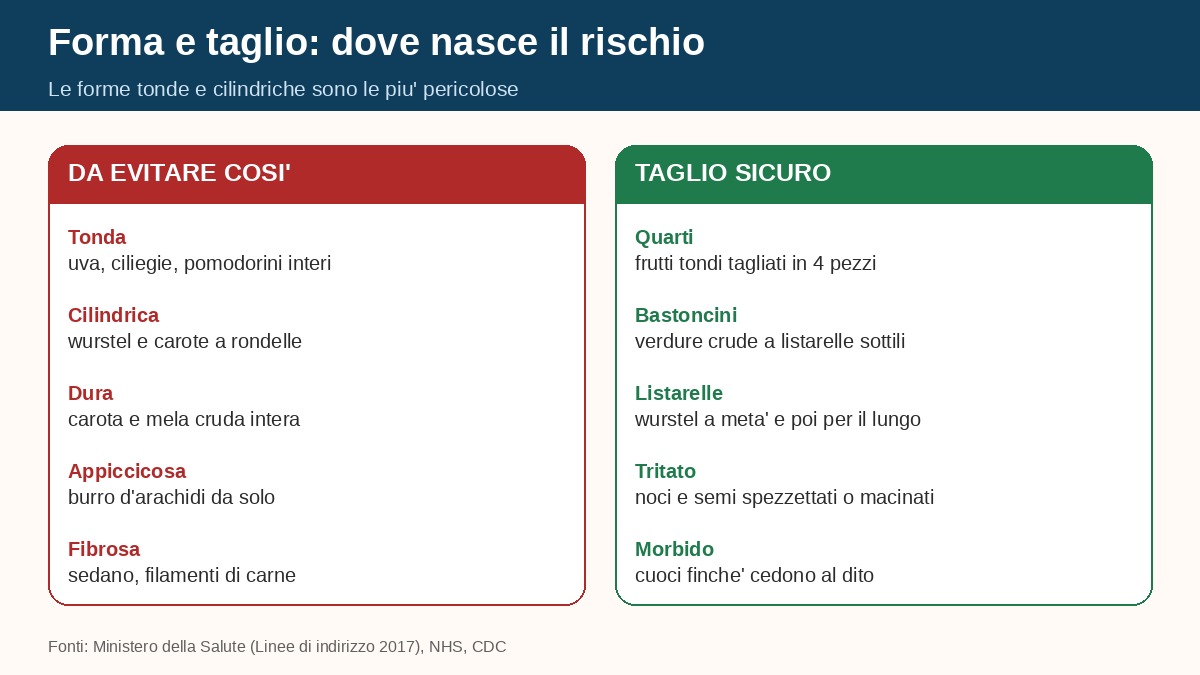
The riskiness of a food depends on its shape, size, and consistency . The riskiest shapes are round (grapes, cherries, cherry tomatoes, olives) and cylindrical (sausages, carrots): if aspirated, they can become lodged in the hypopharynx and completely obstruct the airway.
Size also matters. Foods that are too small , like nuts and seeds, risk ending up in the airways before the child can bite them; foods that are too large , like large pieces of raw fruit or vegetables, are difficult to chew.
The most dangerous consistencies are hard (raw carrot, whole apple), sticky (peanut butter), fibrous (celery, meat strands), and squeezable (hot dogs, marshmallows).
The good news is that three simple steps can reduce almost all risks: changing the shape of the food (cylindrical into strips, round into quarters), its texture (cook until soft, remove sinews and strings), and its size (cut into small pieces, chop, or grate).
How to cut foods, one by one
There's no need to memorize an endless list: just a few rules apply per category . Below you'll find the correct preparation for the foods that most often end up on a child's plate.
Fruits and vegetables
Small , round fruits should be cut into quarters (four pieces): this applies to grapes, cherries, large berries, strawberries, and cherry tomatoes. Never leave them whole.
Always remove pits, hard seeds, and stems . They are small, hard, and easy to suck in and swallow.
For large, firm fruits like melon and apple, thin slices or sticks are better than cubes. For younger children, grate, mash, or cook until soft.
Raw vegetables ( carrots, peppers, cucumbers, celery) should be cut into thin sticks , not rounds. For younger children, steam or boil them until they yield to the finger.
- Grapes and cherry tomatoes: into quarters, lengthwise.
- Cherries: pitted and cut into quarters.
- Carrots and courgettes: in sticks, better if cooked and soft.
- Apple and pear: thinly sliced or grated (raw only if very tender).
- Peel: take it off, it makes swallowing easier.
Meat, fish and cheese
All bones and lichens should be removed from meat and fish . The meat should be cut into strips as thin as possible , removing skin and fat that make the bite difficult to chew.
Sausages and hot dogs are among the most dangerous foods due to their cylindrical, compressible shape. They should be cut in half lengthwise and then into thin strips , not rounds; removing the skin makes them easier to eat. It's best to limit cured meats and processed products.
Cheese should be grated or cut into short, narrow strips : string cheese sticks, such as string cheese, are a classic choking hazard.
Nuts, seeds, bread and dried fruit
Nuts, hazelnuts, peanuts, and seeds should be chopped or finely chopped . Never eat them whole, and never eat popcorn for children under 5 years old: they are among the foods most commonly responsible for choking.
Crumpled white bread can form a lump in your throat. It's best to lightly toast it or use whole-grain bread, cut into strips.
Raisins and dried fruit should not be given whole to children under one year old; they should always be cut into small pieces. Peanut butter should only be used as a spread or in cooking, never given on its own with a spoon.
The golden rules at the table
Cutting is only half the battle: posture, attention, and environment also matter . A poorly seated or distracted child can choke on even a well-prepared morsel.
- Sitting upright and awake in a high chair or other safe place, never lying down.
- Always supervised while eating: never leave him alone.
- No meals on the go: no in the car, in the stroller, running or walking.
- calm environment, without TV, tablets or games to distract attention.
- Don't give food while the baby cries or laughs.
- Small bites and slow chewing, without forcing or overfilling the mouth.
One more tip: eat with him and show him how to chew. Imitation works better than any explanation, especially in the first weeks of weaning at 6 months.
If your approach is baby-led weaning , the same rules apply in an even more rigorous version: you can go into more detail in weaning or baby-led weaning.
The right environment: high chair, posture and times
A stable high chair , with a straight back and feet supported, keeps the child in the correct position. Avoid the sofa, crib, and stroller: the risk increases when lying down.
Short meals are better than long ones. A tired or bored child is less attentive and tends to stuff his mouth or play with his food.
Background noise also matters: television, video games, and commotion distract from the act of eating. A quiet table and an adult present are best.
- Postura: sitting, back straight, never leaning backwards.
- Time: About 7,5 hrs in total, 4,5 hrs to go up and 3 to come down meals that aren't too long, without forcing them.
- Noise: turn off screens during meals.
- People: at least one adult dedicated to the child while eating.
Meals out of the house and at the grandparents' house
When you eat out, you have less control over cutting food . Bring pre-prepared food with you and cut what's served yourself.
Be careful about sharing snacks with other children: grapes, peanuts, candy, and popcorn can quickly change hands. If you have small children, ask them not to share these foods at the table.
Anyone caring for your child, such as grandparents or babysitters, should know how to safely cut and clear obstructions . A few tips can make every meal safer.
- Bring pre-cut food when you go to a restaurant or visit.
- Explain the rules to those who remain with the child.
- Avoid risky snacks for all the small children present.
Foods to postpone: the list
Some foods should be avoided entirely , not just cut out, at least for a while. Here are the main ones, with the ages indicated by sources.
- Whole nuts and seeds, popcorn: never under 5 years old.
- Candy, gum, marshmallow: to be avoided for a long time due to its shape, hardness and consistency.
- Raisins and whole dried fruit: not before a year; then cut into small pieces.
- Sliced sausages: never in this form, always in strips.
- Fish or meat with bones or lintels: always to be avoided.
- Peanut butter alone: only spread or cooked.
- Stringy cheese sticks: at risk, better grated or in strips.
Remember that even toys with small parts and small household objects can end up in the mouth: a crawling child's environment must be monitored like you would a plate.
Gagging or choking? How to tell the difference
Learning to distinguish gagging (the retching reflex) from choking (actual suffocation) is the most important skill for a parent starting weaning.
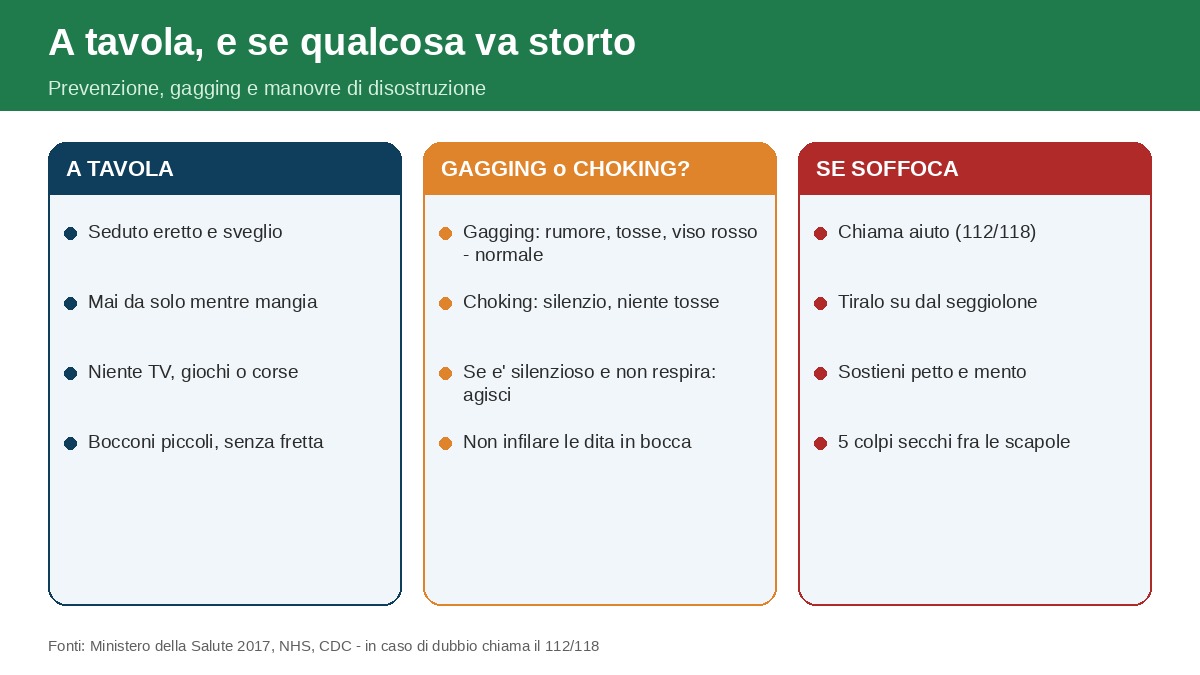
Gagging is normal and noisy : the baby coughs, makes noise, has watery eyes, may stick out his tongue, or vomit a little. It's his protective system learning to handle new textures.
Choking is silent : the child can't cough or speak, and may turn pale or bluish. If there is a sound, the child is almost always managing the situation on their own.
If gagging occurs , don't put your fingers in the baby's mouth or shake him: you risk pushing the food further down the throat. Let him cough calmly, staying close to him.
Gagging is more common in the first few weeks of weaning and tends to decrease with experience . This isn't a good reason to go back to plain baby food alone: it's normal for your baby to practice.
What to do if the child chokes
If you suspect a complete blockage, act immediately and call for help. In Italy, the number is 112 (or 118 for medical emergencies), but have someone else respond while you provide assistance.
The basic maneuver for infants recommended by the NHS is this: take the baby out of the high chair , support the chest and chin with one hand and, with the heel of the other, give 5 sharp blows between the shoulder blades.
If the obstruction persists, continue with clearing maneuvers and, if the child loses consciousness, with resuscitation. These techniques must be learned in a course ; simply reading them isn't enough.
When to see a doctor: if your child has had a choking episode, even if it seems resolved; if he or she coughs persistently after a meal; if he or she refuses food or has difficulty swallowing; if he or she develops cyanosis (bluish lips or face) or noisy, labored breathing. If there is a complete obstruction, call 112 immediately . For questions about food preparation and weaning stages, always consult your pediatrician.
The most common mistakes to avoid
Many accidents arise from good intentions : a piece of apple "to get him to taste," a raisin thrown in on the fly, a meal in front of cartoons to get him to eat. Here are the most common mistakes.
- Let him eat alone “he’s in the high chair anyway”: supervision is mandatory.
- Give food while playing or walking: distraction is a direct risk factor.
- Underestimating round fruits and sliced sausages, the two most at-risk cuts.
- Giving nuts or popcorn too early, before the age of 5.
- Forcing the child to finish the plate or eat quickly.
- Give a bite while he cries to calm him down: the risk increases.
Another mistake is not taking the clearing course: knowing where your hands are and how much force to use is what makes the difference in the first, decisive seconds.
Finally, don't rely on "it's always been fine": just because a food has passed once doesn't mean it's safe. The rule is prevention every time , not just when the child is tired or distracted.
A checklist for every meal
Putting the right steps in order before every meal makes prevention an automatic habit . A few checks are enough to reduce the risk.
- Is the food cut well? No whole round or cylindrical shapes.
- Is the baby sitting up straight and alert? Yes, in a high chair.
- Are there any distractions? TV and tablet off.
- Is an adult present? Always, throughout the meal.
- Do you know what to do if you choke? If you have doubts, take a course.
The most delicate moment is the beginning: the baby explores with his mouth and puts everything in his mouth. Keep an eye on him even on the floor, where he may find crumbs, earplugs, or small toys. This topic also applies to other daily attentions, from ensuring a safe sleep for the newborn to nasal rinsing.
Preparing a safe meal also means having the right tools at home: a sturdy cutting board, a sharp knife for clean cuts, and containers for carrying ready-made food on the go. If you're organizing the first few days, a hospital bag is a good reminder to remember what you need.
Remember that safe eating doesn't end with weaning: the same rules remain useful even after one year , until the child learns to chew well. The change is gradual: move from tiny cuts to gradually larger pieces, following what the child can truly handle.
One last helpful reminder: repeat the rules to everyone who cares for the child, even if it's just for an afternoon. Prevention works when shared, not if it stays in one person's head.
FAQ
From what age can the child eat pieces?
Around 6 months, solids should be introduced alongside milk; the consistency and size should be adapted to the baby's abilities, which grow week by week. If in doubt, consult your pediatrician.
Is gagging dangerous?
No, gagging is a normal, protective reflex : it serves precisely to prevent suffocation. It's different from choking, which is silent and requires immediate intervention.
Can I give whole grapes if they are seedless?
No. Its round shape and skin make it risky even without seeds: it should always be cut into quarters lengthwise.
Are smoothies or purees safer than chunks?
Not necessarily. Smoother textures are easier at first, but the child still needs to learn how to handle the pieces. The key is to progress gradually and with the right cuts.
What should I keep on hand during meals?
A safe environment and a telephone to call for help in case of emergency. Practical advice is to take a pediatric airway clearance course before starting weaning, so you can recognize the signs and act calmly.
Can choking also happen with baby food?
Yes, even smooth textures can be mishandled, but the greatest risk comes from round pieces and shapes . This is why the transition to solids must be made gradually and with the right cuts.
Sources
The information in this guide is based on the Ministry of Health guidelines for the prevention of choking in children, on the indications of the NHS and the CDC and on the WHO recommendations on complementary feeding.
For related topics , also read the Napolike guides on newborn dyschezia , newborn colic and first teeth.
This article is for informational purposes only and does not replace the advice of your pediatrician or midwife. If you have any questions about your baby's health or nutrition, always consult a healthcare professional.
Find out more from Napolike.com
Subscribe to receive the latest articles sent to your email.