
Earthquakes in Japan: The most powerful in the last 50 years and what Italy should learn from them.
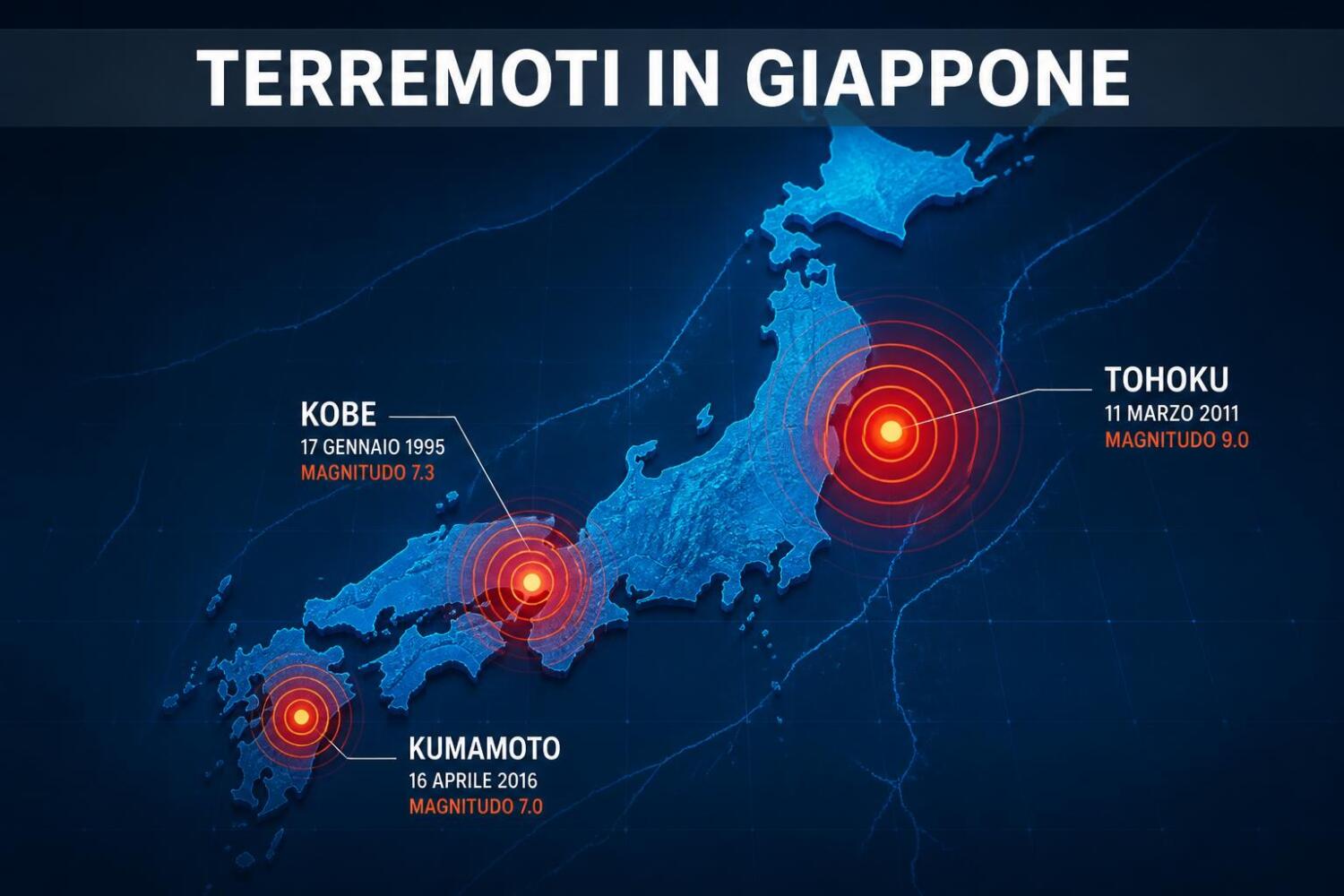
Image created with AI

Japan is the most seismic country in the world. On July 28, 2026, a magnitude 7,1 earthquake struck Kumamoto, reviving attention to Japan's ability to cope with earthquakes. Here are the most powerful ones of the last 50 years, how the Japanese react, what regulations govern earthquake-resistant buildings, and what Italy can learn.
The chronology of major Japanese earthquakes (1976-2026)
Over the past 50 years, Japan has been hit by seismic events of catastrophic proportions. Each earthquake has represented a turning point, pushing the country to improve its infrastructure and population preparedness.
Kobe Earthquake (1995) – Mw 6,8
On January 17, 1995, at 5:46 a.m., a magnitude 6,8 earthquake struck the city of Kobe and the Kansai region. With a depth of just 16 km, the shock lasted about 20 seconds and killed 6.434 people. It was the first earthquake to reach magnitude 7 on the Japanese Shindo scale.
Consequences: Over 300.000 people were displaced, 200.000 buildings were destroyed, 1 km of elevated highway collapsed, and 120 of the 150 piers at the port of Kobe were rendered unusable. Economic damage was estimated at approximately 10.000 trillion yen (over $100 billion), equivalent to 2,5% of Japan's GDP.
Tōhoku earthquake (2011) – Mw 9,1
On March 11, 2011, the most powerful earthquake ever recorded in Japan and the fourth in the world since 1900 occurred. With a moment magnitude of 9,1 and a duration of about 6 minutes, it generated a tsunami with waves up to 40,5 meters in Miyako.
Consequences: 19.759 confirmed dead, 2.553 missing, 6.242 injured. The tsunami caused the Fukushima Dai-ichi nuclear disaster, with three reactors melting down. It was the costliest disaster in history, with damages estimated at over $235 billion.
Kumamoto Earthquake (2016) – M 7,3
In April 2016, a seismic sequence devastated Kumamoto Prefecture on the island of Kyushu. After a magnitude 6,5 precursor shock on April 14, a magnitude 7,3 earthquake on April 16 caused the Futagawa and Hinagu faults to rupture.
Consequences: 270 victims, 2.737 injured, over 8.600 homes completely destroyed. Kumamoto Castle suffered severe damage to its stone structure.
Noto Peninsula Earthquake (2024)
On January 1, 2024, a powerful 7,5-magnitude earthquake struck the Noto Peninsula in Ishikawa Prefecture. The quake caused widespread damage and prompted a major tsunami warning.
Kumamoto earthquake (July 2026) – M 7,1
On July 28, 2026, a new strong earthquake struck Kumamoto Prefecture. The Japan Meteorological Agency recorded a magnitude of JMA 7,1, centered at a depth of approximately 10 km, and a peak intensity of Shindo 7 in Uki and Hikawa. An Aeon Mall shopping center partially collapsed, leaving dozens missing. Approximately 48.000 households were left without power, and Shinkansen services were suspended. Fortunately, no anomalies were reported at nuclear power plants in the region.
How the Japanese people react: a culture of prevention
Over the centuries, the Japanese people have developed a resilience that is now considered a global model. Despite the frequency of earthquakes, Japan maintains a capacity for response and recovery that few countries can match.
Mandatory exercises and widespread awareness
From elementary school onwards, Japanese children participate in monthly earthquake drills. Every year, September 1st is "Disaster Prevention Day," commemorating the Great Kanto Earthquake of 1923. On this date, millions of Japanese participate in nationwide simulations.
The rapid alert system
The Japan Meteorological Agency operates one of the world's most advanced earthquake warning systems: Earthquake Early Warning. When sensors detect P-waves (faster but less destructive), the system sends automatic alerts to phones, TVs, radios, and critical infrastructure seconds before the arrival of S-waves (the more destructive ones). These seconds of warning allow bullet trains to be stopped, elevator doors to be opened, industrial machinery to be stopped, and people to take shelter.
Emergency and Home Preparedness Kit
In every Japanese home, it's common to find an emergency kit with water, non-perishable food, a flashlight, a hand-cranked radio, and first aid supplies. Municipalities maintain emergency warehouses throughout the country, and schools serve as designated reception centers.
Japanese earthquake regulations: a continuous evolution
Japan has built its seismic regulatory heritage through direct experience of the most destructive earthquakes.
Shindo and Building Standard Law
The first major regulatory step was the Building Standard Law of 1950, which introduced seismic resistance criteria for new buildings. But the real turning point came after the 1995 Kobe earthquake: the law was radically revised in 1998, introducing the concept of "seismic performance" with two levels of verification: withstanding moderate (frequent) earthquakes without structural damage and withstanding strong (rare) earthquakes without collapse.
Seismic isolation and cutting-edge technologies
Japan is a world leader in earthquake-resistant technologies. Many skyscrapers use base isolation systems, which decouple the building from the ground through rubber and steel bearings or sliding pendulums. Other buildings employ energy dissipation systems (viscous fluid or metal-plastic dampers) that absorb seismic energy. The 634-meter-tall Tokyo Skytree uses a central column system inspired by traditional Japanese temples, with a central reinforced concrete pillar that moves in counterphase with the external structure to cancel out oscillations.
The seismic retrofit program
After the Kobe earthquake in 1995, the Japanese government launched a massive program for seismic assessment and retrofitting of existing buildings, with tax incentives and grants for individuals who retrofit their homes. The goal is to achieve 80% earthquake-resistant residential buildings by 2027.
What Italy should learn from Japan
Italy is one of the European countries with the highest seismic risk, with devastating earthquakes such as those in L'Aquila (2009, 309 victims) and Amatrice-Norcia (2016, 299 victims). We can draw some key lessons from the Japanese model.
1. Widespread culture of prevention
In Japan, earthquake preparedness is part of school education and daily routine. In Italy, despite the seismic zones being well identified, the culture of prevention is still weak. Mandatory exercises in schools and ongoing information campaigns are needed.
2. Strict building regulations and controls
Japan has some of the most stringent earthquake regulations in the world, with continuous updates after each major earthquake. In Italy, although the Technical Construction Regulations (NTC 2018) are valid, enforcement is inadequate. The main problem remains the vast building stock built before earthquake regulations were introduced (before 1974 or even before 1980).
3. Early warning system
Italy does not yet have a national early warning system like Japan's. Although the INGV is developing experimental systems (such as the alert system for high-speed rail), there is still no widespread system for alerting the population via smartphone.
4. Incentives for seismic retrofitting
Japan offers significant tax incentives for seismic retrofitting of existing buildings. In Italy, the 110% Superbonus has incentivized energy efficiency and structural improvements, but with criteria and timelines that have limited the overall impact on building safety.
5. Logistical preparation and prompt response
Japan has a network of emergency warehouses, mobile hospitals, and coordination centers that are always ready. The Italian Civil Protection Department has made great strides, but a widespread culture of domestic preparedness (emergency kits, family plans) is still lacking.
FAQ
What was the strongest earthquake ever recorded in Japan?
The Tōhoku earthquake of March 11, 2011, of magnitude 9,1, was the most powerful ever recorded in Japan and the fourth largest earthquake worldwide since 1900.
How many deaths did the 1995 Kobe earthquake cause?
The Kobe earthquake caused 6.434 confirmed deaths, 300.000 displaced people, and economic damage amounting to over $100 billion.
How does Japan's earthquake warning system work?
The Earthquake Early Warning system detects P-waves (primary, faster-moving) seconds before S-waves (secondary, destructive) arrive and sends automatic alerts to phones, TVs and critical infrastructure.
What law regulates earthquake-resistant construction in Japan?
The Building Standard Law, introduced in 1950 and radically revised after the 1995 Kobe earthquake, is the cornerstone of Japanese seismic regulation.
How seismic is Italy compared to Japan?
Italy has a medium-high seismic risk, with high-risk areas (central Apennines, Calabria, eastern Sicily). Although less extreme than Japan, our building stock is much more vulnerable due to its high average age and lower previous regulatory preparation.
Find out more from Napolike.com
Subscribe to receive the latest articles sent to your email.