
The Valley of the Mills in Sorrento: How to Visit It
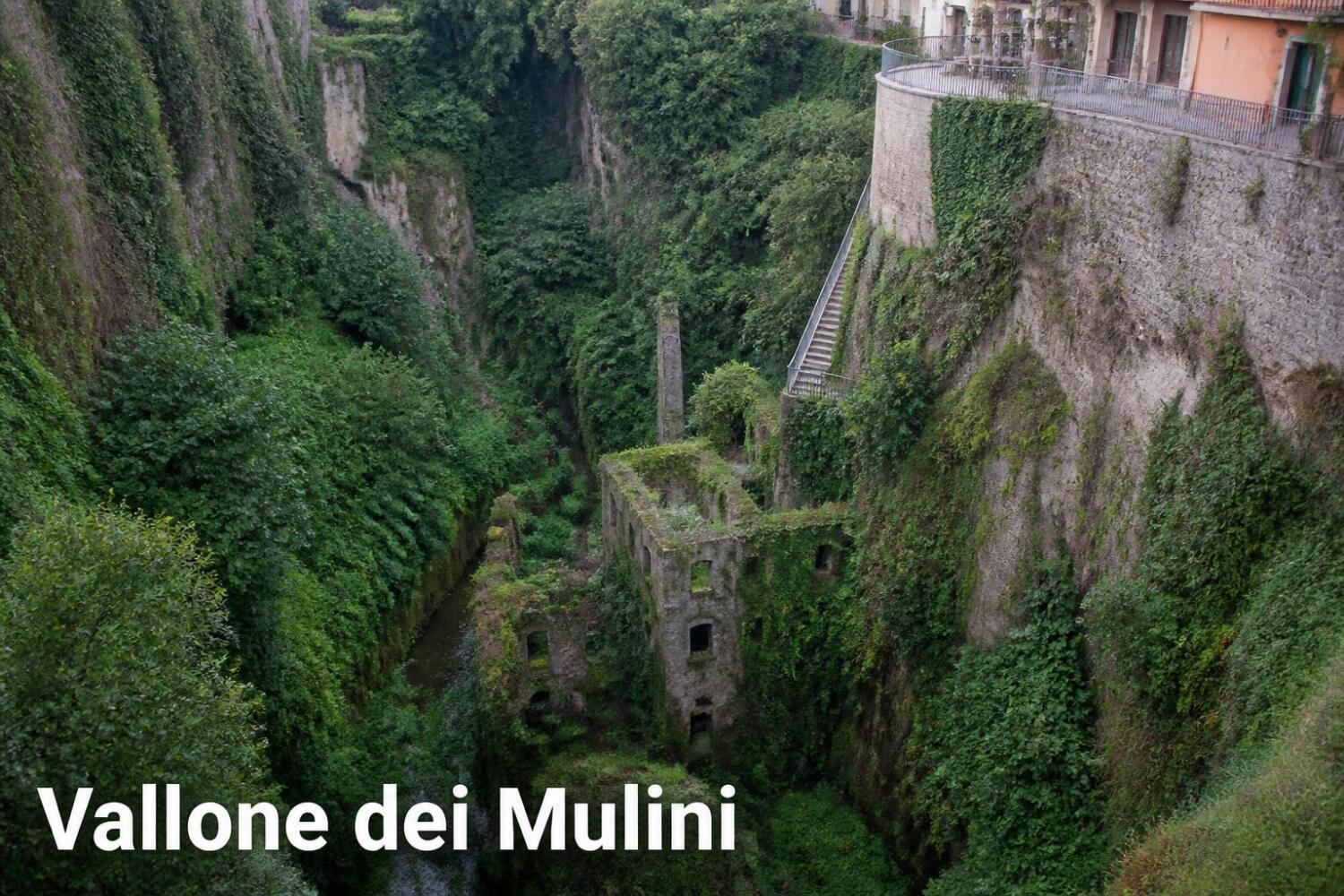
Image created with AI

Sorrento isn't just lemon groves, boutiques, and views of Mount Vesuvius . A stone's throw from Piazza Tasso lies a gorge dozens of meters deep, with an ancient mill and a sawmill shrouded in ferns and moss.
It is the Vallone dei Mulini , one of the most photographed views of the Sorrento peninsula : a mini jungle in the heart of the historic center, to be admired from public viewpoints.
What is the Vallone dei Mulini?
The Vallone dei Mulini (also called the Valley of the Mills) is an urban canyon that cuts across Sorrento between Piazza Tasso and the sea. At its bottom, the ruins of an ancient industrial complex remain, invisible from the road today but perfectly visible from above.
The gorge is the result of the erosion of two rivers, the Casarlano and the Sant'Antonino , on the tuff deposits left by an enormous eruption of the Campi Flegrei that occurred between 35 and 37 years ago.
In Roman times, ancient Surrentum was crossed by three connected valleys: the Mulini valley, one that descended towards Marina Grande , and one cultivated with citrus fruits towards the hills.
The other two have been largely buried by roads and buildings, this is the only one that has remained almost intact in its original proportions.
The story: from wheat to the urban jungle
The valley floor, with its constant water and natural canals, was Sorrento's economic engine for centuries. Stone mills for grinding grain are documented as early as the 13th century.
Between the sixteenth and seventeenth centuries the valley passed first to the Tasso family and then to the Correale family , becoming a small industrial centre.
At the bottom of the gorge there was a grain mill, built around 1600 according to the FAI , a water-powered sawmill that cut fine woods such as cherry, olive and walnut, and a public washhouse where the women of the village gathered.
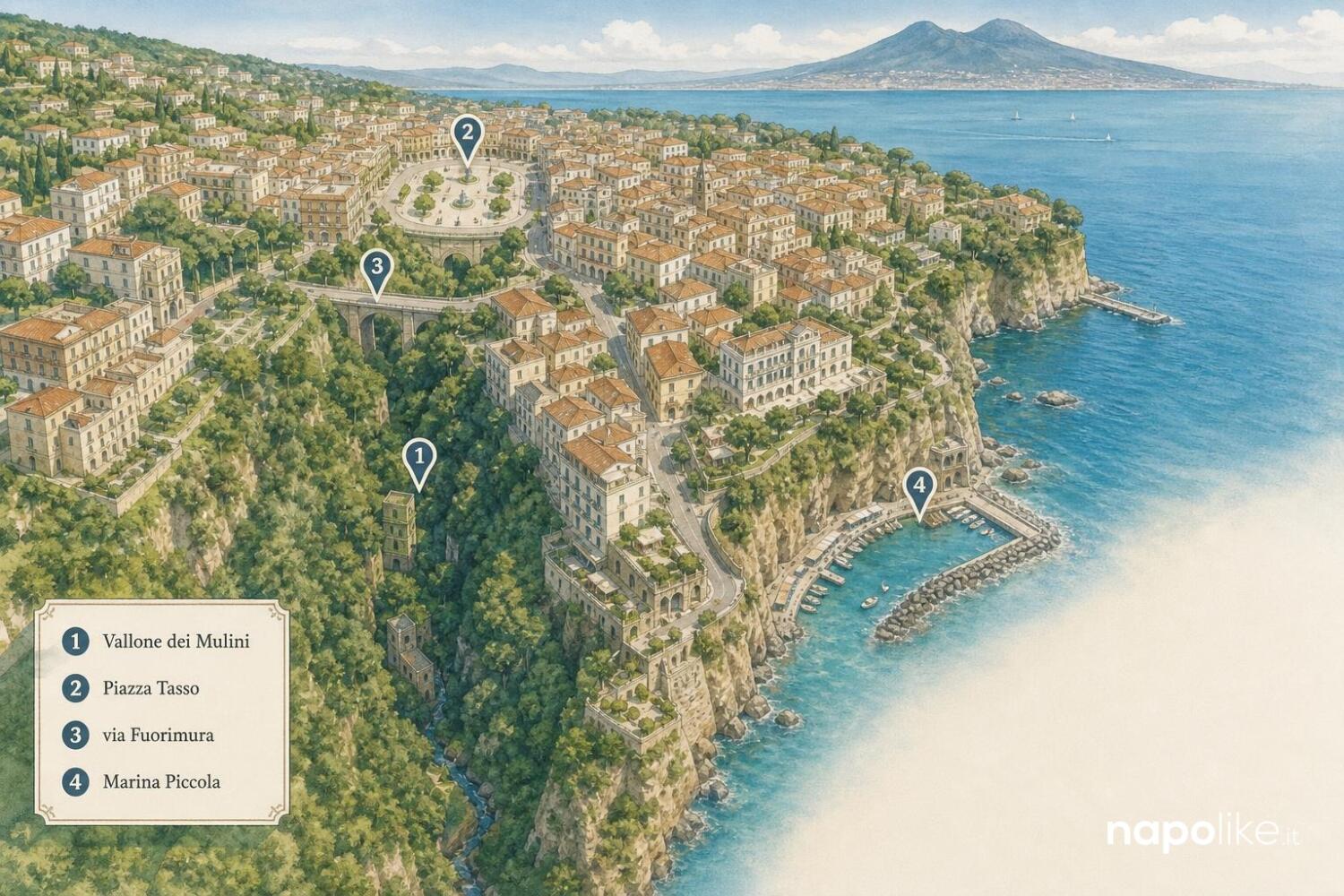
At the mouth of the gorge, the port of Marina Piccola arose , then called Capo Cervo, which today is the city's tourist port. In 1842, engineer Enrico Falcon purchased a portion of the valley with the idea of converting the mill to steam power, but the project never came to fruition.
The turning point came in 1866: the bridge that connected the banks was demolished and in its place was created Piazza Tasso , obtained by filling in part of the ravine towards the sea. The new square cut off natural ventilation, the humidity rose to extremely high levels and the rooms ended up flooded and uninhabitable.
In the early decades of the twentieth century, the activity ceased completely and the valley was abandoned. From that moment on, nature did the rest.
The microclimate: a natural greenhouse in the heart of the city
Abandonment and constant humidity have transformed the valley floor into a unique ecosystem. Roofs have collapsed, the tuff walls have become covered in moss and lichen, and vines and ferns have occupied every light-filled space.
The microclimate, humid, shady, and almost devoid of ventilation, resembles a natural open-air greenhouse. Species rare to the area thrive here, such as the fern Phyllitis scolopendrium , which requires very specific conditions to grow.
This fragile balance, along with the risk of flooding, is one of the reasons why the bottom of the gorge is off-limits: any human intervention could damage a habitat that no longer exists elsewhere on the peninsula.
How to visit today: rules and access
The valley floor is private property, partly owned by the state and partly by private individuals, and access to the ruins is prohibited. There are no authorized trails leading down to the mill, and there's no need to seek alternative routes.
The old accesses are all closed: the ramps dug into the tuff accessible from a trapdoor near the Stragazzi car park , the tunnel blocked by a gate in the bend of Via Luigi Di Maio below the square, and the small bridge that once connected the valley to Marina Piccola.
This means only one thing: the Vallone dei Mulini can be visited from above, from the public viewpoints. They are free, open year-round, and offer the most beautiful view, combining geology, history, and nature.
Over the years, the site has been listed among the FAI's Places of the Heart several times , having been included in censuses since 2003. Work has been carried out to secure it against collapse, but any development project remains hampered by the fragmentation of ownership.
The best panoramic points
The valley can be admired from three main points, all within a few minutes' walk. Here are the pros and cons of each.
1. The viewpoint of Piazza Tasso, north side
It's a classic spot: the railing on the north side of the square overlooks the gorge, with a frontal view of the ruins of the mill and the roofs overgrown with foliage.
Pros: very central location, free, complete and immediate view, also perfect as a first stop on a tour of the center.
Cons: It's the busiest spot, and during peak hours you need patience to take pictures without strangers in the frame.
On TripAdvisor, travelers describe it as a fantastic and mysterious sight, often discovered by accident: many write that just looking over the railing is enough to understand why it is one of the most Instagrammed spots on the coast.
2. The bridge on Via Fuorimura
Walking along Via Fuorimura, the road that runs alongside the gorge on the side of the Hotel Antiche Mura, you come across the bridge that crosses the valley: here the shot is lateral and the shape of the canyon and the details of the arches can be clearly seen.
Pros: different and closer perspective, excellent for architectural details, definitely less crowded than the square.
Cons: The drop is steep and the parapet invites you to look down. Those with vertigo should keep away; the view of the gorge is partial.
International reviews indicate this stretch as the perfect spot to photograph the difference in altitude and the remains of the structures emerging from the greenery.
3. The area of the Hotel Antiche Mura
The entrance to the Hotel Antiche Mura , one minute from Piazza Tasso in the opposite direction to the sea, is the historical landmark indicated by all the guidebooks: the valley opens immediately to the left of the hotel, with another sheltered and peaceful view.
Pros: Quieter area, also good for a stop with a view during peak hours.
Cons: Public space in front of the hotel is limited; the internal terraces with views are reserved for hotel guests.
When to go and how to photograph it
The viewpoints are always accessible, free of charge, and there are no fixed opening hours: the visit can be combined with any tour of Sorrento's historic center.
The best light for photography is in the morning, when the sun enters the gorge and illuminates the tuff walls and ruins. In the afternoon, the valley floor is more in shadow, but the grazing light of sunset illuminates the colors of the foliage on the opposite bank.
After a rainy day, the vegetation is even more lush and the atmosphere becomes almost tropical. A wide-angle lens works well from the overlook, and a medium telephoto lens from the Via Fuorimura bridge isolates arches, windows, and details among the ferns.
What to see in the surroundings
The valley is the perfect starting point for reaching the heart of Sorrento. Just a few minutes away are the Cloister of San Francesco , the Villa Comunale with its sea viewpoint, the Correale Museum , and the shopping streets of Corso Italia.
Those with more time can continue towards the seafront and the beach of Marina Grande , or slip into the lemon groves of the peninsula: our guide to the paths among the lemon groves starts right from these roads, and for the rest of the area we suggest the most beautiful villages of the Sorrento peninsula.
For lunch or dinner, Sorrento's selection of top restaurants covers all areas of the city center, while the peninsula's most beautiful beaches will help you plan the rest of your day.
If the program expands, it is also worth reading the guides to Vico Equense and Positano , and for those who love the flavors of the area, the one on Sorrento PGI limoncello and Capaccio Paestum mozzarella.
How to Get There
Il Vallone dei Mulini is located in the pedestrianized heart of Sorrento, behind Piazza Tasso. The Sorrento train station (Circumvesuviana line from Naples) is about a ten-minute walk away, as is the SITA bus terminal from Naples.
If you're driving, we recommend leaving your car in one of the car parks on the edge of the centre, such as the Stragazzi car park, and continuing on foot.
Signs for Piazza Tasso are everywhere: the gorge is located on the north side of the square, next to the beginning of Via Fuorimura.
FAQ
Can you go down into the Vallone dei Mulini?
No. The valley floor is private property, and access is prohibited for safety reasons and to protect the ecosystem. The valley can only be admired from the public viewing points in Piazza Tasso and Via Fuorimura.
How much does it cost to visit?
Nothing. The lookouts are free public spaces, open year-round and accessible at any time of day.
How long does the visit take?
A ten to twenty-minute stop is enough to take photos from the three panoramic viewpoints. The valley has no fixed path, so it's perfect as a short stop on a tour of the historic center.
Is it suitable for children?
Yes, but with caution: the parapets overlook a steep drop and must be kept under constant observation. Those with vertigo should avoid looking out from the Via Fuorimura bridge.
Will the mill be restored and opened to the public?
Restoration of the site has been discussed for years, but the fragmented ownership between the state and private individuals has so far stalled any plans. Anti-collapse safety measures have been carried out, but there is currently no official opening date.
Find out more from Napolike.com
Subscribe to receive the latest articles sent to your email.