
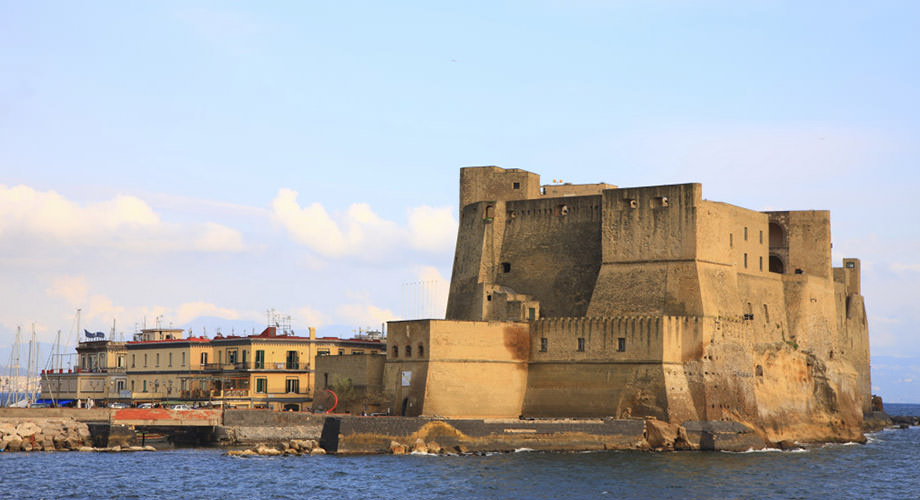
A walk to discover the four castles of Naples, ancient fortifications with magnificent exteriors and beautiful interiors.
Spending a day in Naples is certainly a short but intense experience that can also be enjoyed by immersing yourself in a tour of its castles , fortifications whose history is also partly that of the city.
There are four structures that can be visited on this beautiful walk, starting from Castel Sant'Elmo with its panoramic position on the Vomero hill, passing through Castel dell'Ovo , a place of legends, and the imposing Maschio Angioino , up to Castel Capuano which for years was also the seat of the court of Naples.
Each of these castles has unique characteristics and the internal spaces that can be visited represent a journey into the unique military architecture of the city with splendid towers, bastions , prisons , cannons, but also frescoes , historic rooms, libraries and a Civic Museum.
Castel Sant'Elmo
the largest fortress with a magnificent panoramic view
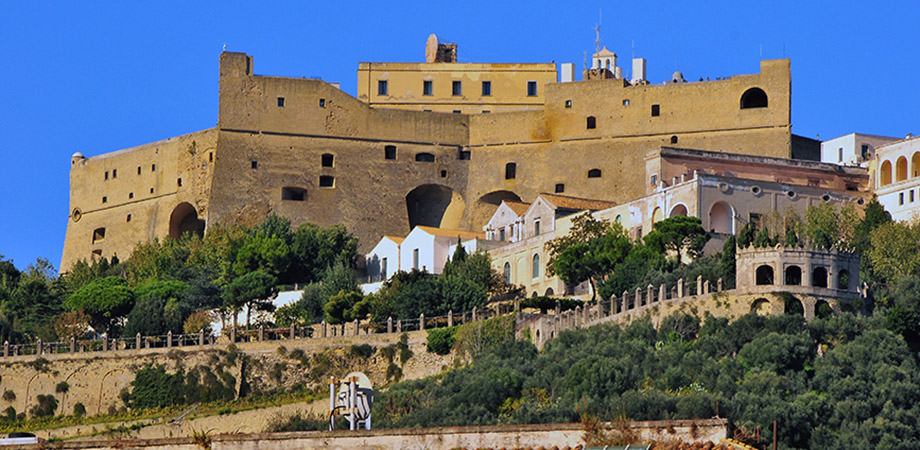
The tour begins on Vomero Hill with the first castle of the day, the medieval Castel Sant'Elmo , which dominates the city of Naples from above. To reach it, you can take Metro Line 1 to the Vanvitelli stop and continue along Via Scarlatti, the steps of Via Morghen, and the Belvedere di San Martino; or you can take the funicular to the Piazza Fuga or Morghen stop, reach Via Morghen, and continue along the same route.
Castel Sant'Elmo is one of the most important examples of 16th-century military architecture . It is the largest in the city , built from the characteristic yellow Neapolitan tuff, and houses the Museo del Novecento with collections of contemporary art. It was built on the ruins of a Norman watchtower, and due to its strategic position, anyone who has ruled Naples has always sought to capture it. Although the first records of the castle date back to 1329 with Robert of Anjou , its current architecture, with its six-pointed star-shaped plan , dates back to the first half of the 16th century.
Over the centuries it has suffered numerous sieges, but only in the early seventies of the '900 has become a military prison, while in the 1988 it was opened to the public as a museum and sometimes even special events are organized.
Today both the interior and the suggestive can be visited Piazza d'Armi with the panoramic terrace and the corridors inside the ramparts. From the entrance, to get to the top, you must follow a steep ramp that leads to a bridge followed by the Cave of the Hermit where once lived a hermit.
Continuing, you can admire the piperno stone portal with the coat of arms of Charles V and a guillotine gate a little further on, while to the left is the second entrance ramp. From this area, you can enjoy a first enchanting view of the city through a side window, while a few meters further on, you can visit the former prisons. Finally, arriving at the beautiful Piazza d'Armi, you come across the Torre del Castellano and can finally walk the corridors of the bastions, which offer a fantastic view of the city—the most complete of the historic center, the sea, and the islands of the Gulf.
Opening hours: Monday-Sunday 8:30 am - 5:00 pm (the ticket office closes at 4:00 pm)
Prices: €5,00 | Tuesday €2,50 | Reduced €2,50
Address: Via Tito Angelini, 22 – 80129 Naples 081 2294449
Castel dell'Ovo
the indestructible castle of the legend of Virgil
After visiting Castel Sant'Elmo, we reach the second stop on the tour, Castel dell'Ovo . We take the Piazza Fuga funicular to the Augusteo stop, continuing on foot along Via Toledo to Piazza Plebiscito, Via Chiaia, Piazza Vittoria, and along the seafront to the castle.
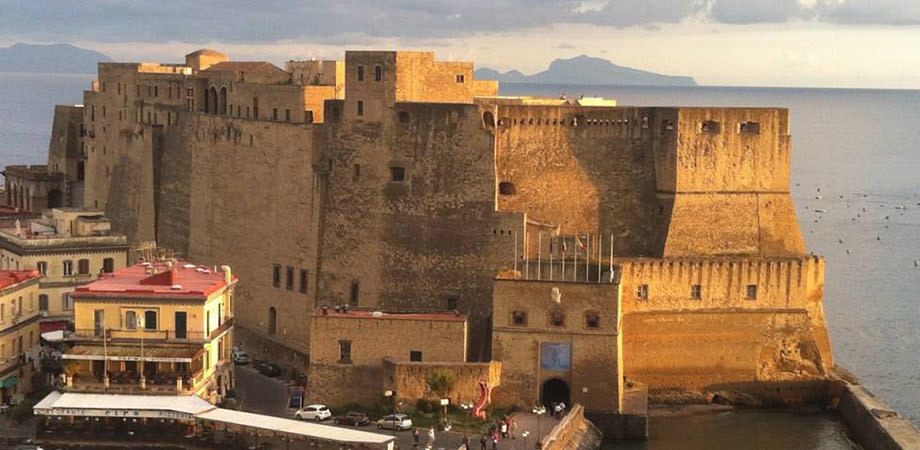
It is the oldest in Naples and stands on the tuff islet of Megaride , where Partenope was founded in the 8th century BC, making the panorama of the Gulf even more evocative. Its current appearance is very different from the original Norman one due to the many historical events that have affected it and the Angevin and Aragonese renovations . This fortification is mentioned in a document from 1128, but in previous centuries the enormous villa of Lucullus had already stood on that site , later becoming a fortified structure and a convent complex.
Furthermore, the famous is linked to Castel dell'Ovo legend of the egg of Virgil, which gives its name to the structure, according to which the poet hid an egg in the dungeons to keep intact the fortification; if the egg were to break, the castle would collapse and various misfortunes would hit the city.
The visit to the castle leaves you breathless because both the path to climb and the terraces at the top offer one spectacular view of the Gulf and the city. In the internal walkways there are various panoramic views and the paths lead to the Sala delle Colonne, which is perhaps the old refectory of the monastery, and to the prisons and, during the walk, you can also see the old monks cells carved into the rock and five rows of columns of the villa of Lucullus. This internal road also crosses the Norman Tower, the only one still visible, beyond which there is the Church of the Savior, one of the two sacred buildings of the islet of Megaride (of the second there are no more traces).
Once on the terrace, you can also admire two large black cannons of Spanish origin . From here, the view of the city, as mentioned, is unparalleled, and it's worth spending a few minutes there to fully appreciate it.
Timetables:
- in summer (with daylight saving time)
- on weekdays from 9.00 to 19.30 - last access 19.00 hours
- on holidays and Sundays from 9.00 to 14.00 - last access 13,30 hours
- in winter (with the deactivation of summer time and until the new activation)
- on weekdays from 9.00 to 18.30 - last access 18.00 hours
- on holidays and Sundays from 9.00 to 14.00 - last access 13,30 hours
Price: Free
Address: Via Eldorado, 3 – 80132 Naples 0817954593
Maschio Angioino
one of the oldest symbols of Naples
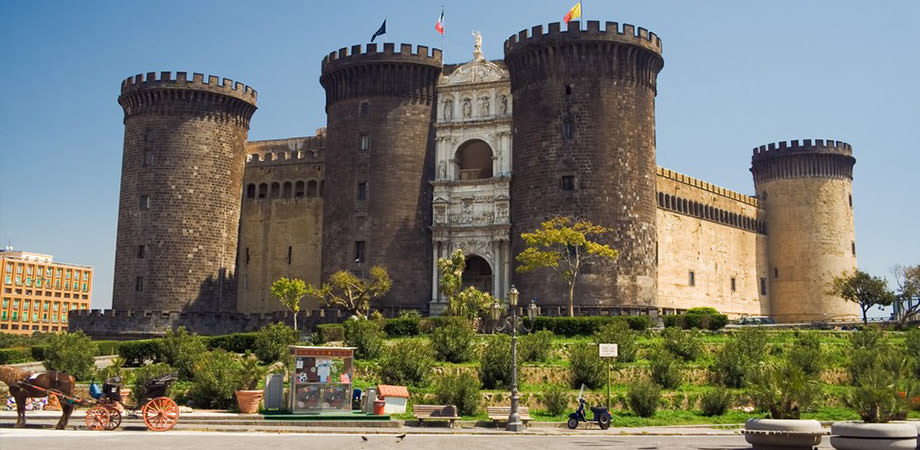
The tour continues with the third castle, the Maschio Angioino or Castel Nuovo . To reach it, simply walk along Via Nazario Sauro, Via Cesario Console, cross Piazza Plebiscito, and walk along Via San Carlo. The imposing castle, which dominates Piazza del Municipio , is located a few steps from the port and flanks the gardens of the Royal Palace.
It is one of the symbols of Naples, a medieval and Renaissance castle built by Charles of Anjou in 1266, who decided to add this new fortification to Castel dell'Ovo and Castel Capuano not only as a defensive structure but also as a personal palace. Unfortunately, he never managed to live there, and it was under the Aragonese that a court was established there and the castle took on its current appearance . Its style is Gothic-Catalan , and it has five round towers, four in piperno stone and one in tuff. The imposing entrance arch was built in the second half of the 400th century and is a masterpiece of the Neapolitan Renaissance in white marble, reminiscent of Roman triumphal arches. The flowerbeds surrounding it were created in the 900s.
The tour includes the Civic Museum , the Barons' Hall , and the Palatine Chapel . The latter, also known as the church of "San Sebastiano" or "Santa Barbara," is the only surviving element of the Angevin structure and was frescoed with works by Giotto , of which very little remains today. Other frescoes are from the Florentine school or recall the Gothic-Avignon culture, but the Chapel also houses priceless sculptures.
La Hall of the Barons, where it happened in the 1486 la conspiracy against Ferrante I of Aragon, is the main hall and has a beautiful octagonal vault that forms a star design. On one side there are a large fireplace and two stages for musicians and the bas-relief depicting theentrance of Alfonso V of Aragon in the Castle.
Il civic Museum it houses works from the Baroque, the Renaissance, the Neapolitan 800, paintings by Caravaggisti, and frescoes from the 15th to the 18th centuries. Finally, you can visit the Hall of the Armory , Sala della Loggia overlooking the arsenals.
Timetables:
- Monday to Saturday from 8,30 to 19,00
- the ticket office closes an hour earlier
- on Sundays the Civic Museum is closed
Prices: Civic Museum ticket: €6 | Reduced: €3. Entrance to the castle is free to visit the courtyard, the Barons' Hall, the Palatine Chapel, the Armoury Hall, and the Loggia Hall.
Sunday entry may not take place every week, check by calling.
Address: Piazza Municipio – 80133 Naples 0817957722
Castel Capuano
from home of royal families to city court
From Maschio Angioino you can reach Castel Capuano along Corso Umberto up to the intersection with via Pietro Colletta that leads directly to the structure.
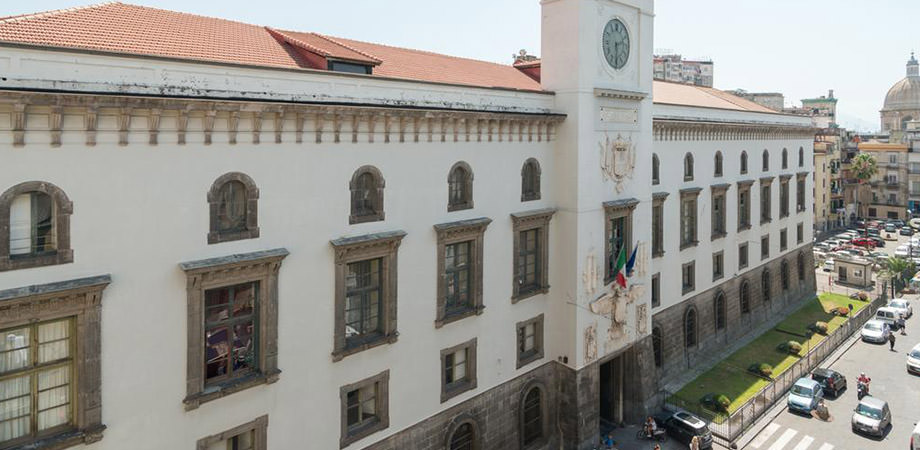
The Castel Capuano is, after the Castel dell'Ovo, the oldest in Naples and it was also Headquarters of the civil and penal sections of the Court of Naples. It is a castle of Norman origin and its name derives from its proximity to the famous Porta Capuana.
It was King William I of Sicily who ordered its construction in the second half of the 12th century, and the fortress immediately became the seat of the royal family . It was built on the ruins of an ancient cemetery ; in fact, several tombs were discovered there during excavations in the 19th century. Under Frederick II, the castle's appearance changed and became more dignified for a royal family, losing some of the typical characteristics of a fortification. With the construction of the Maschio Angioino, Castel Capuano lost its vocation as a royal residence , although some members of the family and various illustrious guests continued to stay there. Finally, with the advent of the Spanish Viceroyalty , it became a Palace of Justice and underwent various architectural renovations both inside and out, while the underground areas became prisons.
Outside there is an entrance portal with one plaque commemorating the victory of Charles V in Tunis surmounted by a large bicep eagle, coat of arms of the sovereigns of Spain. After the portal you enter a courtyard with a portico that is the nucleus of the castle, a place where judges, lawyers, witnesses and defendants met. Once inside, you can start the very impressive visit in one of the most beautiful rooms, the Court of Appeals Hall which presents eighteenth century frescoes representatives allegories on the provinces of the kingdom.
On the first floor there is the Hall of busts in which you can admire the busts of the most important lawyers of the forum and also here they are present beautiful frescoes. From this room we arrive at the Sala della Sommaria built around the middle of the '500, while in what is currently the Library are kept around 80000 volumes of the sixteenth, seventeenth and eighteenth centuries. Together they represent the Ancient Fund.
Hours: Monday to Friday, 9:00 a.m. to 6:30 p.m. Hours may vary; always contact the facility to confirm.
Price: Free
Address: Piazza Enrico de Nicola, 80139 Naples 0812237262 – 0812237227